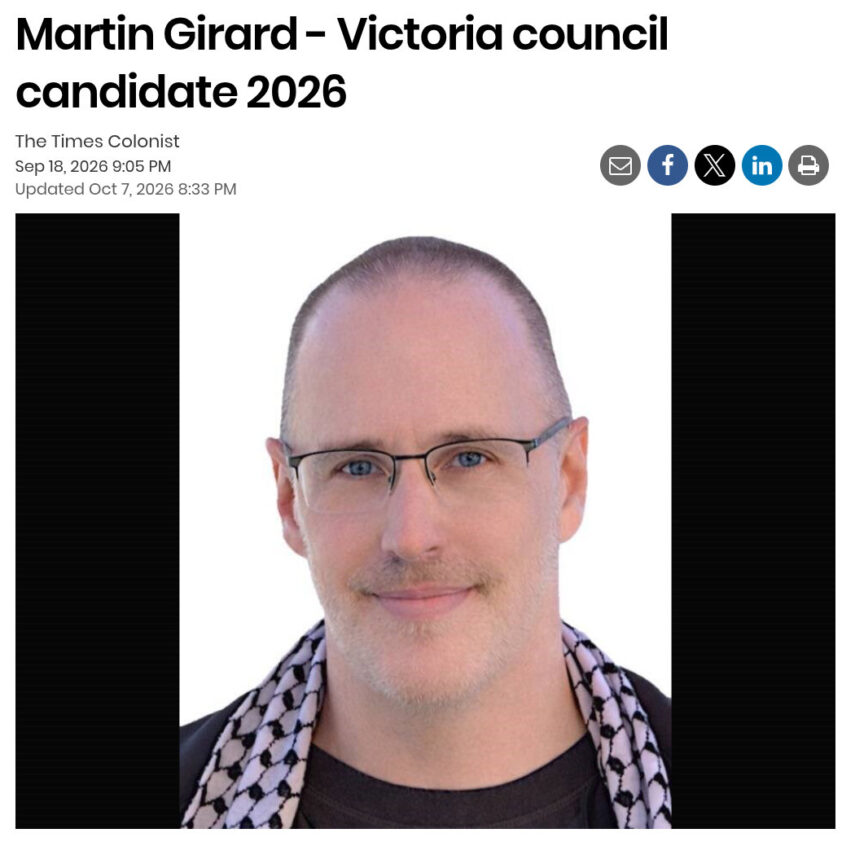
I ran for the city of Victoria’s municipal council this election cycle. As a radical activist. Living off disability benefits in a supportive housing complex. With a total budget of $585.
I ended up in 17th place, fifth from the bottom, with a respectable but paltry 2857 votes. It was comfortably above unserious candidates who filed their paperwork at the last minute, yet I needed about five times the number of votes to win a seat.
I learned a lot in this first attempt, and I mean to use those lessons to run again in four years—and win. I also want the rest of you to learn from my brilliancies and blunders, so that next time I call upon you—yes, I mean you!—to run alongside me in your own jurisdiction, you’ll be confident you can win as well.
There’s so much I want to write about, but for sake of brevity I shall focus on how various factors influenced the outcome.
From activist to politician
Ask not what your country can do for you; ask what you can do for your country.
John F. Kennedy
Running for office changes the dynamic of activism.
As activists, we’re used to demanding things of society, and our message focuses on what society can do for us, or for the people we advocate for. In politics, the pitch must change accordingly, from what we want out of people to what we have to offer them instead.
I ran as an advocate for homeless people, with lived experience at that. Instead of begging or pressuring them to fund social services, I had to reassure the electorate that I wasn’t running solely to solve my clients’ problems; I was running because my clients’ problems were everyone else’s problems. And I had to persuade voters that I wasn’t solely a one-issue candidate but instead one serious about governing a local government juggling with a wide variety of problems.
I say every veteran activist ought to give political campaigning a shot, because it broadens one’s horizons. It makes reaching out to the public a lot more effective, by adjusting one’s message to address the public’s concerns instead of merely one’s own.
Maybe you think you cannot do it. I’ll let you into something then: the first person I had to persuade to vote for me was the man in the mirror. The one thing a political candidate needs the most is confidence, which you will find to be contagious. Practice lyin’ and smilin’ in front of a mirror every day until confidence oozes from every pore of your skin if you must, but fake it till you make it!
The Master Plan
I never do anything without a plan. It may be bonkers, but I have one.
For this campaign, my plan was to take advantage of the fact that the electorate’s priorities revolved around homelessness and the cost of living, which made my lived experience a feature instead of a bug. It worked; I stood out more than any other candidate as a result, and that gave me a fighting chance.
I also intended to run on a very low budget, if only to prove it was possible to outperform candidates with lots of money, and also to present myself as a more ethical candidate. I’m persuaded I made the right call and I would once again run on a shoestring budget.
A pillar of my strategy was to exploit both mainstream and social media to get my story out. For better or worse it didn’t go as planned. This is the one aspect of my strategy which had the most impact on the results and the one part I would alter the most.
In contrast, I gave up on canvassing altogether in favour of attending community events, and that was the right call. My take is that door-knocking is only effective on a scale that is usually beyond the means of local election candidates, while in contrast shaking hands at rallies yields results almost without effort.
Lastly, I sought controversy as much as possible—the more divisive an issue, the better. My calculation was that if a given platform item had twice as much public support as opposition, it was a winner in the court of public opinion. That helped me stand out and win over people considerably.
That, and some… targeted disruption. My rivals couldn’t plan for a radical activist campaigning for office!
Media
To be honest, my attempt at capturing mainstream media attention turned out to be a flop.
I gave it two serious attempts. First with the announcement of a petition for judicial review of a decision by the Office of the Information and Privacy Commissioner not to order disclosure of the City of Victoria’s investigation reports into widespread misconduct by several bylaw officers. Then by inviting every fellow municipal council candidate to shelter overnight on Pandora Avenue in solidarity with unhoused residents of this city. In both cases I say the issue was timing: there were simply too many events and crises competing for media attention, especially during the campaign period. I had to content myself with early coverage by the Capital Daily before the No Tyrants rally in March, then a letter to the editor in the Times Colonist, and finally an interview in French with Radio-Canada. That was good, but that didn’t cut it in the end.
On the other hand, my social media strategy worked way better than anticipated. My Facebook posts were the talk of the town, many with tens of thousands of views and hundreds of comments. All I needed was to post engaging content and tailor it to take advantage of the algorithm. While my rivals were posting bland coverage of their campaign trail, I was posting about bylaw enforcement on Pandora Avenue, transphobia by rival candidates, and residential school denier Frances Widdowson being handcuffed at UVic. With even more exposure and a better conversion rate, I could have won a seat hands down.
And then my website helped tremendously. While most of my rivals had only a barebone NationBuilder website with three priorities, I had a WordPress blog with dozens of articles continually generating traffic. In the end though it only attracted about eight thousand visitors, which is a lot but fell short of the numbers I needed to win. Also, my website’s main asset was also its main flaw: it had too much content scattered left and right, and I took too long to address this issue. In a sense, barebone NationBuilder websites with three priorities have the advantage of being easy to digest by people with very limited time to research candidates.
Advertisement
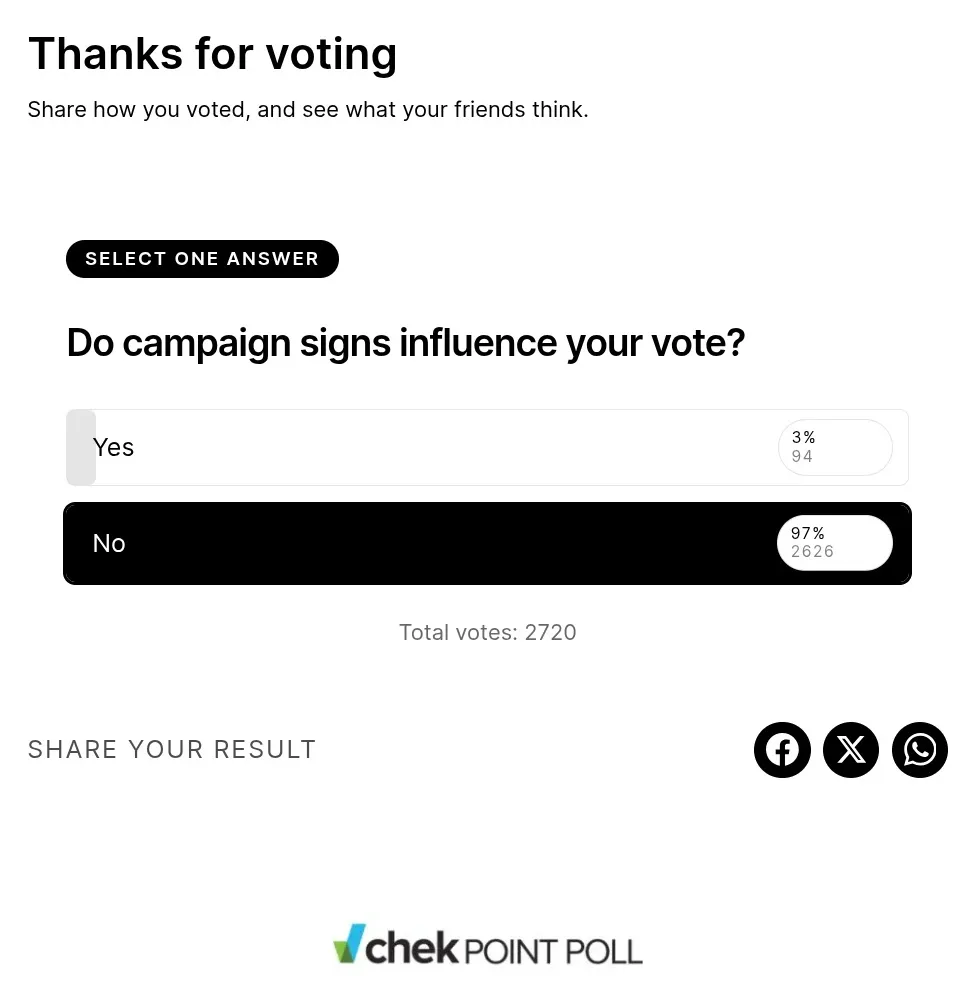
I’d decided in advance not to bother with lawn signs and road signs, because nobody cares about those; I even wrote an article on the topic.
That being said, I did have an evil plan to flood the zone with thousands of signs on sanctioned street poles and have the taxpayer foot the bill, because hey, I’m a radical activist after all. So in July I started posting hundreds of signs I printed for free at the public library. I had to stop after little more than a week though, because competing with VicPosters was just too much work for a single person, let alone a disabled one; it meant being out there a couple hours every night covering dozens of locations across town.
To add insult to injury I taunted Elections BC with a notice that it wasn’t sponsored advertisement under the Local Elections Campaign Financing Act (LECFA). Of course election officials came calling and opened an investigation, to which I replied as follows:
I maintain my stance that the advertisement was legal within the letter of the law and your own guidelines. Allow me to elaborate on my analysis:
In order to require an authorization statement under any reasonable reading of LECFA, advertisement must have financial value. I do understand that obtaining a service for free does not by itself waive that requirement, as the recipient must sponsor it to use for campaign purposes.
Nevertheless, in order to be considered sponsored advertisement, an ad must have a sponsor. There are only two possible sponsors in such a case: the service provider, and the candidate.
In this case the service provider is the Greater Victoria Public Library, a public body funded by municipalities. It is of course a service provided to any member of the public without charge, and it would be unseemly for Elections BC to claim that self-service in this case would amount to sponsorship of my campaign by a public body under LECFA. […]
Which leaves the candidate as the sponsor. In this case the candidate has to account for it as an expense against their own campaign contribution limit, as the difference between the price paid for the item and its market value. Allow me to quote your own guidelines from the Guide to Campaign Financing for Local Candidates and Financial Agents in B.C.:
[…] Financial agents must also determine and report the value of in-kind contributions, such as goods and services. In-kind contributions must be reported at market value. Market value is the lowest price charged for an equivalent amount of property or services in the market area at the time. [Emphasis added]
Of course I’d done my homework beforehand and supplied the signs from the local service provider with the lowest cost, which in this case is zero. Its market value is therefore zero. This may sound like an absurd conclusion, but this is what happens when the taxpayer provides a marketable service to the public for free.
Consequently, it would have been deceitful for me to label those posters sponsored advertisement requiring authorization by my financial agent.
[…]
Campaign finance law was drafted under the assumption that a service’s market value reflects the cost of the service in question, but as I’ve just shown this is clearly not the case, and to posit otherwise would open a can of worms.
Let me know if you wish to challenge this theory in court. You may also reach out to lawmakers with any concerns about this loophole in campaign financing law.
Predictably, Elections BC issued a mere warning under the following rationale, which I could have written myself in advance:
After reviewing your file, I have determined that a contravention to section 44(1) likely occurred when you transmitted election advertising during the 2026 General Local Elections pre-campaign period without the required authorization statement.
However, I have considered the totality of the circumstances, including that this is your first instance of non-compliance with LECFA, and I am notifying you that EBC will not be proceeding with a monetary penalty for this file.
A contravention “likely occurred,” of course. In other words, Elections BC warned me to keep quiet and swept the case under the rug because it didn’t want word of a loophole in election campaign financing law to spread right before the campaign period—much less debate it in court afterwards. Now it’s moot, both because the election period is over and GVPL branches no longer offer colour printing (darn). As for the first offence excuse, that didn’t stop Elections BC from issuing a $450 fine to Mike Harris after he mass printed flyers without an authorization statement during his campaign for MLA of Langford-Highlands in 2024. Or maybe it didn’t bother because in this case the corresponding fine would have been a mere $2.25.
If you want inspiration for more cool ideas to exploit legal loopholes, read my book.
Attack!!!
Let’s be honest: I remained an activist even as a political candidate, and I intended to run as such from the onset. If nothing else, that meant targeting subversive candidates, because keeping them out of office was a major motivation behind my campaign. On with the character assassination spree!
One of my targets was mayoral candidate Mike Harris, who was so toxic that he endorsed Kerry-Lynne Findlay for Premier—only to delete evidence on his Twitter account the moment she resigned in disgrace from the Conservative Party of BC leadership. Later he pulled out of a debate hosted by the Downtown Residents Association with the following rationale, according to the Times Colonist:
Mayoral candidate Mike Harris was scheduled to appear at the Downtown Residents Association debate, but pulled out, saying some of his interactions with one of the other candidates have become “increasingly concerning and at times hostile,” going beyond “the normal disagreement and competitiveness you expect during an election.”
In a statement sent to the Times Colonist, Harris said that as a result, he “decided it was better not to attend.”
Harris did not name the candidate. Alto said there’s little chance he could mean her, as she has stayed out of that kind of personal interaction.
Gee, I really wonder who that uncouth individual was. But hey, that gave my ally Bruce McGuigan a fighting chance, as from that point forth he only had to contend with Marianne Alto.
But my main target was Wendy Bowkett, for her rabidly anti-trans Twitter posts I’d been warned about by a community member. My posts reached thousands of people in town, and while she initially rejoiced at the attention, she eventually recoiled at the resulting backlash. Honestly, I counted her out of the race back then, and I was dead wrong about that. I shouldn’t have presumed that everybody in town knew just because of a few thousand views on my website and social media posts; in fact, some of my closest allies didn’t find out until it was too late to do anything about it. If I had kept aggressively spreading the word right until election day, I could have changed the election’s outcome.
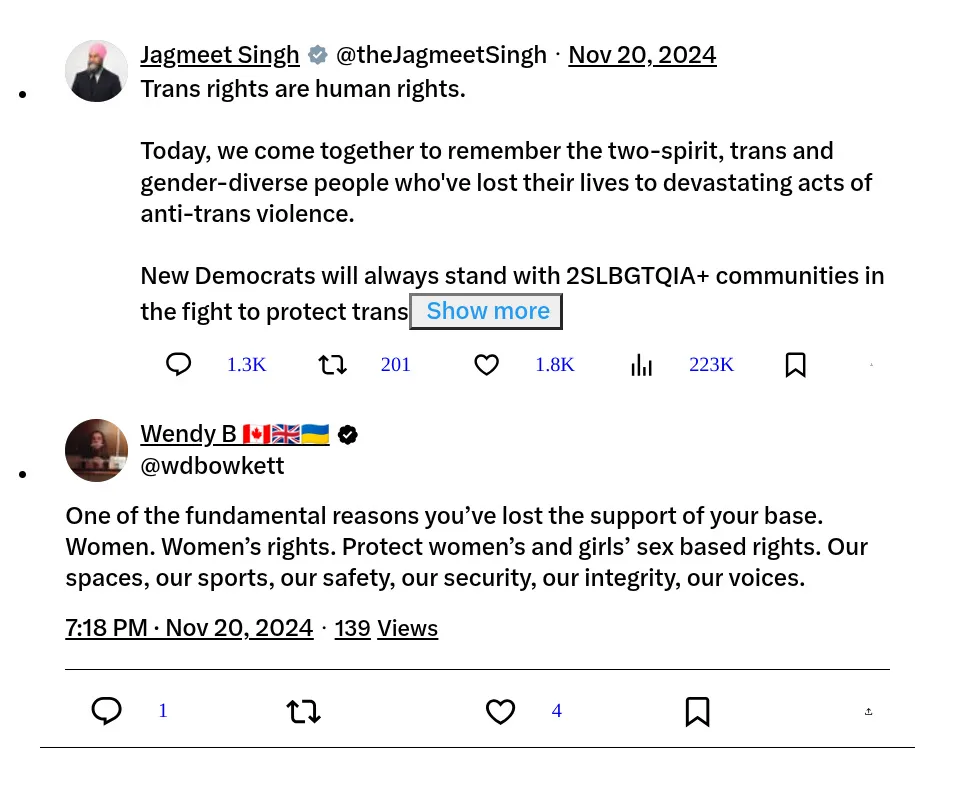
That being said, I would get a consolation prize, as a belated campaign calling for her resignation in the aftermath of the election drew significant media coverage and even compelled an apology following a council meeting at which presenters confronted the municipal council on the issue. So she won, but she’s a lame duck from day one. I can work with that!
Palestine
This turned out to be my biggest disappointment, especially since I was initially campaigning while wearing a keffiyeh and championing the apartheid-free pledge. It looked like a good opportunity, because a majority of the public supports sanctions against Israel, and an election campaign would put the spotlight on the issue. I even went as far as asking the local Palestinian organizers to run for council alongside me, and had they accepted to join the race, the outcome would most likely have been very different.
That being said, there was one huge risk to that plan: toxicity from fellow activists. And indeed everything I attempted to prevent came to pass, in spite of my earnest efforts.
Lots of people thought I had lost my mind when I turned on the apartheid-free campaign over misconduct by its local affiliate. As a result I made enemies of over a dozen long-time allies, alienated many supporters, and took flak from coast to coast as the news spread online.
Yet in hindsight it was the right thing to do. My concerns became more obvious to casual observers when Grandma Losah of all people called out the local Palestine rally organizers for faux nativism and discrimination against… Palestinian Christians:
As a result of internal drama, attendance at the rallies would plummet from 70 to 20 in less than two months.
But the worst was yet to come. The real disaster was when a planned presentation to the municipal council targeting the mayor and the local Jewish community, with the blessing of local activists, was pulled from the agenda, which made the topic so toxic that the next council most likely wouldn’t touch it with a ten-foot pole—and please spare me the list of belated local candidate commitments to the apartheid-free campaign; in particular, if you believe that Jeremy Caradonna and Matt Dell give a damn about Palestine then I have a bridge to sell you.
Moreover, the presenter doubled down at the next council meeting after the election, in spite of my attempt to dissuade her. Predictably she got evicted from the council chambers, in the aftermath of which new rules are being introduced that make discussing international conflicts beyond the jurisdiction of local governments explicitly verboten.
There goes my plan to have the City of Victoria join the Boycott, Divestment, and Sanctions movement. And since I never do anything without a plan, I have to give up on championing causes pertaining to international conflicts before local authorities altogether.
Some may express scepticism that I could have anticipated all of this nearly a year in advance. If so, I invite you to read my book, especially Chapter 12 which discusses how burnt out activists turn toxic and scuttle themselves.
Questionnaires galore!
He who can, does; he who cannot, teaches.
George Bernard Shaw
As a gifted individual who was already too smart for school as a kid, I hate tests with a vengeance. It started when I flunked a portion of a math test in Grade 2 because the teacher couldn’t tell that multiplication is commutative (you know, a × b = b × a). Since then I’ve learned that if I score poorly on a test, it’s because its answers are wrong, the teacher is incompetent, and the curriculum is absurd.
Well, during the election campaign I was flooded with requests to answer questionnaires, especially graded ones. And I was reminded exactly why I still hate tests, more than twenty-five years after dropping out of college.
For example, the Livable CRD questionnaire had a section about housing, and one question in particular:
What kinds of housing could your municipality use more of? Select all that apply.
- Supportive housing for those who need mental health and substance use support.
- Publicly funded accessible housing for elderly and/or disabled people.
- Non-market affordable housing.
- Small homes (< 500 sq. ft.).
- Market rate rental housing.
- Family-suitable housing (i.e., 3 or more bedrooms and more than 1200 sq. ft.).
- Market ownership housing (e.g. condos, townhouses).
- Luxury housing.
- None of the above.
- Decline to answer.
This question was worth eight points, and the “correct” answer was… all of the above. Including of course those overpriced unsold condos that the provincial and federal governments had to buy back to bail out the market. And luxury homes too—because hey, we do need more luxury homes in the midst of a housing and homelessness crisis. What was I thinking…
Another questionnaire which irked me afterwards was that of Doctors for Safer Drug Policy, which epitomizes what’s wrong with campaign questionnaires. It gave top grades to Jeremy Caradonna, who once appealed to Prime Minister Justin Trudeau to declare a state of emergency, deploy the military in downtown cores across the country, and round up this city’s unhoused at the Bay Street Armoury for triage. Also to Matt Dell, who proposed building a splash park at Centennial Square by City Hall back when an open use drug decriminalization pilot was being floated with an exemption within 15 metres of a splash park. It even gave decent grades to Jason Heit, who would then write a piece for the Western Standard calling for an investigation into safer supply manufacturers—the same Western Standard which published multiple articles praising the white nationalist Dominion Society of Canada’s remigration platform.
I’ve learned my lesson after this. Next time I won’t answer a single questionnaire that is either graded or longer than ten questions. Especially considering that some candidates won without answering any questionnaire, so screw that.
In conclusion, I have one piece of advice in retrospect for all those groups who believe they are so much smarter than candidates that they presume to grade them: instead of publishing a questionnaire, start an elector organization, put forth candidates of your own, and sell your platform directly to the electorate. I’m dead serious. Either do that or stay out of politics, because your questionnaires’ answers are off-base, your evaluators are clueless, and your platform points are bogus.
Debates and forums
I hate speaking in public. I’m extremely introverted and a chronic pain patient with a malformed jaw. While I like to quip that my writing is a murder weapon, it’s a lot harder to improvise in front of a crowd. But hey, I signed up for this, and my rule number one is never to chicken out, so yeah, that meant participating in debates and speaking before an audience.
While I could feel the pressure like everyone else (well, not quite…), I must say it wasn’t as stressful as people might think. I have enough experience documenting speeches at protests to know that the audience never mocks a speaker for an awkward performance; instead people wish they had the guts to likewise walk on a stage, stand behind a mic, and speak to a crowd. If you can manage that, you’re almost guaranteed to earn voters’ respect, regardless of what you say.
That being said, debates are different from ordinary speeches. Usually one doesn’t know in advance what the questions will be, and sometimes the candidates have only a few seconds to muster an answer. The topics are varied and often fall outside one’s comfort zone. Not only that, answers typically have to fit within one minute, sometimes even less. And unlike at a protest, voters attending debates judge candidates by their answers. It’s a lot harder than it looks.
To be honest, the hardest part was getting into aspects of municipal governance outside of my experience. In this regard, incumbents and those who had worked in government had a huge advantage over other candidates. That’s indeed a lot of knowledge to assimilate; I’m a machine by human standards and even I struggled to soak it all up in a matter of months. Voters expect you to be experts in most such topics, and debate questions are crafted accordingly.
I actually liked candidate forums a lot more, because I got to engage with voters individually. Once again I’m not a natural but it felt a lot more like normal conversations so I was more at ease. If like me you’re an introvert then work on your persona and fake it till you make it. Don’t know how to get the conversation started? Try a handshake and some generic ice breaker. And while you’re at it, practice speaking to a large audience like it’s a casual conversation with a single person and you’ll fare better at debates as well.
So how much of an impact do these have? I estimate roughly one thousand people attended all-candidate debates and forums, and while these are disproportionately likely to vote, they’re also a small minority of the electorate. It’s possible to ace those events only to be crushed at the polls. It’s a bit different for mayoral candidates because their debates get more exposure and some may even be televised, so debate performance can make or break their campaign. But as a candidate for councillor? Not so much. To make a point, Melissa Cseszko only attended one minor all-candidate forum, no all-candidate debate, and didn’t answer a single public questionnaire for that matter, yet managed to win a seat.
Lead-up to General Voting Day
Don’t stop campaigning until polls close on General Voting Day.
It’s easy for a candidate to presume every prospective voter in town knows about their platform weeks ahead of voting day. Trust me, it’s a huge mistake. In fact, my website was flooded by hundreds of visitors on General Voting Day, and more than a thousand in the last few days, compared to about one hundred visitors a day in prior weeks. I swear my website got visitors until about thirty minutes until poll closure. Considering that the election was decided by razor-thin margins, every little effort candidates made at the last minute had an impact on the results.
Of course you may be puzzled by voters struggling to make up their minds to this extent. Allow me to substitute this letter published by the Times Colonist to a proper explanation:
Bring in ward system for municipal elections
For those of you who voted in this month’s two election campaigns here in Victoria (and elsewhere perhaps), wasn’t the provincial election (unnecessary as it was) a walk in the park compared to the municipal one? On my provincial ballot, I had a simple choice of choosing one of three candidates. Having researched them and their party leaders, my choice was quick and easy. Compare that to Victoria’s municipal election, where there were 21 candidates, and I had to choose eight.
No contest. The provincial one was best.
Imagine a provincial election where we each have to choose 93 MLAs. The prospect is so ridiculous that it will never be.
Yet we persist in having the cumbersome and inefficient “at large” system for our municipal elections.
In my humble opinion, and I am a humble man, it must be the first order of business for our new Victoria council to institute a ward system of electoral representation. Far more efficient and representative.
It is about time.
David (Uriah) Hansen
Victoria
I initially thought that the at-large system gave outliers more of a chance, but I had neglected the flip side of an independent candidate being reduced to campaigning on one’s own: it’s a lot more difficult to capture voters’ attention, because they have very limited time to research candidates and a very short attention span tested by a media sphere bombarding them with signals, plus countless mundane worries beyond municipal elections.
Aftermath and lessons
My conclusions are most cynical: this election ultimately wasn’t decided on the candidates’ merits, nor by the efforts of third parties. It was largely decided by luck.
I’ve already argued that debates, forums, questionnaires, and canvassing had negligible impact. Same for endorsements. There is widespread debate over the local firefighter union’s controversial endorsements, for example, but I don’t think it mattered all that much; after all, firefighters also endorsed Jason Heit and he ended up far behind the leading candidates.
There is also a lot of controversy behind the impact of astroturfing by the Sustainable Victoria Network and the BC Politics Watch substack. I don’t think these have had much influence on the results. The Sustainable Victoria Network had few followers on social media and its posts generated little engagement—especially compared to mine. As for BC Politics Watch’s posts, they were off-putting AI-generated nonsense.
Money? If performance were to be measured by campaign spending, Mike Harris would have probably won the mayoral election, yet he ended up a distant third. Seriously, who cares about road signs and newspaper ads anyway.
I’ve explained in the previous section how voters think, especially those who research candidates at the last minute. They had neither the time nor the motivation to look into every single candidate’s platform. They voted for slates, essentially picking one at random. The election was so close that voters might as well have tossed a coin to make up their minds.
Of course one could conclude that running for office on the merits is a waste of time, and choose to either just put their name on the ballot hoping a catchy campaign theme gets them rounded together with like-minded candidates, or perhaps give up altogether out of spite. I say it’s the wrong attitude. It is possible to win on the merits. In fact, how one wins does matter, as Wendy Bowkett found out afterwards. Also, a candidate who wins with a three-priority NationBuilder website for all grasp of politics shall struggle to carry out an agenda once on the municipal council; I’m keeping an eye on Melissa Cseszko in particular, who’s struggling to integrate council deliberations already.
One way is to improve voter turnout, on the assumption that those who vote for the first time will pick outliers instead of mainstream candidates. I was optimistic that turnout would be significantly higher because of campaigns by grassroots organizations like Dogwood and the West Coast Climate Action Network. But in the end only candidates can convince voters to turn out, not third-party sponsors. I say these third-party sponsors should form elector organizations and field their own candidates instead; had they done so, the outcome could have been very different.
I was right about reaching out to fellow activists in an attempt to get them to run for office alongside me, and indeed my main liability in the end was to run alone. I only persuaded two of them to give it a try, and they gave up when they failed to get nominated by Victoria For All. By the way, I say Victoria For All made a huge blunder by championing only two candidates for municipal council; had it produced a full slate instead, it would probably have won.
So how does an outlier campaign on the merits and win? By campaigning four years in advance. I intend to run again in 2030, and by then everybody in town will know about my candidacy and platform. In the next four years I’ll have ample opportunity to score points in the court of public opinion with tangible results I just couldn’t deliver by the end of this election campaign.
Also, since campaigning via social media worked so well, I intend to build upon this strategy by increasing my reach and number of followers. My target is to secure ten thousand new followers across at least three social media platforms. In fact, I’ve reasoned that the one reason Jason Heit got twice as many votes as I did was because he had twice as many followers on Instagram as I had on Facebook.
But most importantly, I’ll be spinning RevolutionNow into an elector organization for outliers like me who need to run under a label, and register it in municipalities across the province. I don’t mean to form a traditional party with the kind of strictures that turn activists off, quite the opposite; I mean to provide a banner for independents who want to win without joining a faction. Trust me, three years from now I’ll have carved us a path toward victory; just follow my lead then.
I’d like to dedicate my campaign to Shea Smith, rest in peace, who ran for council in 2022 while homeless. He ended up in last place with 403 votes, but that’s 403 more votes than I got because I didn’t run. I improved upon this result with 2857 votes and fifth place from the bottom, which isn’t all that much but it’s 2857 more votes than the rest of you who didn’t run. Maybe in 2030 it’ll be your turn to run for the first time, and hey, maybe then we’ll win together.