
Chapter 12
The endgame
John Connor: “We’re not gonna make it, are we? People, I mean.”
The Terminator: “It’s in your nature to destroy yourselves.”
Terminator 2: Judgment Day (1991)
Beware of burnout
Upon reading this far, you may feel like the knowledge in this book can make you invincible. Surely no government which won’t resort to shooting the mob can withstand this devilry, right?
You would be dead wrong. Three years devoted to activism have taught me what our single worst menace is. It isn’t the government. It isn’t the police. It isn’t Big Money, the mainstream media, propaganda, or disinformation. It is us.
I began Chapter 2 by introducing the concept of ochlocracy, or mob rule, and how authorities fear it. Our counterparts have learned to channel public discontent rather than systematically suppressing it, just like they have long learned the value of parley. Activists have to learn the same lessons, by embracing antithetical concepts such as politics, law, and diplomacy, as I demonstrated throughout this work. The flip side of mob rule is that it is no more viable on its own than authoritarianism. They form a dichotomy like order and chaos; imbalance leads to infighting and collapse. In a sense, authorities are right to fear us, because on our own we would turn on each other endlessly and bring everything to ruin.
I am convinced that if we activists just rallied together for a common cause instead of bickering among ourselves, we would indeed become invincible. But in practice activists are, for better or worse, headstrong. Many are libertarians, anarchists, or radicals. We’re all convinced we’re right and the rest of the world is wrong—starting of course with our closest allies. None of us likes to be told what to do, thus we abhor leadership. Few of us understand diplomacy and accept compromise. We either take turns deliberating in vain with a talking stick, unable to ever make a decision, or we resort to drowning each other’s voices before slamming the door on each other’s fingers. We may fight alongside each other as long as our respective agendas converge, but in the end we’re all rivals.
As disputes take their toll, setbacks pile up, and frustration builds up, we actually grow paranoid and bitter. We distrust our former allies and become recluse. We shun mainstream media narratives and embrace the very disinformation we sought to counter. We dress in black and sink as low as painting graffiti on walls or smashing windows out of spite. We outright fight each other rather than common foes, which have the last laugh.
I navigated such shitstorms myself. Three years on, I was thoroughly burnt out, if only due to my poor health. Many allies wasted my time with dithering and crass incompetence. I couldn’t stand petty disputes anymore and felt sorely underappreciated. Left and right, my closest partners withdrew from activism for the exact same reasons. As the town’s activist scene virtually collapsed, I rage quit altogether and spent the next several months on worthier pursuits, such as saving Faerûn from the combined menace of the mind flayers and the death gods triad (in other words, I played Baldur’s Gate 3).
I look at my retirement as a tactical retreat. Upon reaching the end of my rope, I was fighting battles I couldn’t win at the moment with the meagre means at hand, and any more struggle might even have killed me outright.
Allow me to warn you about what activism feels like as you jump into the fray. Activism is war, and protests are battles. As your campaigns devolve into trench warfare, battlegrounds turn to mud, and casualties mount, you may end up losing hope. You may start hating your allies, the people you advocate for, and the rest of the world while you’re at it. You may start hating your own powerlessness to stop the inexorable. But don’t stop fighting, even if you lose faith in humanity and your own cause. If nothing else, keep fighting for your own sake. Because we’re all in the same boat together, and other people’s problems are our own.
My favourite portrayal of this quandary belongs to the realm of fiction, in the Japanese light novel series 86 by Asato Asato (adapted into an animated series). It revolves around Major Vladilena Milizé of the San Magnolian military, mandated to oversee a squad of children conscripted from minority racial groups to fight endless waves of war machines on behalf of the insouciant majority hiding behind its walls. She comes to loathe her own country as the brutal reality sets in and her troops are deliberately sent on suicide missions so they won’t rebel against their cowardly overlords. Eventually the walls crumble as everyone else at headquarters stands down, out of cynicism and resignation. Yet defying orders, she musters a desperate last stand of a sham republic she firmly believes deserves to fall, leading troops and protecting a populace she hates. She keeps fighting out of sheer grit, even though their struggle seems vain and pointless, for her own sake and in memory of the children she sent to their deaths.
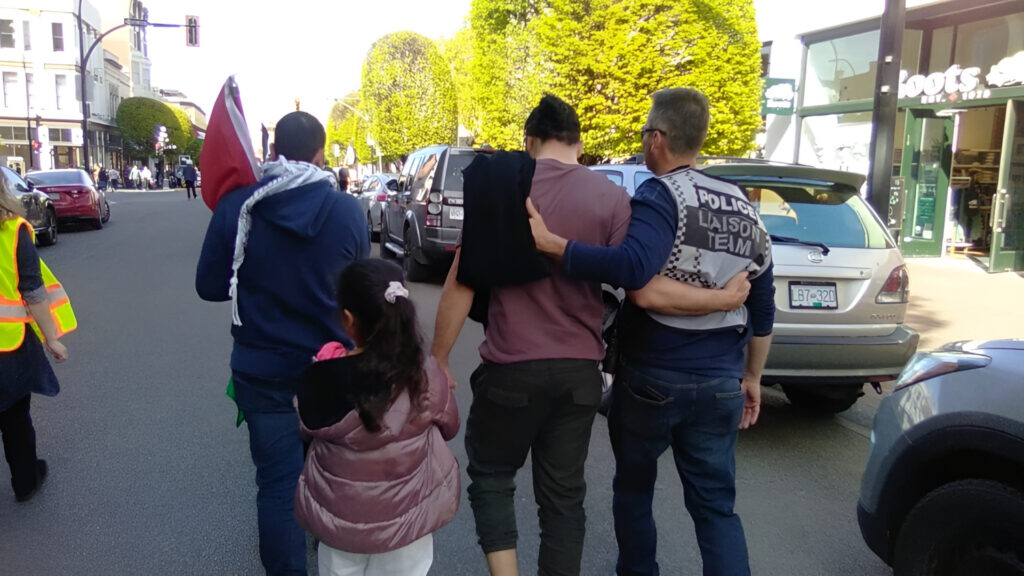
In reality, just about anyone would throw in the towel in a fit of rage instead, as in this case I witnessed firsthand. I snapped the following picture at a Palestine protest in downtown Victoria, of an unseemly scene in the middle of a meltdown by the organizers, which a police community liaison officer defused before the situation grew out of control. At the time I took this picture down upon request because the subject (recognizable even from behind by acquaintances) faced retaliation for being shown way too close to a cop, which missed the point I meant to convey. Now that tempers have cooled down, I’m publishing it again. This grief-stricken man may be you down the road, being talked out of fucking your whole life up by a dirty cop of all people, six months into a campaign to persuade the world to stop the genocide of your people. This is indeed what activism feels like when things don’t go your way.
You may fail to grasp the gravity of this. That’s just fine. I presume only someone who has tasted defeat after putting everything on the line for a cause can understand its pull. When it does happen to you, heed my warning: relent, lest activism destroy you and all that which you sought to achieve.
Pyrrhic victories
[To the Free State soldier who killed Harry Boland]
Michael Collins: “You killed him you little uniform git! You plugged him you little ‘Free State’ gobshite! You were meant to protect him.”
Free State Soldier: “But he was one of them, sir—”
Michael Collins: “No, sonny! You don’t understand. He was one of us.”
Michael Collins (1996)
If you think victory feels any better, think again. Many revolutionaries have made the mistake of presuming their struggles would end by defeating their foes, while in fact the fighting had just begun. Before starting your own revolution, learn the importance of mastering politics and diplomacy from failed ones, by those who lost patience or lacked foresight; otherwise your every victory shall be hollow.
In Chapter 8 I’ve shown how the Egyptian Revolution of 2011 unraveled. The government of Hosni Mubarak collapsed, but the Egyptian people couldn’t capitalize on its downfall, because it failed to build the proper legal and political foundations for victory beforehand. In the end, the people rejected its own provisional government, thereby inviting the military back into power.
Let’s have a look back at the aftermath of India’s independence from the British Empire in 1947, after decades of steadfast struggle. One would imagine Gandhi to have been content with the result, if only it hadn’t been followed by the country’s partition among sectarian lines, decreed by the 1947 Indian Independence Act, which led to massive migration to and from newly-founded Pakistan. Gandhi resorted to hunger strikes in desperation as riots spread across the country.1 To this day, violence persists in the disputed Kashmir region.2
Another example is the Irish Civil War of 1922-23 between the Provisional Government of Ireland and the Anti-Treaty IRA. The conflict erupted at the conclusion of the Irish War of Independence of 1921-1922. Weary of fighting insurgencies, the British government changed its strategy: it purposefully split the Irish into two factions by offering them only half of what they demanded, the main points of contention being the partition of the country and having to pledge allegiance to the British Crown. The provisional government ratified the Anglo-Irish Treaty with a slim majority, which proved to be its undoing as the minority rebelled. The ultimate irony is that the ensuing civil war was actually won by the British, which supplied the Free State Army with artillery and armoured cars to turn against its erstwhile allies.3 Even then, the civil war didn’t truly end with the Free State Army’s victory in 1923; violence kept breaking out sporadically between survivors of both factions, especially during the Troubles which started in the late 1960s, to end only with the Good Friday Agreement of 1998.4
This is victory viewed through the lens of cynicism. Truly, down the road of activism awaits only despair. Deal with it.
Literal burnout
Every fibre of Agapito called out for him to order the attack and he knew that the Talons would gladly obey once they saw the target. His hearts hammered and blood throbbed through his body, flushing him with rage.
A detonation rocked the building across the street as the first of the skitarii war engines clanked into range, sending an avalanche of smashed masonry onto the road.
Agapito barely noticed the explosion.
He was here to avenge; to punish; to kill.
Yet at the burning heart of his anger there was a cold core, formed of pure hatred. It did not fuel his rage but cut through it, gifting him with clarity, shredding the fugue of ire that clouded his thoughts.
‘Victory is vengeance,’ the commander muttered.
‘Please repeat, commander, what are your orders?’
‘Victory is vengeance,’ Agapito said, louder and more confidently. He could see the traitors with his own eyes now, a few hundred metres away, cutting through a bombarded district temple. Beyond them he spied larger shapes moving through the gloom of the smoke; Mechanicum reinforcements. If the Raven Guard attacked, then they would certainly be surrounded, even if they destroyed the Word Bearers.
Cold, rational hatred won over blind fury.
‘Withdraw to grid one, at speed.’ He issued the order through gritted teeth, as though the words were forcing themselves from his throat under protest.
—Excerpt from Corax: Soulforge by Gav Thorpe (Black Library, 2013)
When tempers flare and the fighting gets heated, the compulsion to bring down your foes even if it means going down in flames with them may grow nearly irresistible. Trust me, I’ve experienced it myself, and I’ve witnessed it in many fellow activists who embraced radicalism out of spite rather than acumen.
Don’t be your own worst enemy by giving in; live to fight another day instead. Be a cockroach through and through, even if you disgust yourself in the process with conduct barely distinguishable from cowardice. Remember Chapter 4’s lesson in asymmetric warfare: Engage the enemy only on your own terms. If you cannot prevail immediately, then recollect yourself, withdraw, and consolidate your support in anticipation of the next charge. Play the long game, and win in the long run. Choose lasting victory over vindictiveness and martyrdom.
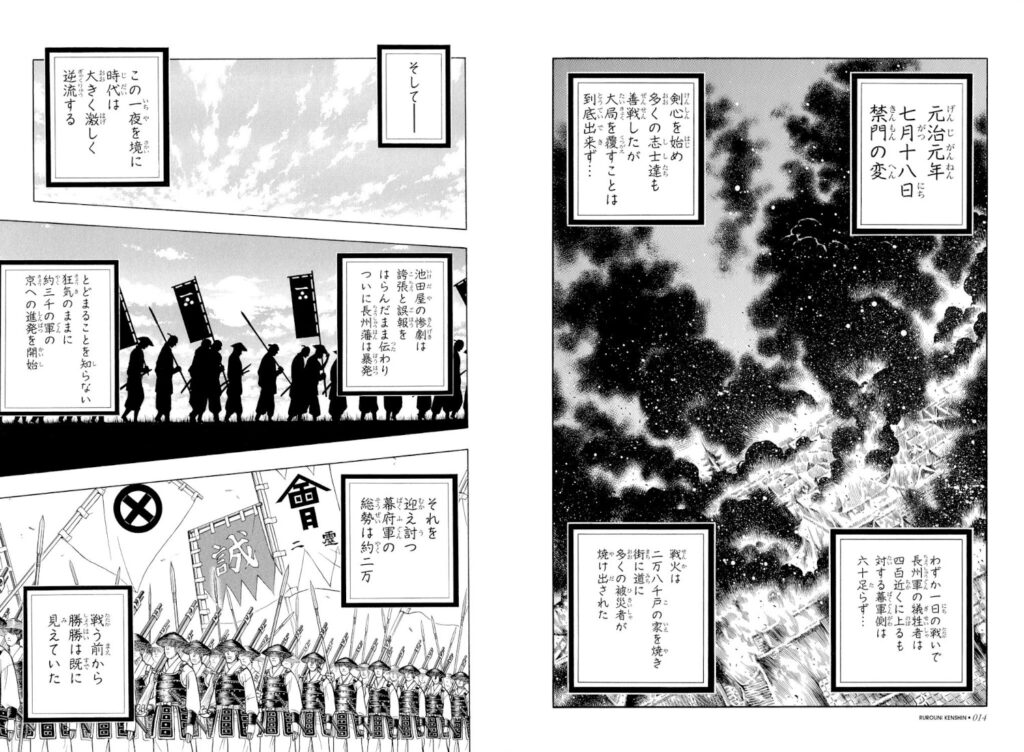
Reckless obstinacy can jeopardize an entire revolution, as it did the Chōshū clan’s rebellion against the Tokugawa shogunate near the end of Japan’s feudal period. In July 1864, the rebellion’s Kyōto cell was wiped out in a single night before it could carry out a plot to set the capital aflame as a prelude to a military incursion to liberate the Emperor. While cooler heads among rebel leaders camping outside the city advised caution and patience, those blinded by the imperative to exact immediate retribution prevailed, even though their plan lay in tatters. Against all reason, the rebels marched on the city the next month anyway, despite being dramatically outnumbered by the shogunate’s forces, and suffered catastrophic casualties as a result, which almost proved to be their undoing.5
As a warning, I close the concluding chapter of this work with a brief discussion of human rights activists who literally set themselves on fire out of grief or desperation, after giving up on legal and political recourse, instead attempting to incite a revolt with the most powerful of symbols. They burned brightly indeed. Yet their light extinguished just as quickly, leaving only ashes for legacy. Honour their sacrifice, but don’t follow their example. Keep seeking a political solution, even if it means building the underlying framework from scratch, over the course of years or even decades. Governments may break or even collapse overnight, but no lasting reform happens thus.
Most Palestine activists are familiar with Aaron Bushnell, a US Air Force serviceman who in February 2024 set himself alight before the Israeli embassy in Washington DC while wearing his uniform, to denounce the US-backed genocide of Palestinians in Gaza.6 Two years on, the onslaught continues unabated; for all his noble intent, Bushnell died a mere footnote in America’s ephemeral media spotlight.7
Better known among self-immolation cases are the Tibetan monks who set themselves on fire in protest of China’s cultural genocide since it annexed Tibet in 1950. About 160 have done so sporadically since February 2009, in order to draw attention to their plight. Yet Tibet is no more free nowadays than it was seventeen years ago. The outpouring of international support they wished for did not materialize. Those who made the ultimate sacrifice have merely accelerated the eradication of Tibetan culture. Don’t take my word for it, but that of a Tibetan man: “Don’t self-immolate just because my cousin did. Don’t consider him a hero. If you really want to do something good for Tibet, go to school, preserve the language, and be a good Tibetan.”8
You may be surprised to find self-immolation in the history of labour rights. But South Korea under military dictatorship used to have among the harshest working conditions in the world in a paradoxical push by its government to raise the country’s abysmal standard of living. In 1970, a worker named Jeon Tae-il set himself on fire in protest as a last resort; his last words were: “Abide by the Labour Standards Law! Workers are not machines! Do not let my death be in vain!” His mother, Lee So-sun, dedicated herself to his cause henceforth by illicitly organizing factory workers and staging demonstrations.9 Although whether Jeon Tae-il’s death was indeed vain remains a matter of debate, it would nevertheless take the 1987 Great Labour Struggle, a natural consequence of the June Democratic Struggle which finally transitioned the country into a democratic state, for South Korean workers to earn the right to unionize, the authorities brutally crushing every act of defiance in the meantime.10
More recently, the Arab Spring of 2010 was sparked by Mohamed Bouazizi, a Tunisian fruit merchant who set himself on fire after the police confiscated his scales, on which depended his livelihood, for working as a street vendor without a permit. A video clip of his death went viral, the resulting outrage triggering revolutionary uprisings across North Africa and the Middle East.11 The Egyptian Revolution failed because the sudden democratic wave left a power vacuum; the Egyptian people were eager for change, but not yet ready for self-determination.12 The Syrian popular uprising ravaged the country with civil war which has only concluded in December 2024 with the belated collapse of the Assad regime, leaving in its wake nothing but scorched earth.13 The fall of the Gaddafi regime in Libya invited jihadi factions rather than democratic reform.14 Tunisia also failed to turn itself around; Hosni Kalaya, a man who set himself on fire three weeks after Bouazizi, conceded in an interview that he regretted his act even though it changed History.15
Earlier I announced my intention of crossing the aisle by running for office, just like I told how I once did the same with legal advocacy. I elected to out of desperation, not personal ambition, for I hate politics more than anything else. In Chapter 8 I presented my rationale, in this chapter my inspiration. Revolution is a gruelling process which must not be rushed lest it fizzle out and self-injury ensue. If you’re serious about enacting lasting change, bide your time and plan ahead, in memory of those who in contrast chose martyrdom in vain.