Since some people have expressed regret not to have been able to attend either of the information sessions I gave due to unfortunate scheduling, I'm posting a condensed version online. As a bonus I'm adding links to source material. If you're reading this in July it's not too late to join the fray; at the time of this writing some elector organizations have yet to announce their candidates. Enjoy!
This is a nonpartisan, cause-agnostic presentation. I'm not doing this to promote my candidacy nor to endorse candidates, and while we'll be discussing causes we won't be debating them. The target audience is community advocates and activists interested in running as independent candidates in the upcoming local elections. Some of this material is also of interest to volunteers, especially pertaining to election law.
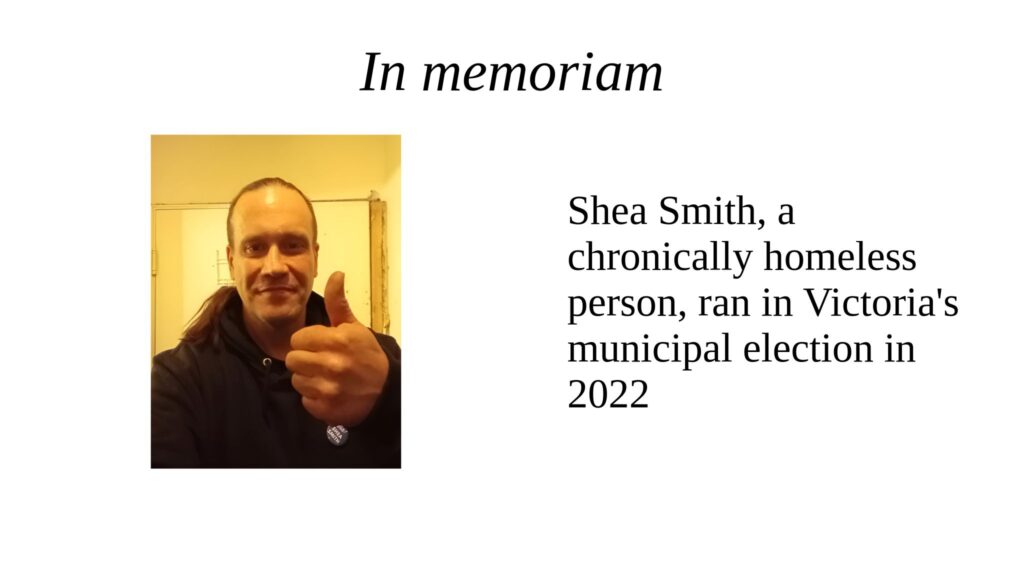
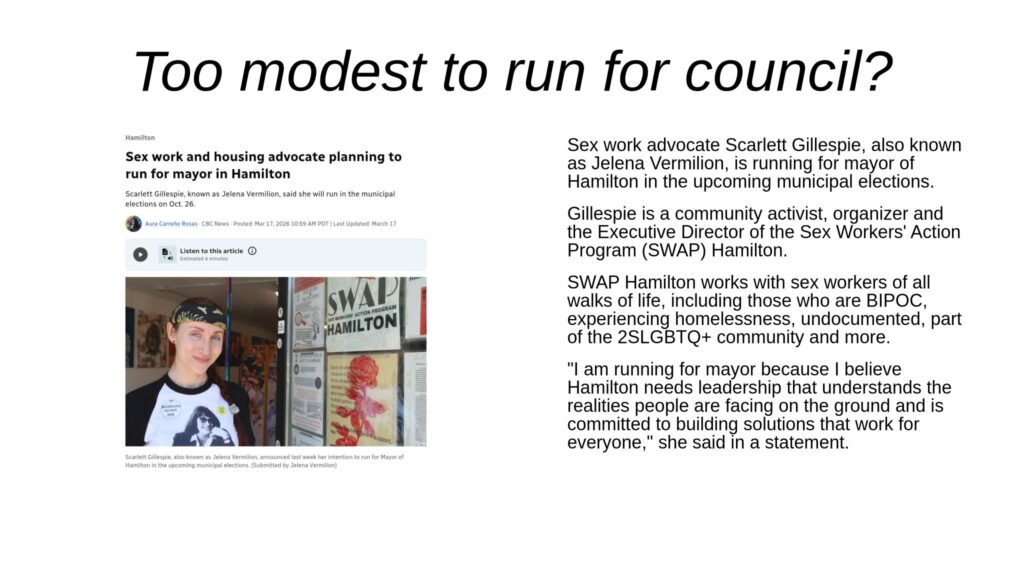
Just in case you think you don't have what it takes to run for office! All you need is confidence and a good story to tell. Source: Sex work and housing advocate planning to run for mayor in Hamilton
See also the following interview:
Let me know if you have questions.
If you're a community advocate and you've addressed your municipal council before, you must know this feeling: they smile, they tell you you spoke well, they thank you for your contribution—and then they ignore you. If you think you can do a better job, by all means, quit being a supplicant and become a candidate!
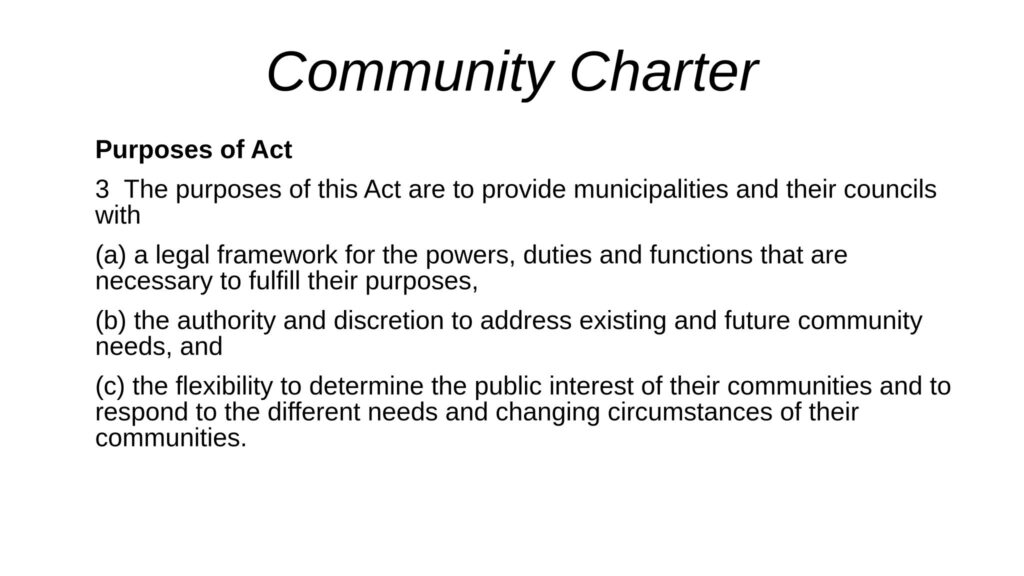
Let's start with the boring part: the foundations of local government. Nearly every municipality in the province is governed by a provincial law called the Community Charter, which grants them the prerogative to govern themselves.
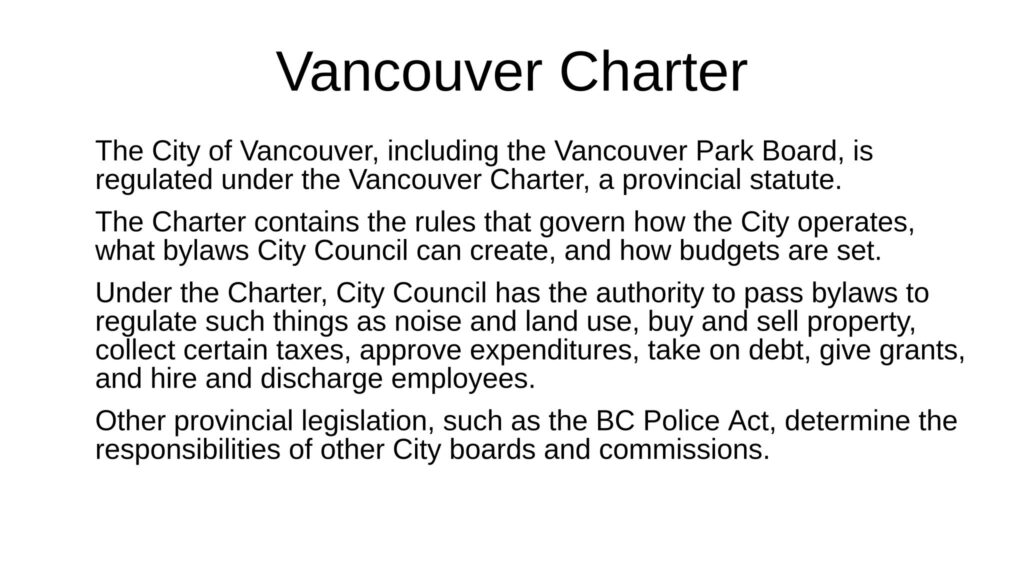
The most notable exception is Vancouver, which is governed by the Vancouver Charter.
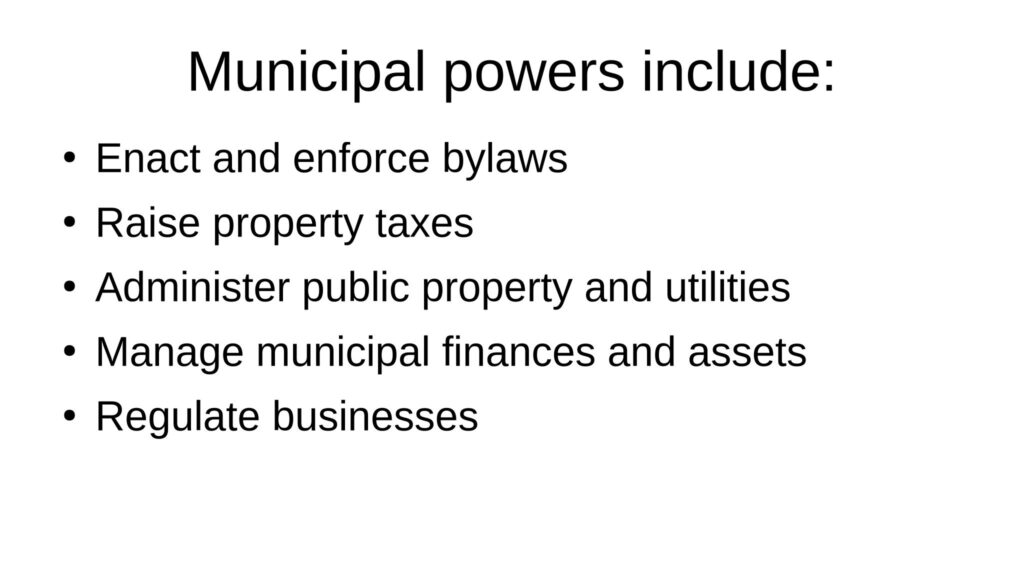
Municipalities constitute the most important level of government. A municipality could technically operate by itself as a microstate; on the other hand, a province or country without municipal governments would collapse instantly.
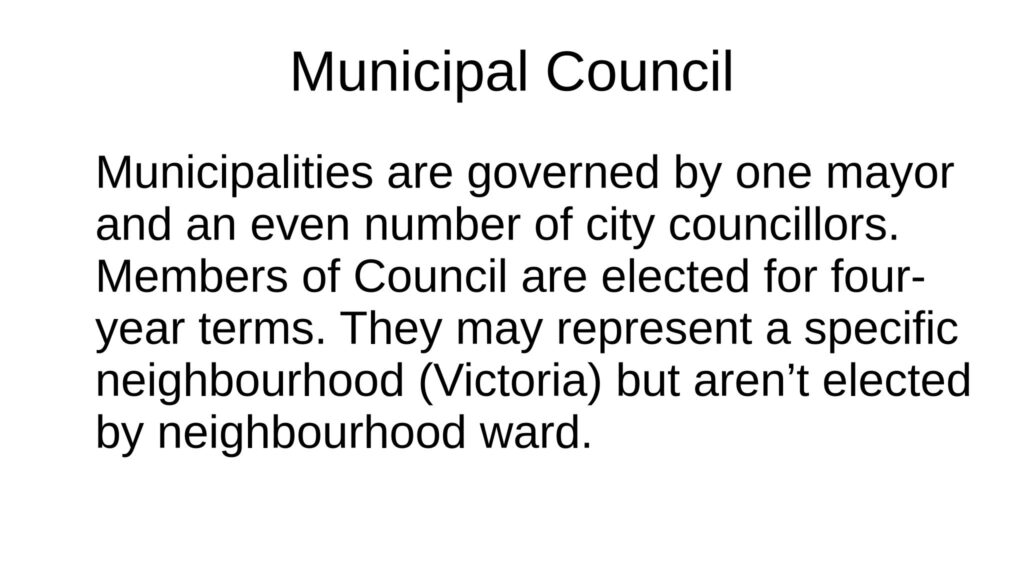
It is indeed a common misconception that council members are elected by ward, perhaps because some municipalities assign neighbourhoods to councillors once they're elected.
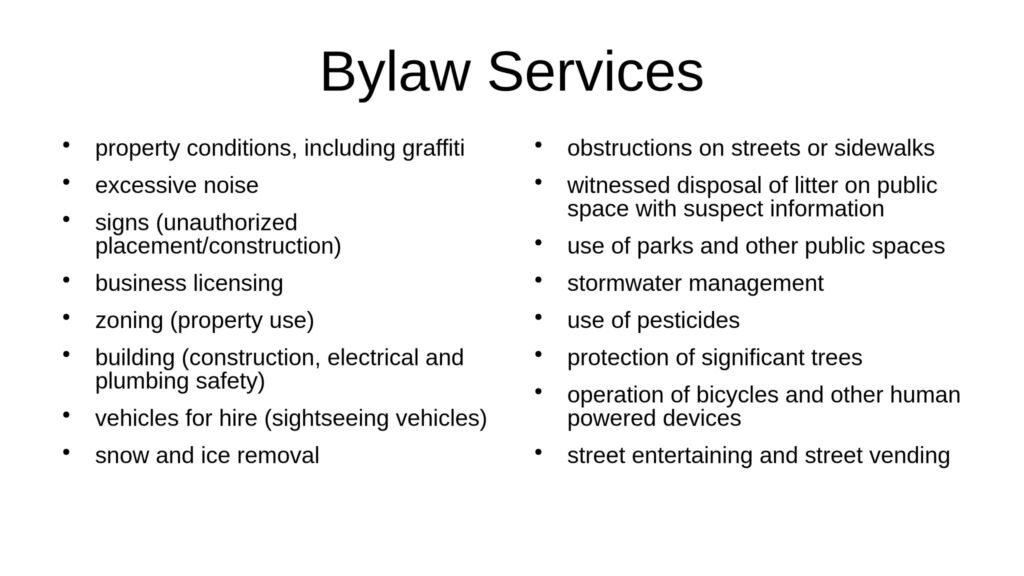
Every municipality is granted the power to enforce its own bylaws, with the mandate to keep the municipality functional and preserve the peace.
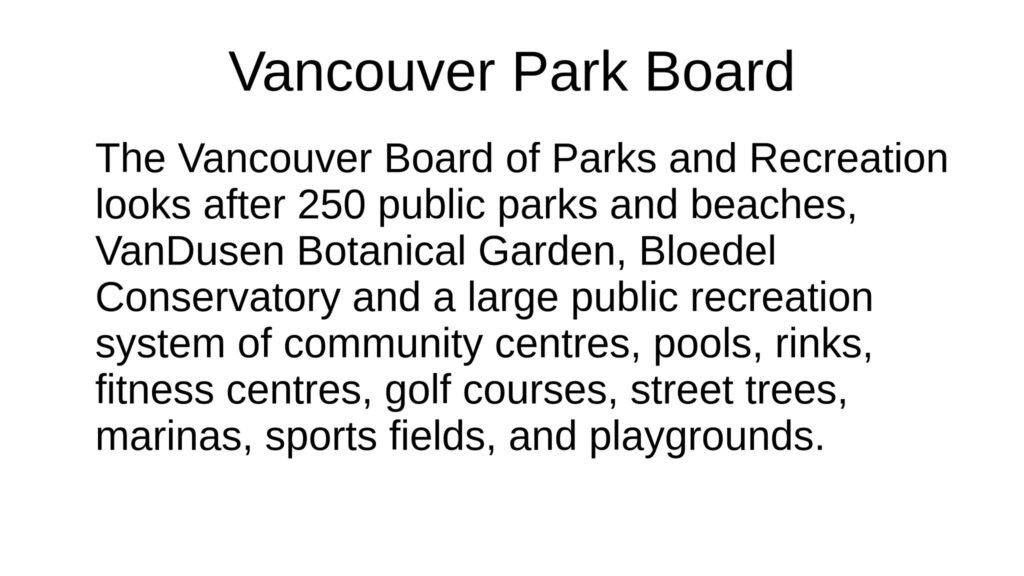
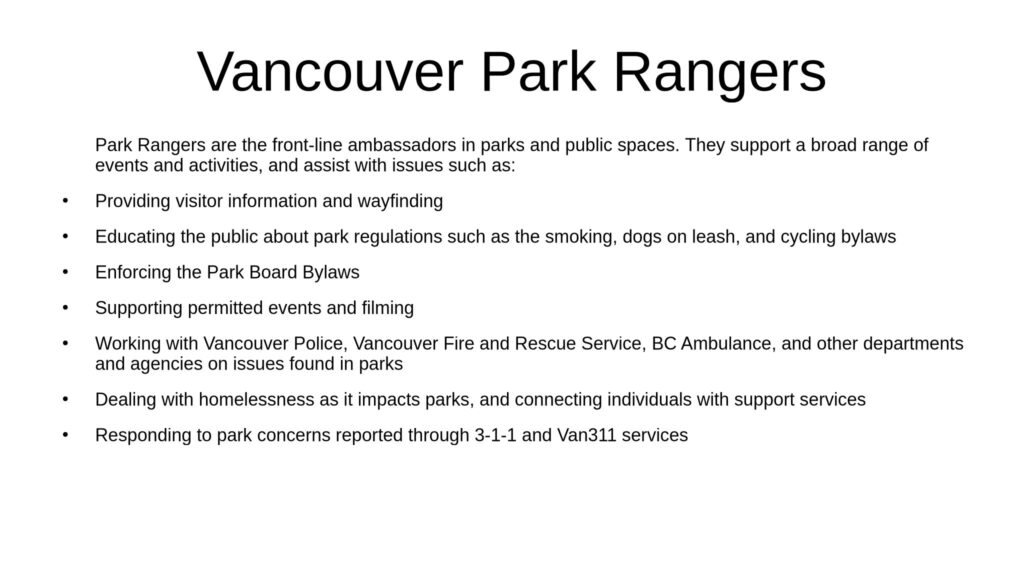
Vancouver has a Park Board, without equivalent in other municipalities. Its park rangers are effectively bylaw officers. Committee members of the Park Board are elected directly.
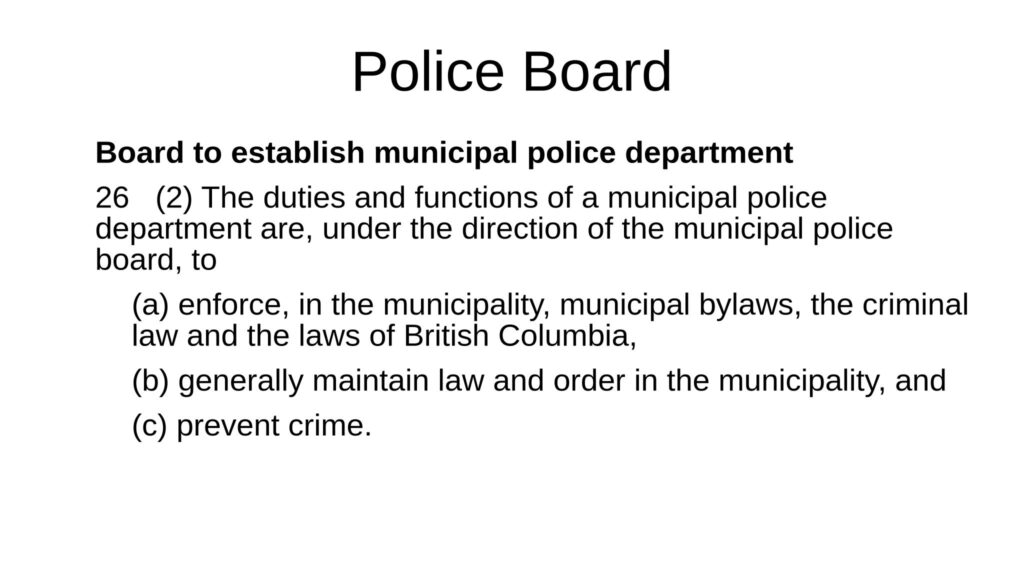
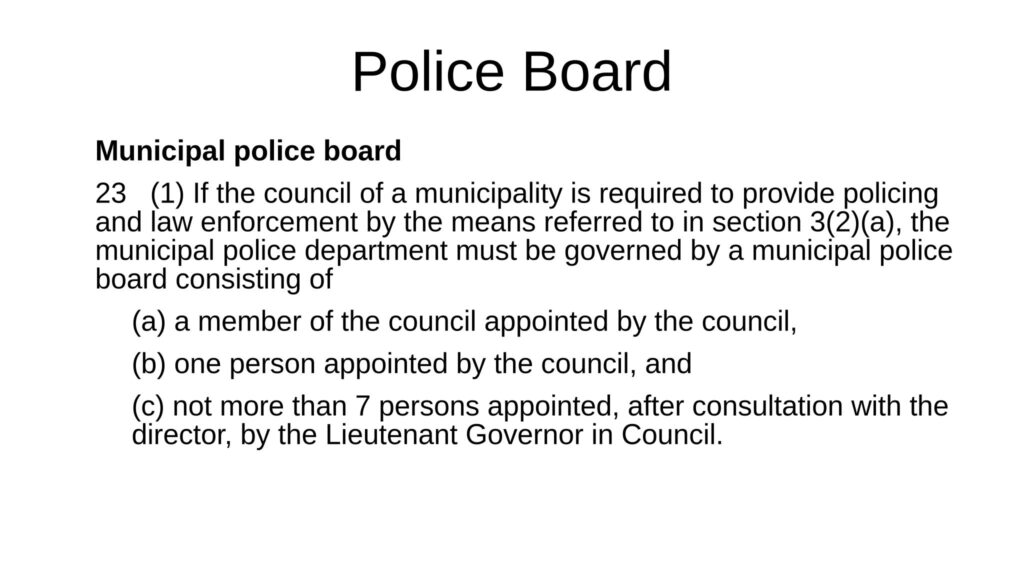
A municipal council does not supervise its police department directly; that is the purview of the Police Board, a civilian oversight body which sets its law enforcement priorities and its budget. The municipal council appoints one of its own as a director, usually the mayor.
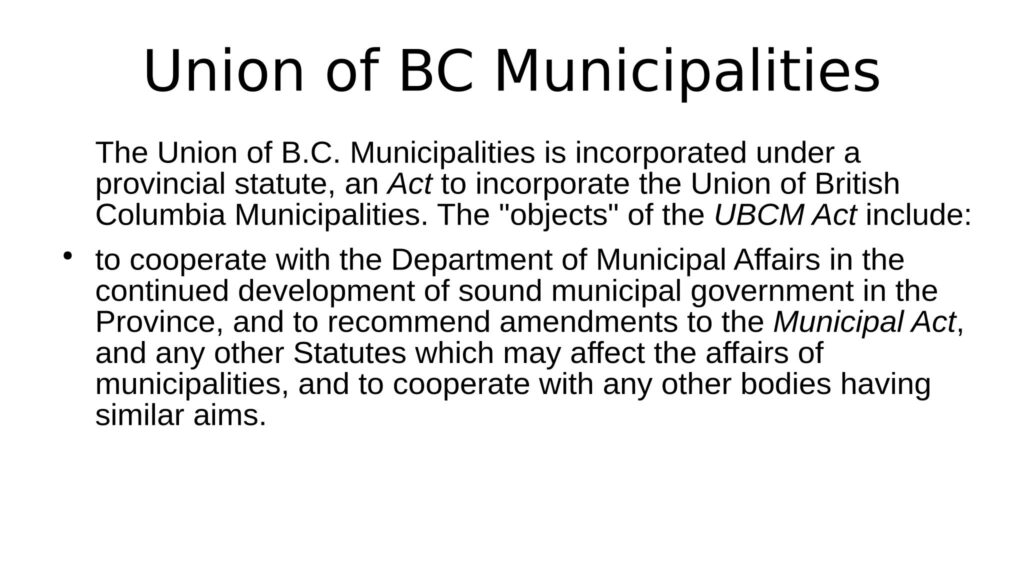
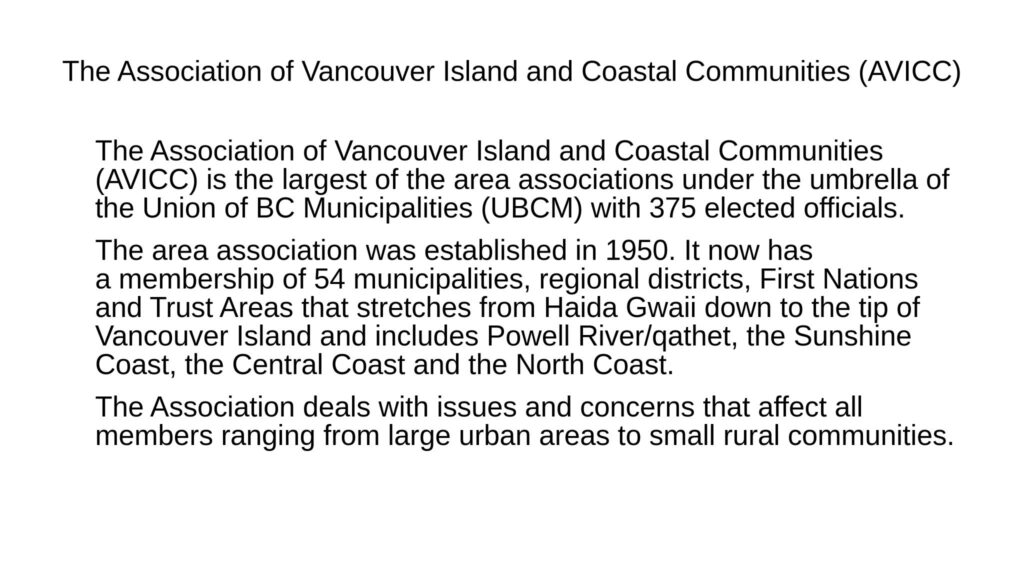
The Union of BC Municipalities is meant for municipalities to debate and harmonize their policies, and also to reach out to higher levels of government with nonbinding resolutions. There are smaller such unions at the regional level, such as the Association of Vancouver Island and Coastal Communities.
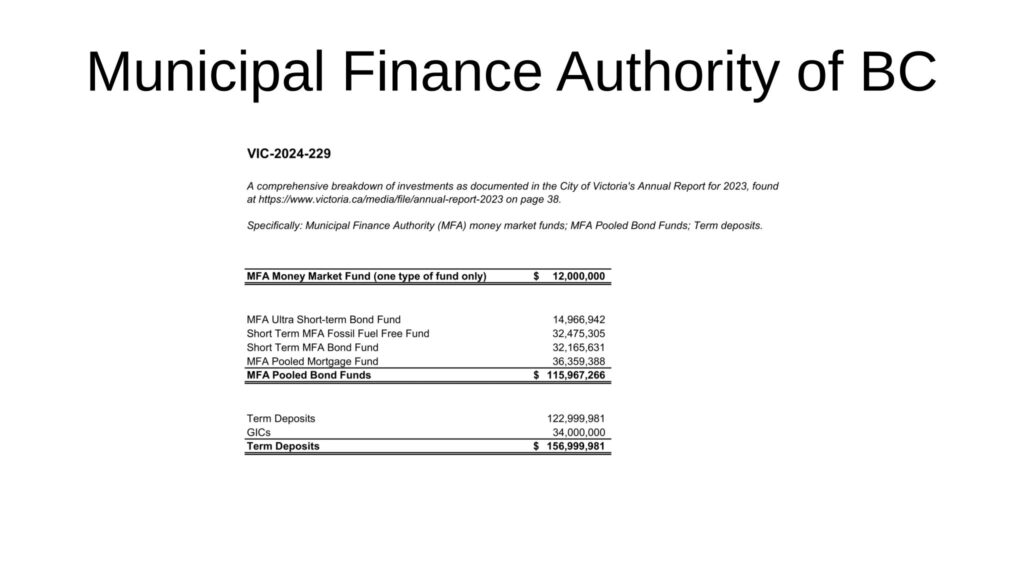
The Municipal Finance Authority of BC is a misnomer, as it isn't strictly speaking an authority; it simply offers municipalities funds through which they can invest their assets into, a task beyond most of them. The above slide is the response to a Freedom of Information request to the City of Victoria asking for a breakdown of its investment portfolio; observe that nearly half of it is constituted of MFA funds, the remainder being government bonds.
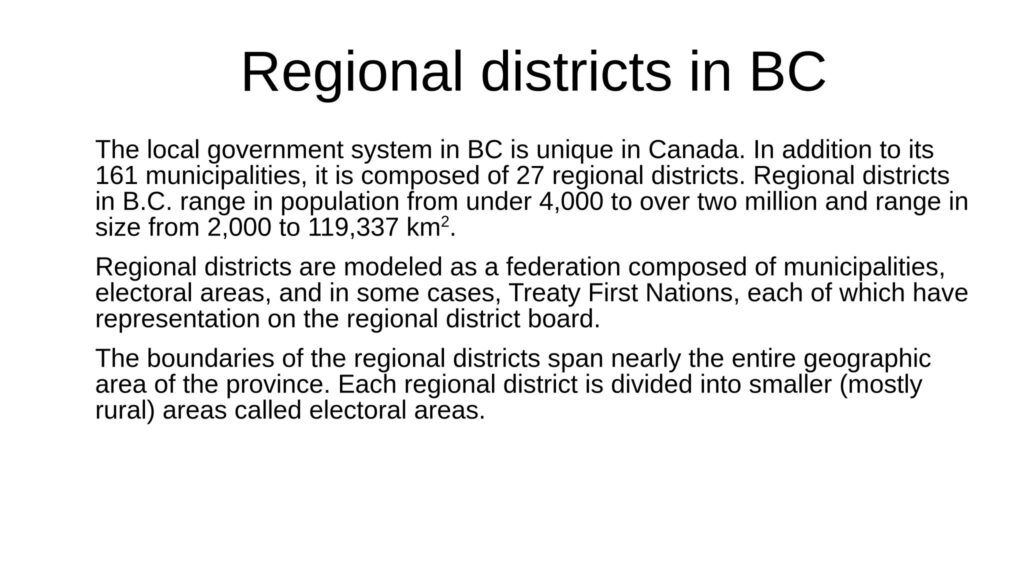
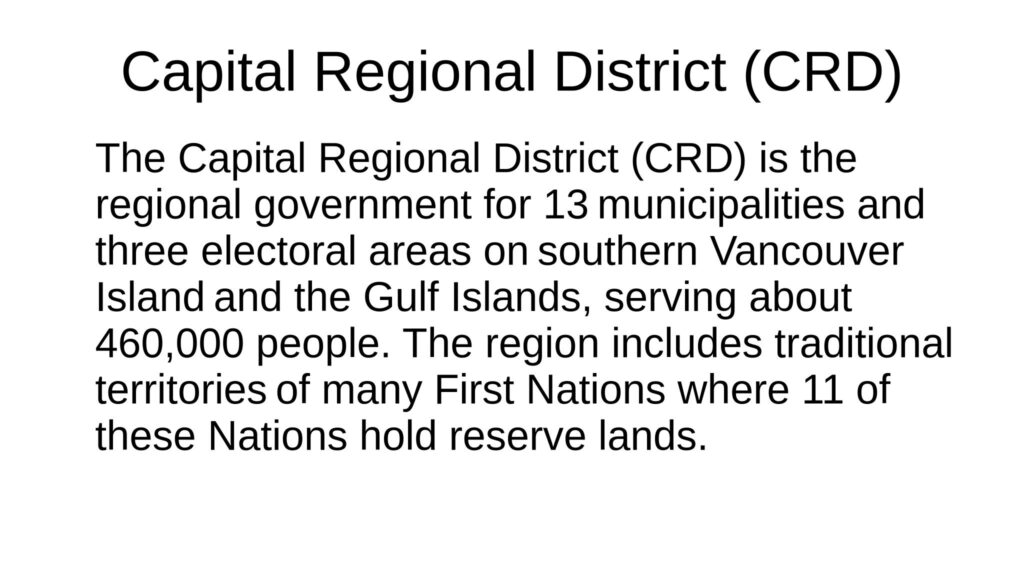
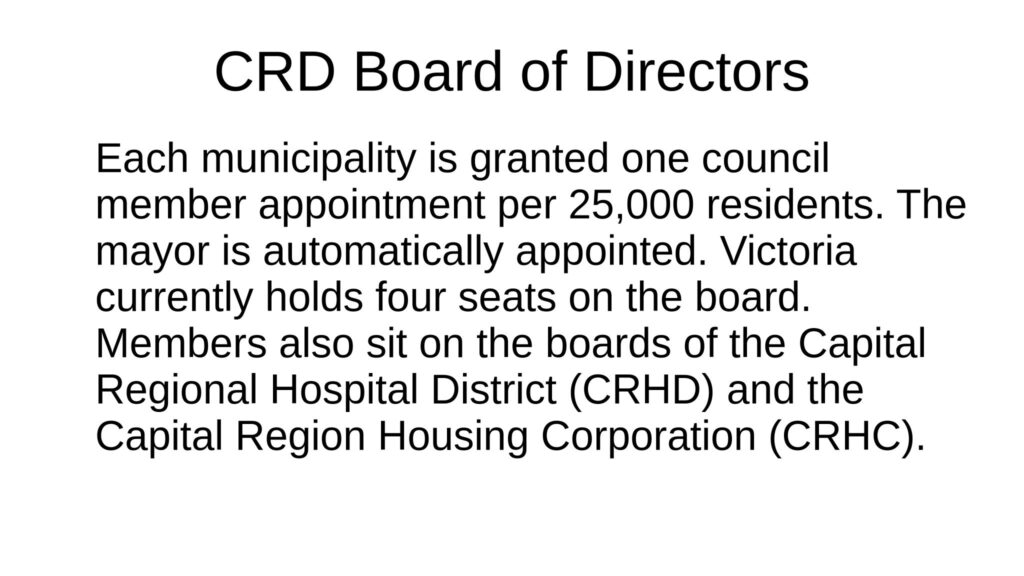
Every municipality falls under the umbrella of a regional government, which holds two notable portfolios: housing, and hospitals. Members of its board of directors are also elected directly, although the mayor is automatically appointed. The two most notable regional districts are the Capital Regional District for the greater Victoria area, and the Metro Vancouver Regional District.
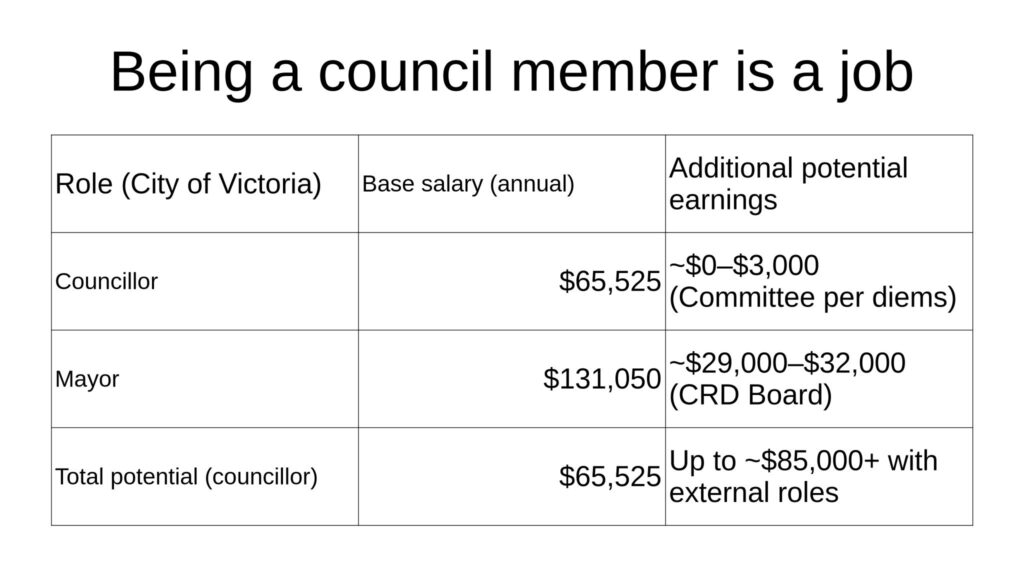
Becoming a council member means taking on a job. The above gives you an idea of the remuneration. While assuming the role of mayor is a full-time job, it is possible to treat the role of councillor as a part-time job by keeping optional appointments minimal. Considering this, the base salary isn't bad for sitting at a table one day per week.
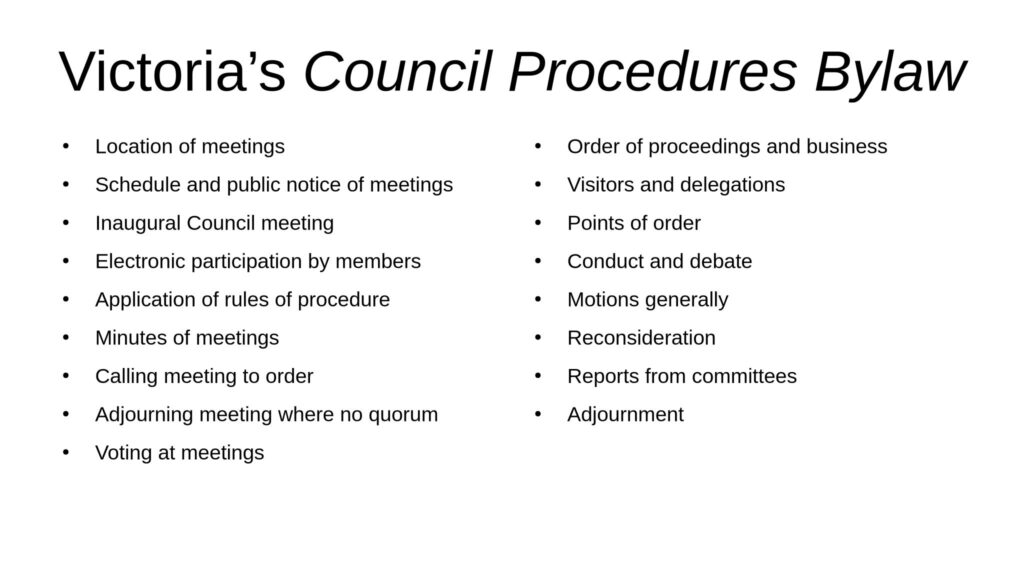
Every municipality sets its rules of council debate, derived from the British parliamentary system; if you're not already familiar with it, I recommend attending a council meeting rather than just reading the bylaw.
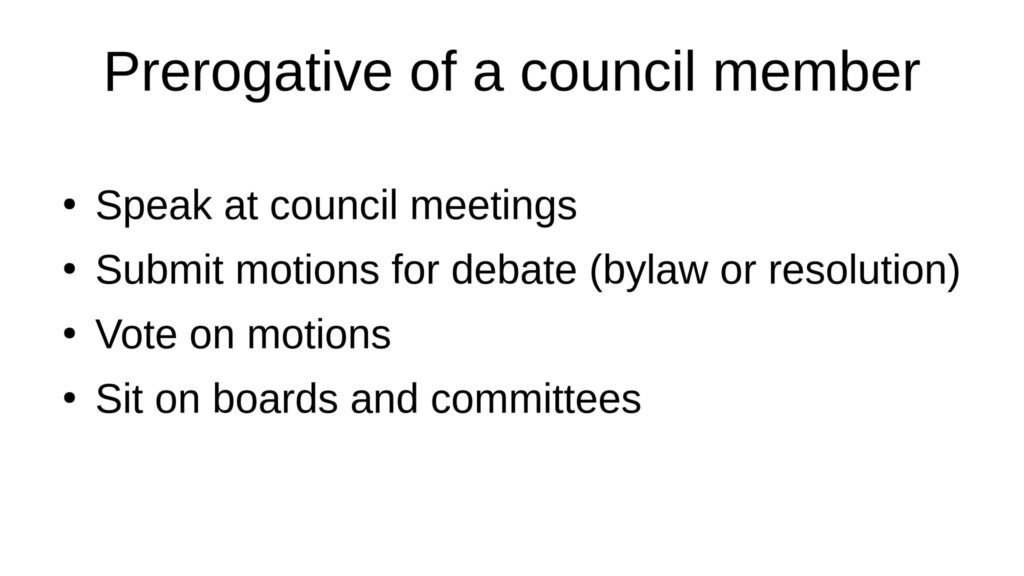
It is worth noting that council members do not run a municipality directly, but through acts of council, short of which staff members may refuse to follow certain directions. If you mean to have any power on a municipal council, you need to work with other council members; otherwise you'll become notorious for being the lone dissenting voice on the council!
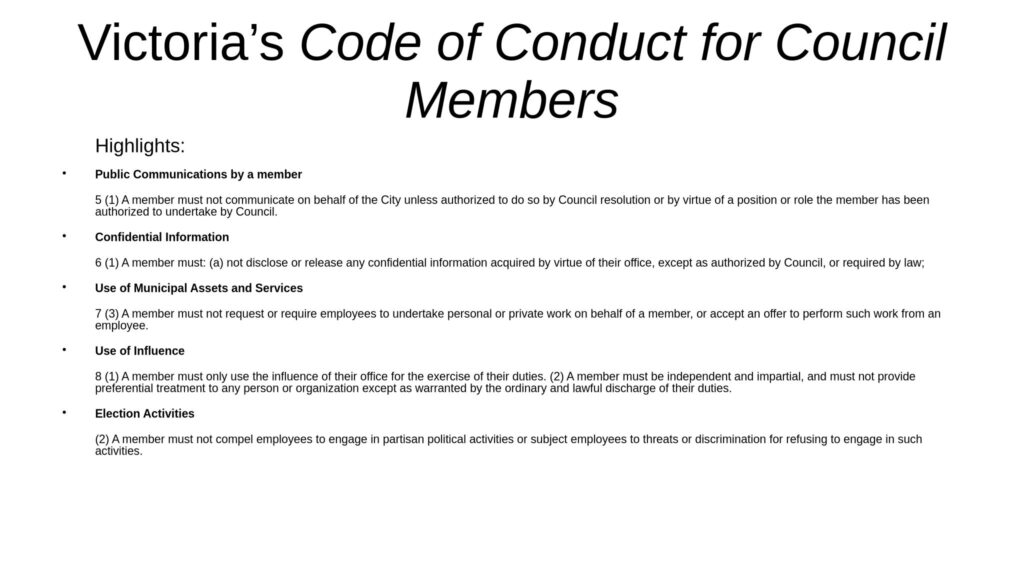
Many municipalities have enacted a code of conduct for their council members, proscribing unethical conduct.
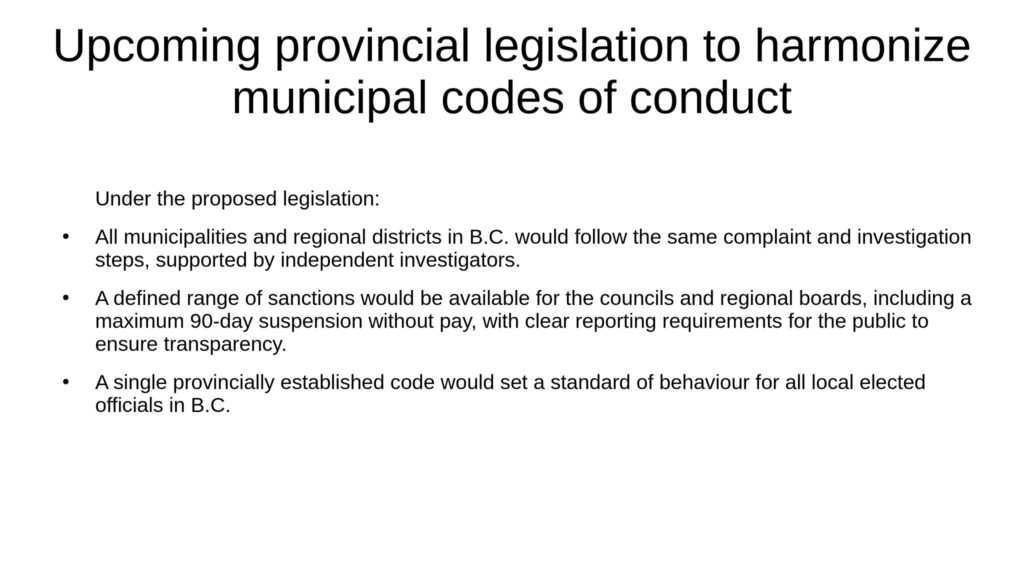
Upcoming provincial legislation would impose a uniform code of conduct for every municipality. Many do not have a code of conduct, have a nonbinding one, or lack a mechanism for members of the public to file a complaint; the harmonized code would address these issues.

Before proceeding any further, I would like to burst the bubble of any one-issue candidate who presumes that sitting on a council is exciting. It shall be the single most testing job you've ever had. If compared to a simulation game, the pace would be excruciating slow, every single mouse click would be debated ad nauseam, and council members would be fighting for the controls like a pack of dogs.
You may be under the impression that I'm trying to discourage you from running altogether, which isn't quite my intent. Instead, I would like to show you this letter, both as a fair description of the role you presume to play and as a sample list of expectations from the electorate:
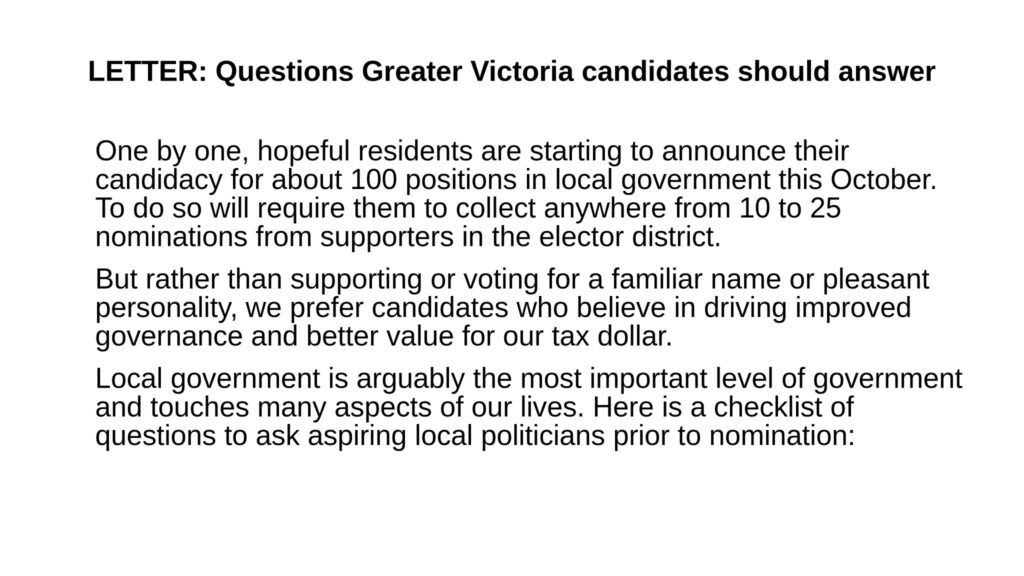
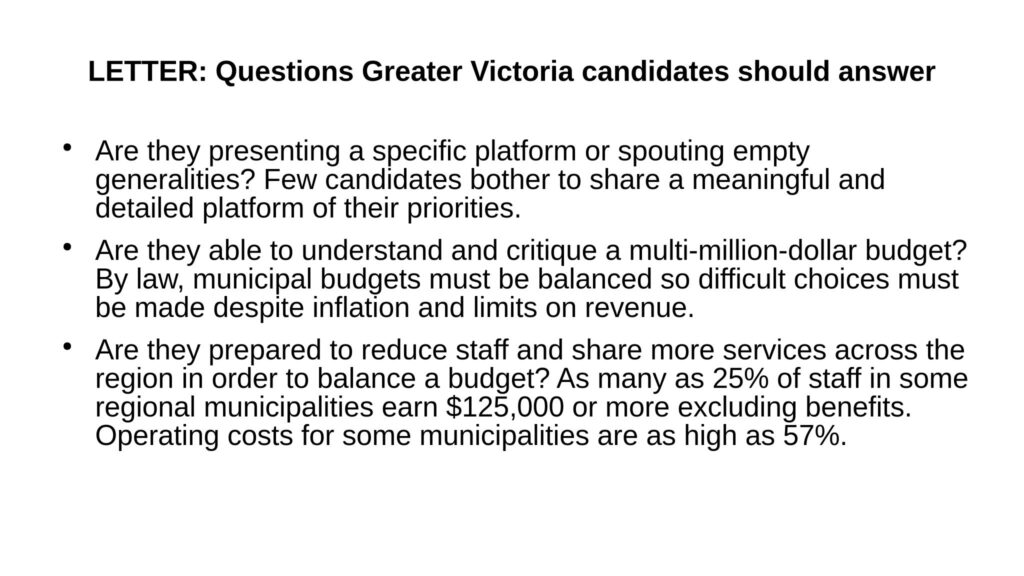
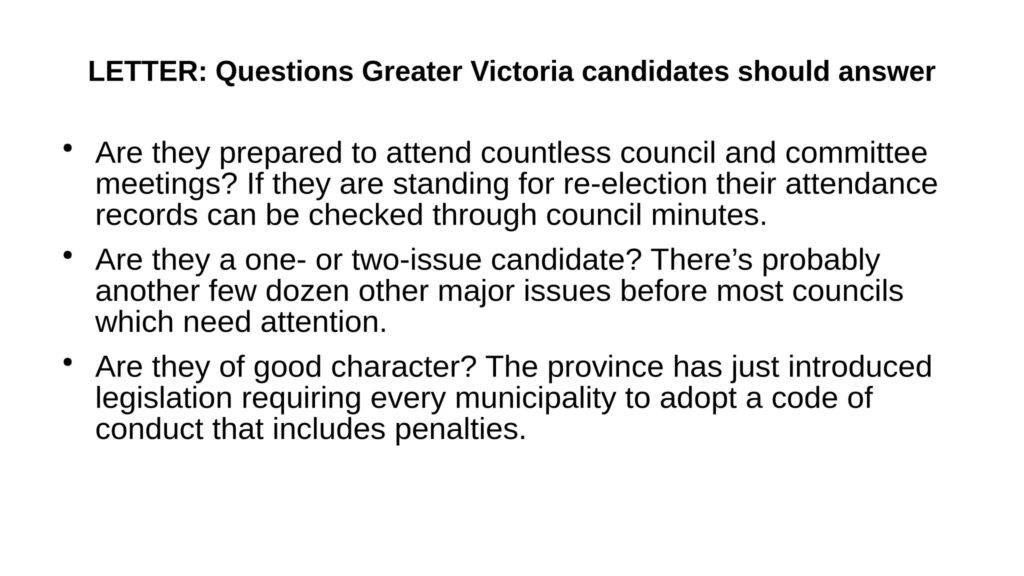
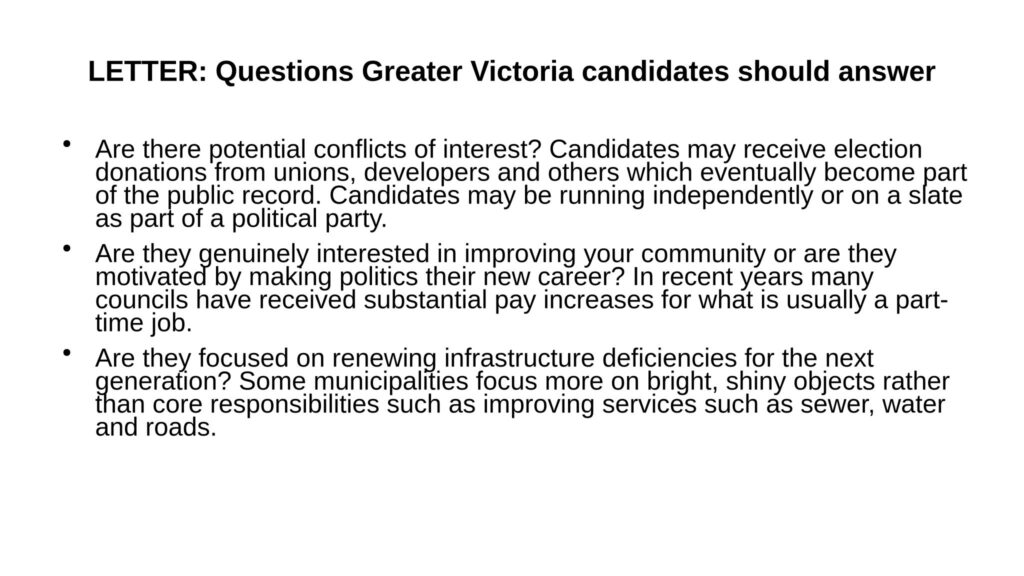
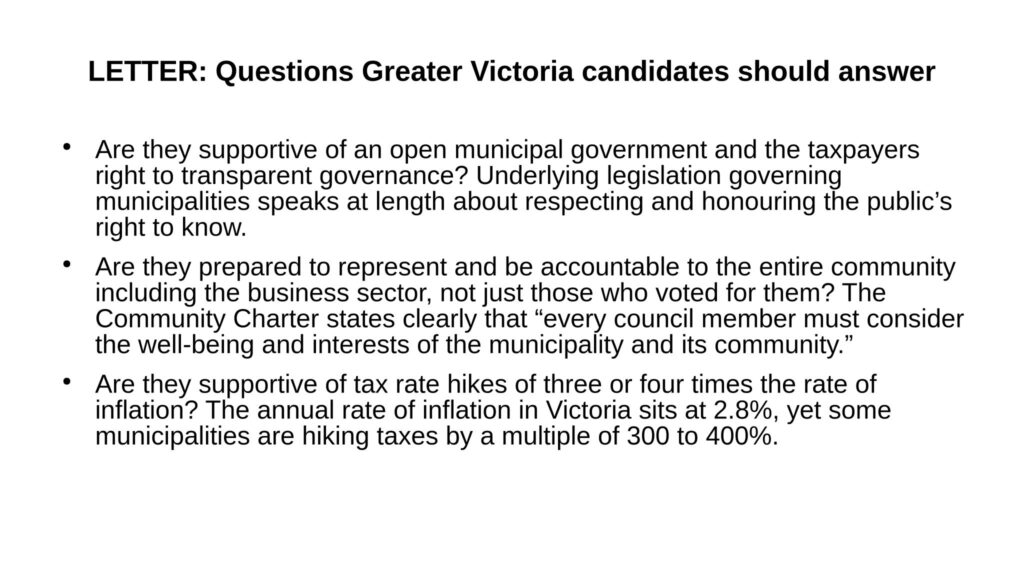
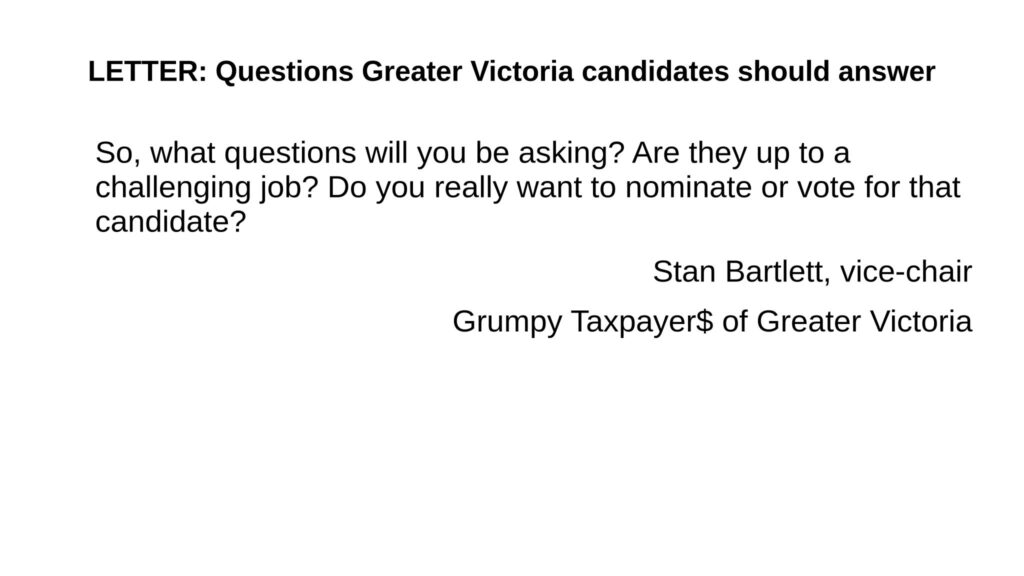
Source: LETTER: Questions Greater Victoria candidates should answer
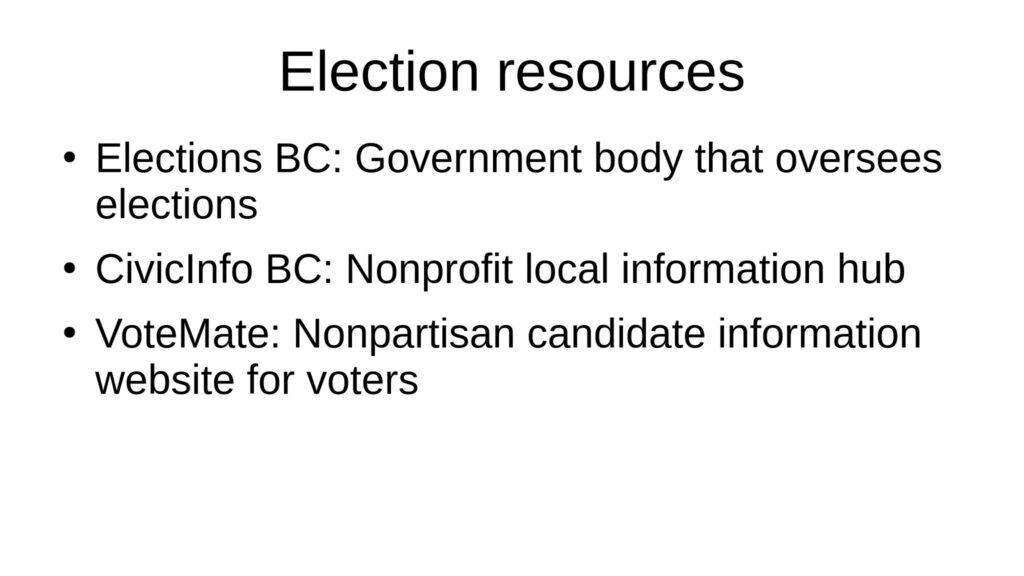
Elections BC: Local Elections
CivicInfo BC
VoteMate: British Columbia
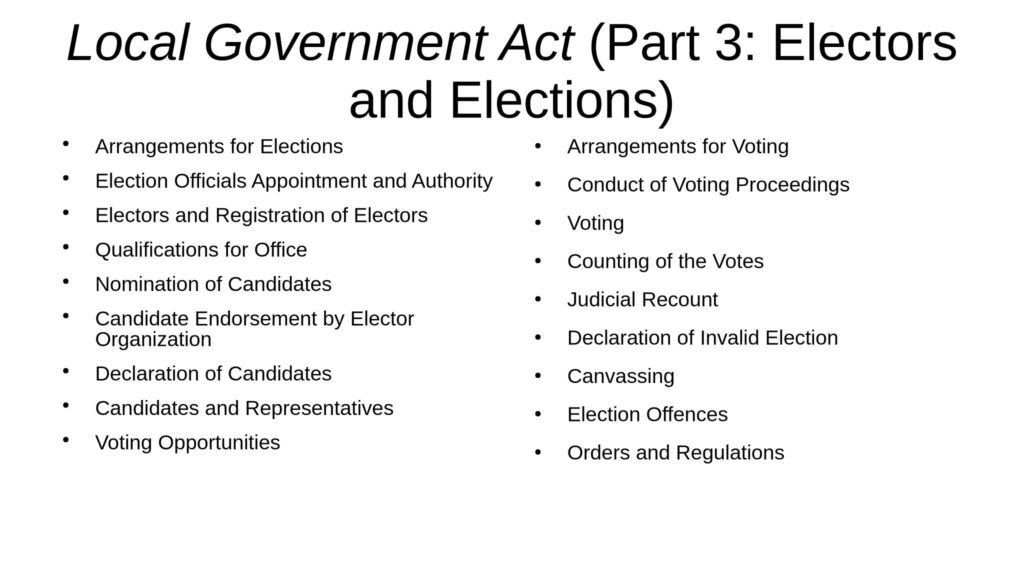
Election rules are detailed in Part 3 of the Local Government Act. Much of these are only of interest to election officials or apply solely in narrow circumstances, but candidates should still skim over these.
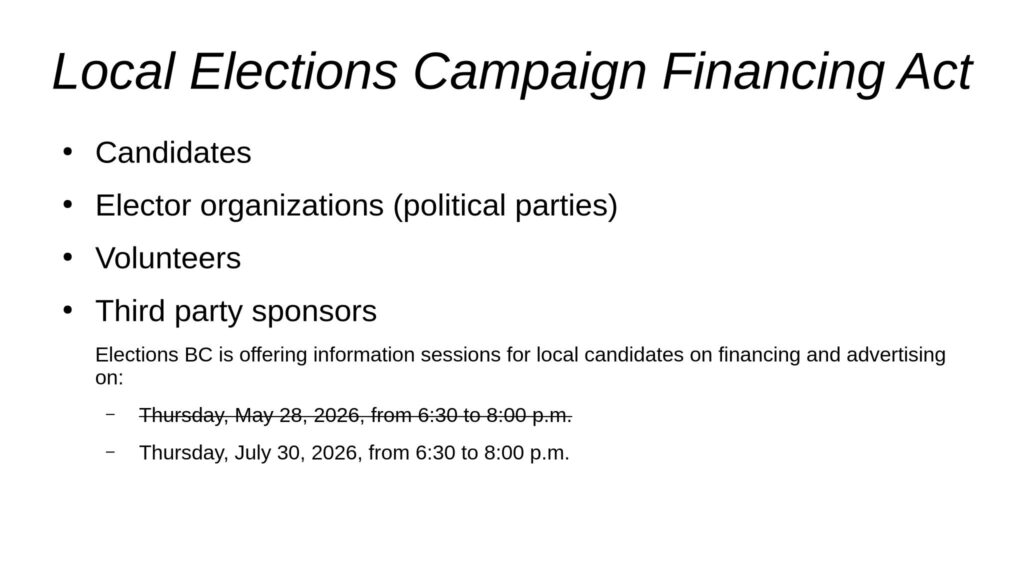
The rules pertaining to campaign financing are detailed in the Local Elections Campaign Financing Act. Elections BC has recorded the information session on campaign financing it gave on May 28. As of this writing, it is still possible to register for the July 30 information session.
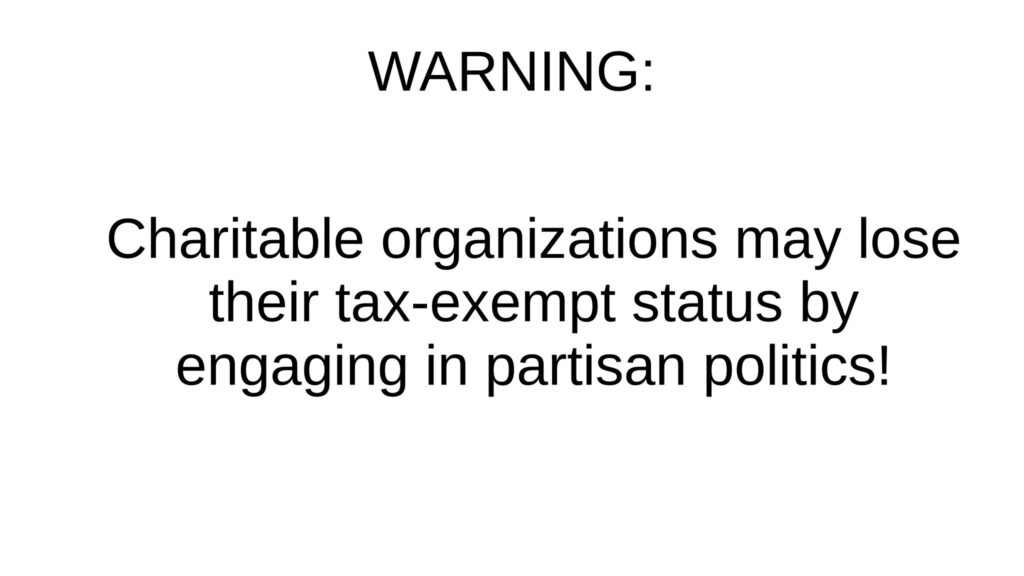
Worth mention because many advocates work with charitable organizations. Think before asking a nonprofit for a formal endorsement.
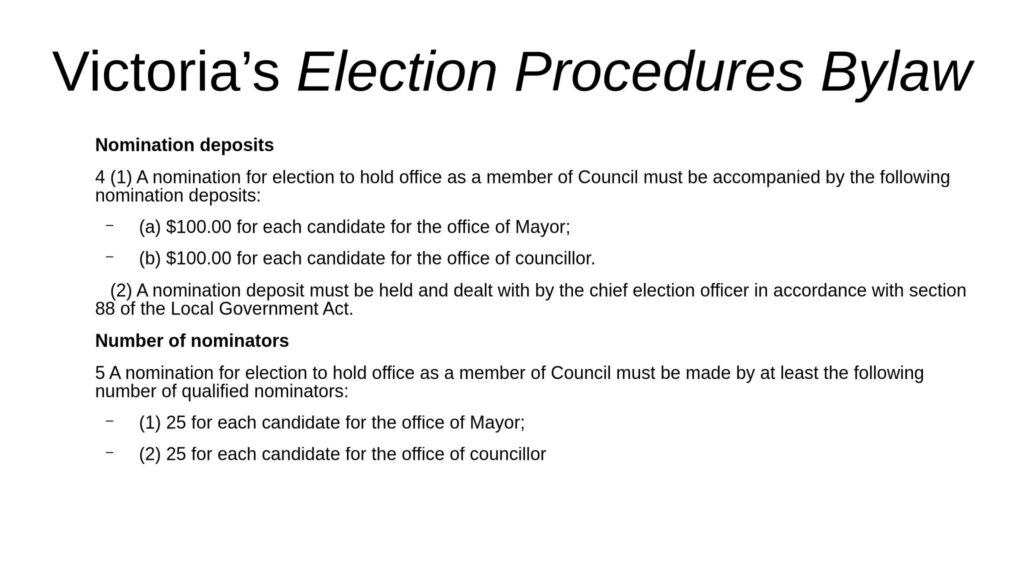
The Local Government Act grants municipalities some latitude in setting election rules, such as nomination deposits and the required number of nominators, so have a look at your municipality's bylaw for specifics. The above holds in most case though.
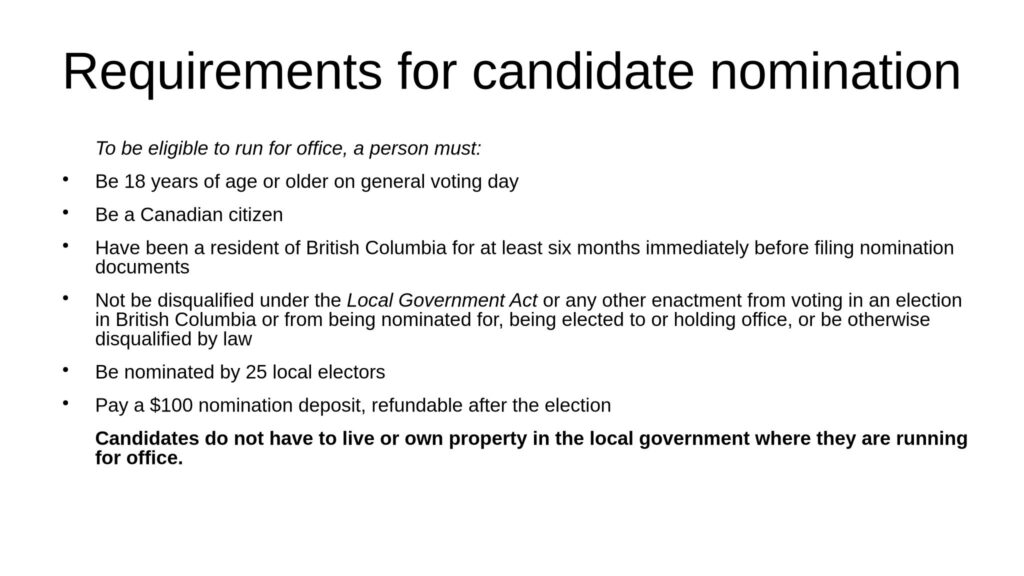
The requirements are indeed as low as the above. Just about anyone can get nominated. Are you an adult? A Canadian citizen? Been residing in BC for at least six months? That's about it.
Of course the more tedious requirement is to find 25 nominators. These are people eligible to vote in your locality who are willing to formally endorse your candidacy. Even then, this is a trivial threshold for any community advocate to meet.
Then you need a refundable $100 deposit, which isn't exactly breaking the bank.
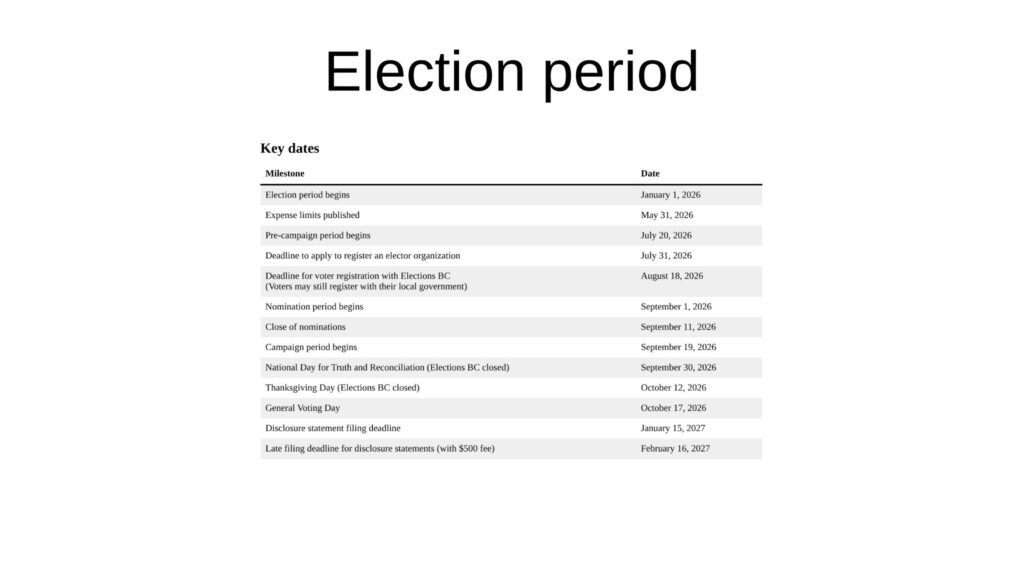
The election period has already started. The pre-campaign period begins on July 20, the nomination period ranges from September 1 to September 11, and Voting Day is on October 17.
The following slides are an excerpt from ElectionsBC's Candidate Handbook. It is of course a mandatory read.
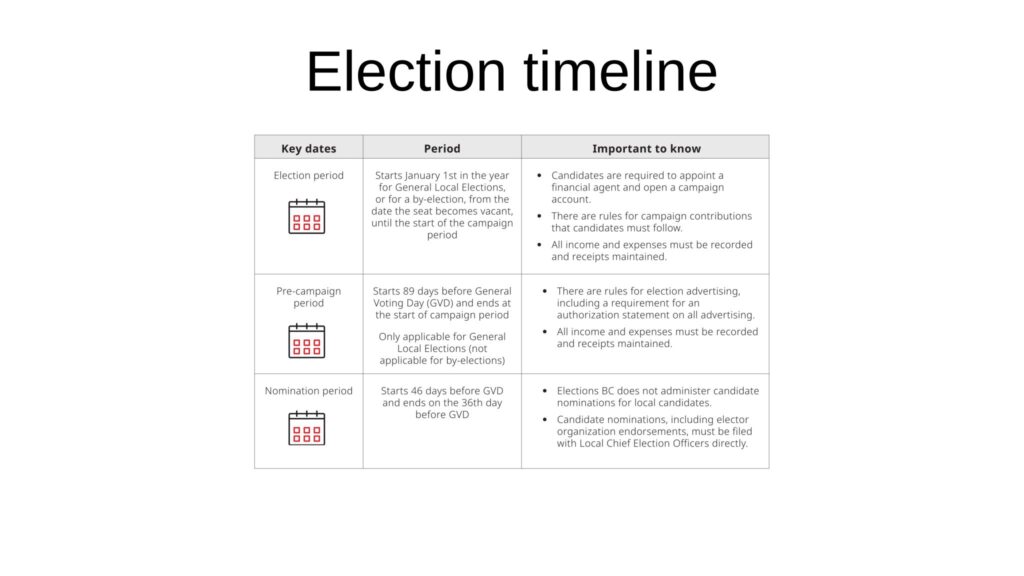
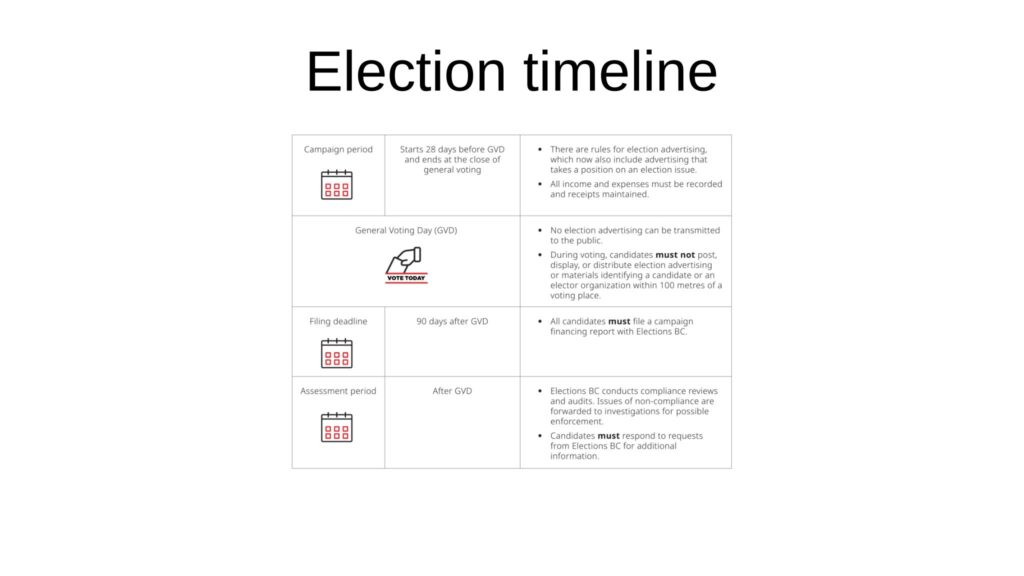
Before spending a dime on your campaign, you have to open a separate bank account for it. This letter is intended for financial institutions and should facilitate the process.
You also have to designate a financial agent for your campaign. A candidate can be their own financial agent, although the role is commonly assumed by an accountant instead. Personally, I'm confident I can handle the paperwork for my own campaign, and so should most serious candidates. Even if you pick someone else, that person doesn't need to be an accountant, just someone willing to go through the tedium on your behalf.
Also note that there are rules pertaining to election advertising, which are also discussed in the handbook.
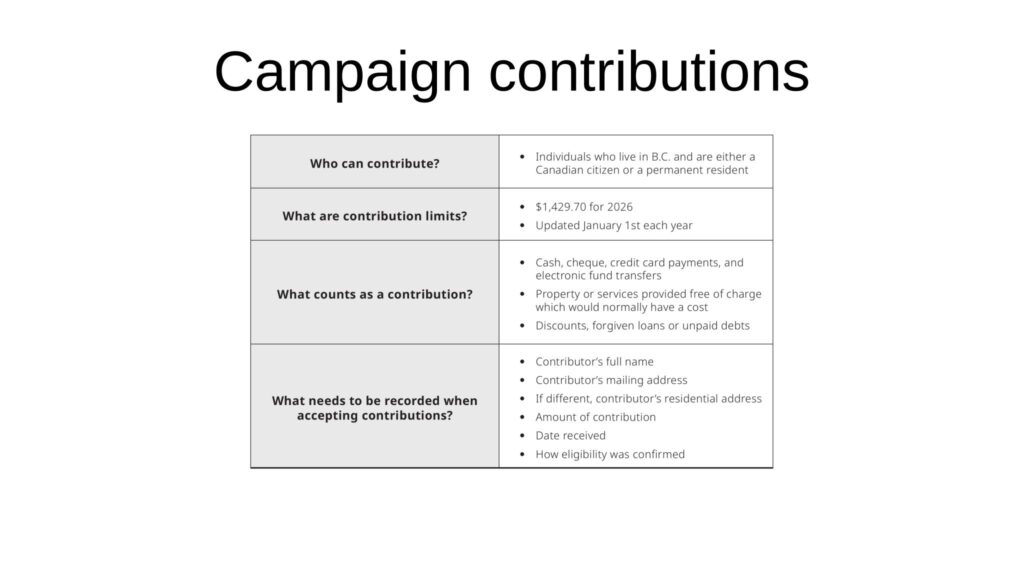
Then you should familiarize yourself with the campaign financing rules, as explained in ElectionsBC's local campaign financing guide. The above shows the basic rules for campaign contributions, which is the most important part. Also have a look at candidate expense limits, which vary by jurisdiction and position.
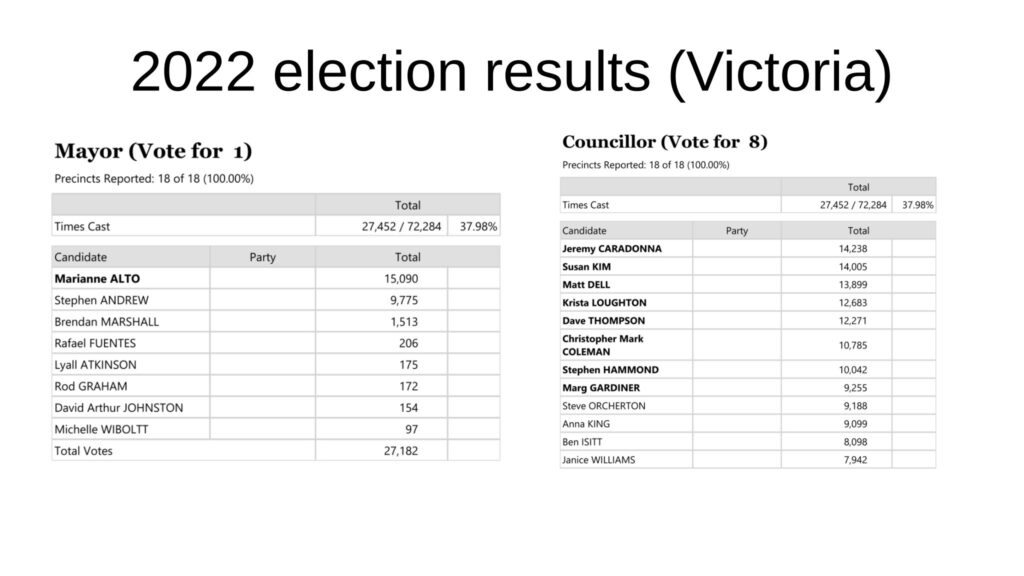
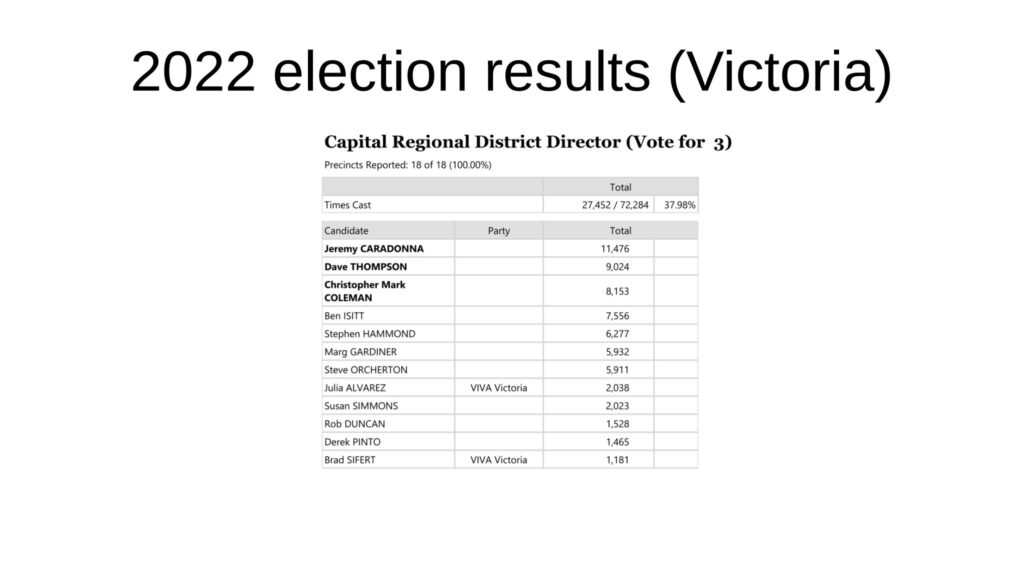
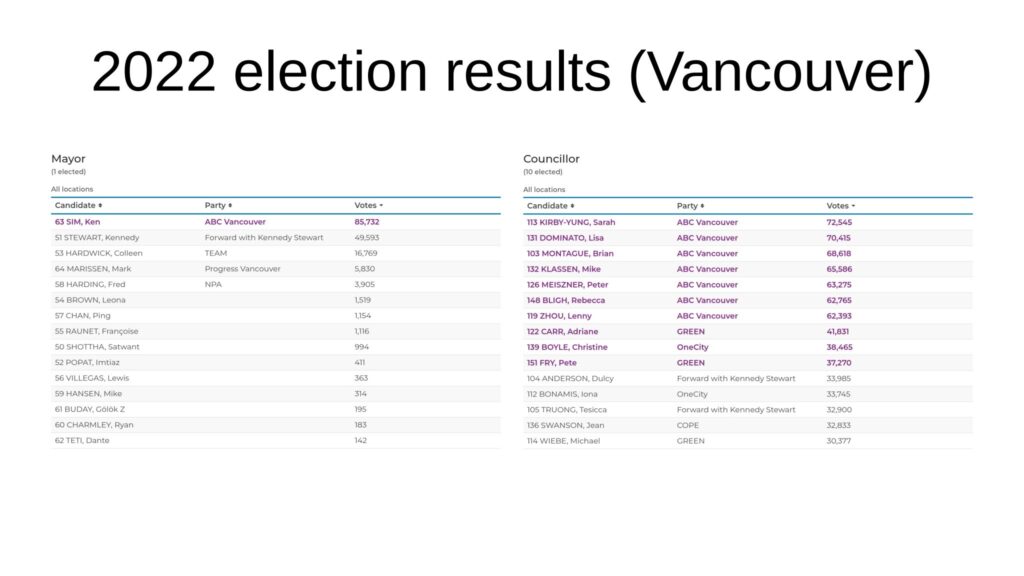
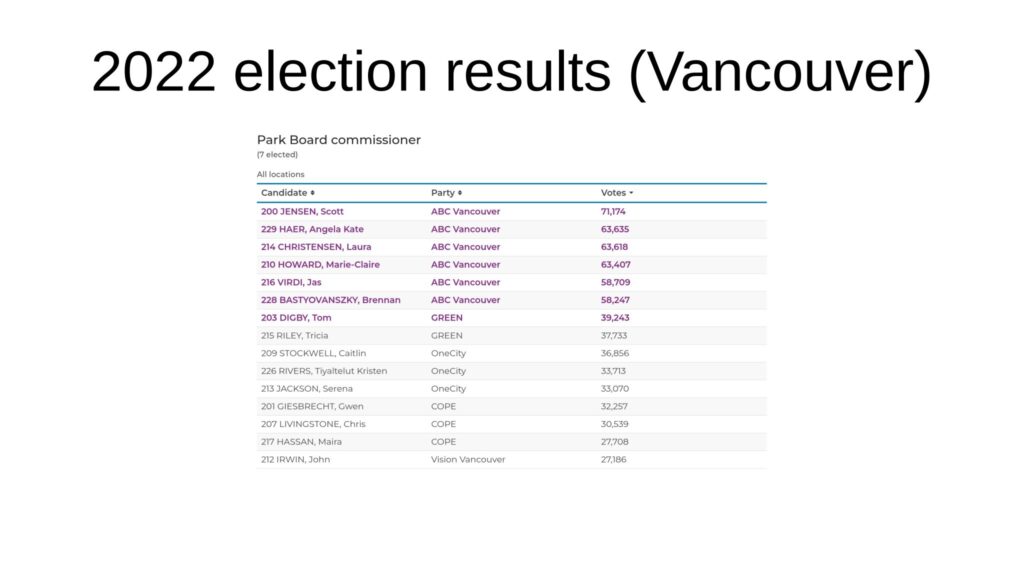
These show 2022 local election results for Victoria and Vancouver, and give you an idea of the bar to meet in order to get elected.
Note that unlike for mayor, voters cast multiple votes for councillors and board members, one per available seat. This voting system give outliers a chance, as I explain below.
Observe that in Victoria, all nine council members are independent. The only party was VIVA Victoria, which fielded seven candidates, yet it was wiped out. Just in case you wonder about your chances without party backing. Furthermore, seven out of eight councillors were upstarts without experience in politics.
It looks more difficult to win as an independent in Vancouver though, especially considering recent ABC Vancouver dominance. That being said, the party has been beset by scandal lately, and one of its councillor has been ousted due to internal division. The dominant party may realistically implode in the next election, and who knows where those votes shall go instead; it may result in a windfall for outliers as disillusioned voters seek a way out of municipal council drama.
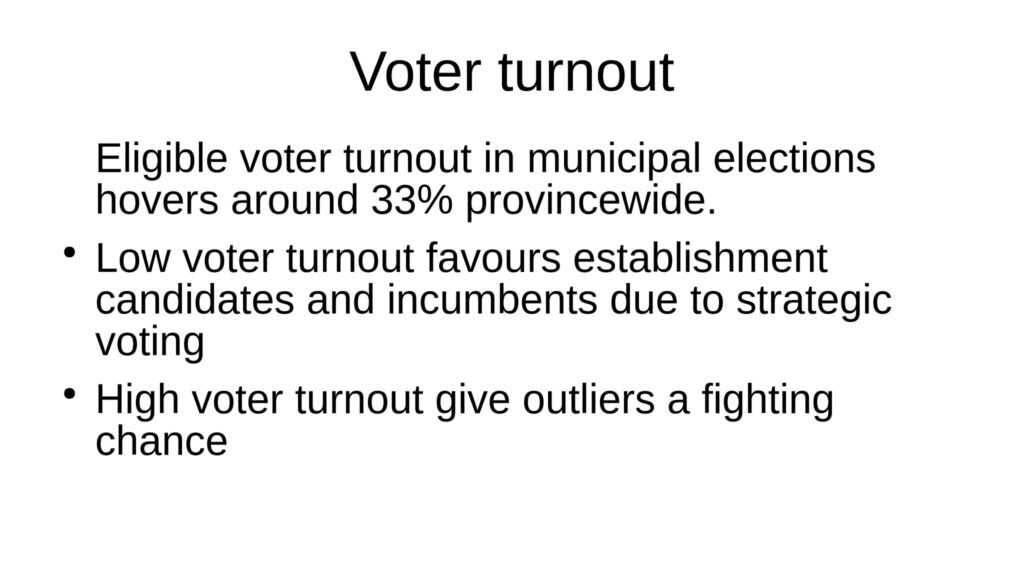
Voter turnout is the ratio of actual voters to registered or eligible ones. About one in three eligible voters does cast a vote in local elections. Since establishment candidates with party backing are better at getting their numbers out, a low voter turnout encourages strategic voting out of fear of the worst-case scenario, especially in two-party systems. An independent candidate who's serious about winning should therefore reach out to the portion of the electorate that does not normally vote, usually those disillusioned by the establishment. Seriously, if the voter turnout were to suddenly double then local election results would become anybody's guess.
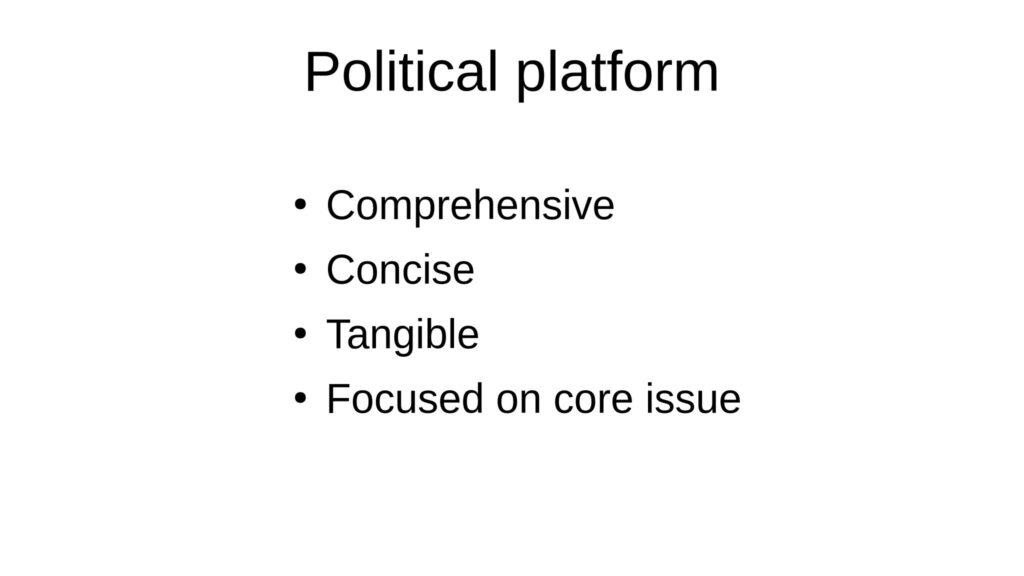
For better or worse, since you don't have an elector organization dictating your political platform, you will have to come up with your own. Make sure it's broad enough to encompass the wide range of municipal duties (not just one or two issues!), concise enough to explain without boring the audience with tedium, proposing tangible solutions as opposed to mere values and empty promises, and most important for an advocate or activist: focused on core issue. Come up with an attractive platform which revolves around what you feel passionate about!
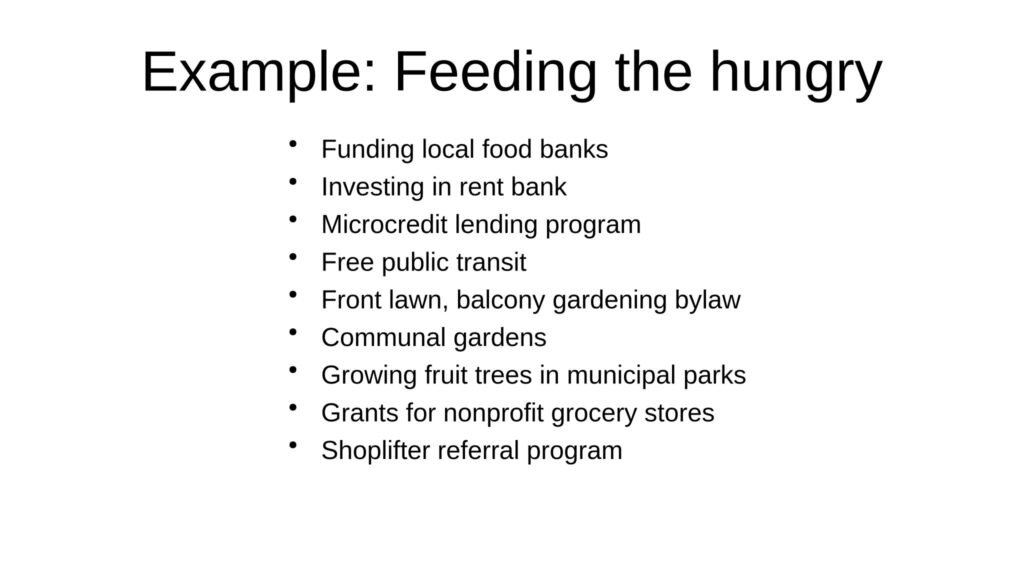
I came up with this hypothetical platform for an advocate out to solve world hunger. I've put in some economical initiatives like free public transit and rent banks meant for those experiencing a pinch to put more food on the table. Also note the shoplifter referral program to address the problem at the root, which is usually poverty. With less than ten minutes of brainstorming I came up with a platform linking world hunger to housing, public transit, public safety, the economy, and the environment. And if you think feeding the hungry isn't a winning platform, you haven't been reading the news lately!
So you got a platform? Great! Let's look into how to use the skills you already have in order to break through. I'm about to demonstrate that you already know how to campaign for office, you only need to let go of the notion that you need traditional campaigning methods like lawn signs and citywide canvassing, and instead rely on what has made you successful as an advocate or activist to begin with. No need to leave your comfort zone!
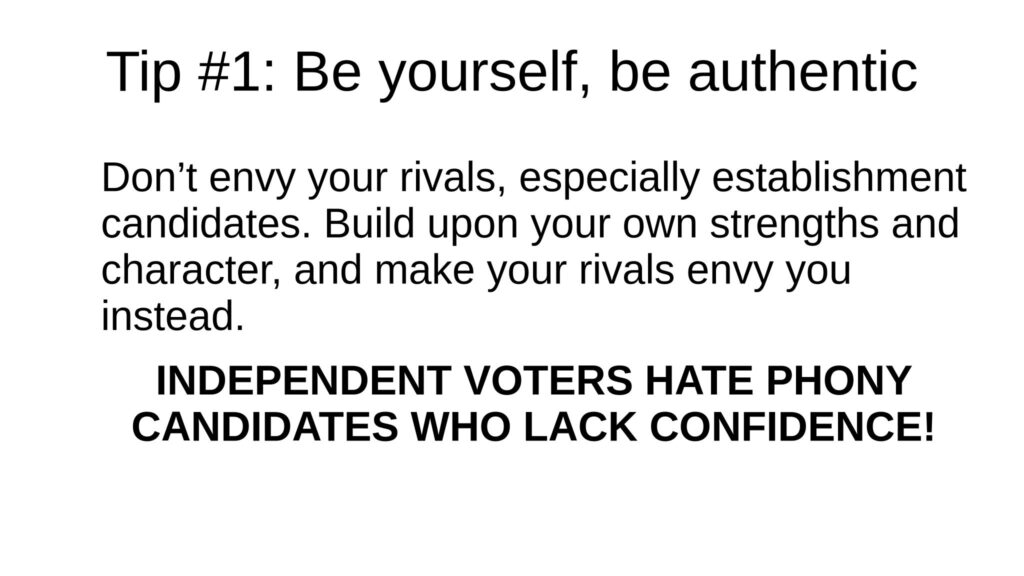
The number one trap for an activist would be to lack confidence and envy their rivals. Trust me, you would rather lose with confidence than scuttle yourself with lack thereof.
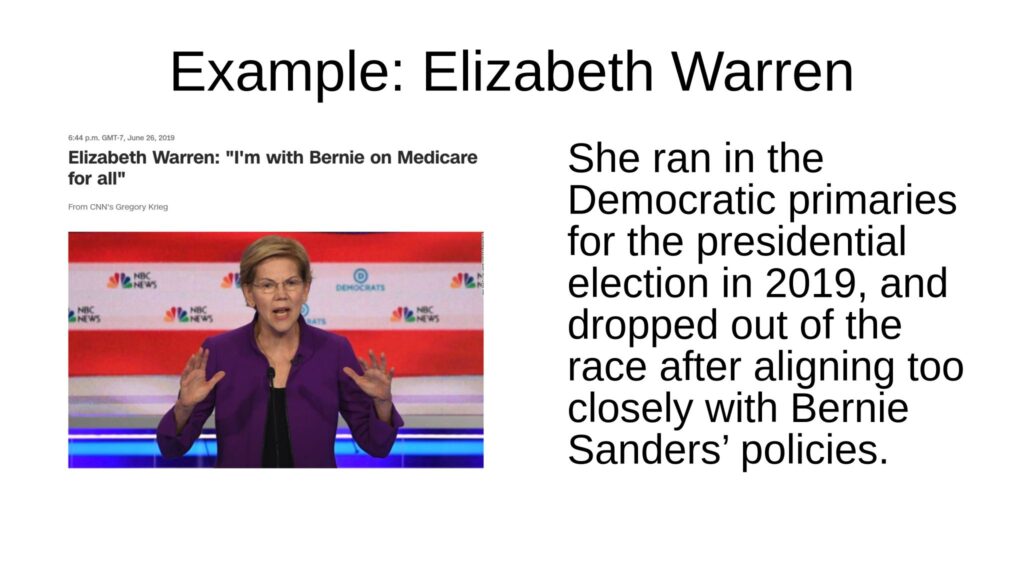
The best example I can come up with is Elizabeth Warren's 2019 campaign during the Democratic primaries for the presidential election. She lagged a bit behind Bernie Sanders, and calculated that she could pull ahead by attracting his supporters. So she blatantly stole his platform, including universal Medicare coverage which she used to be apprehensive about. Of course it fell flat; Sanders' supporters stuck with him whereas her own base deserted her.
Here I'm borrowing a maxim from creative writing. Advocates and activists might be envious of establishment candidates' traditional campaigning methods, but here I argue it should be the other way around; in reality, the establishment needs those tedious and expensive methods to compensate for what it lacks.
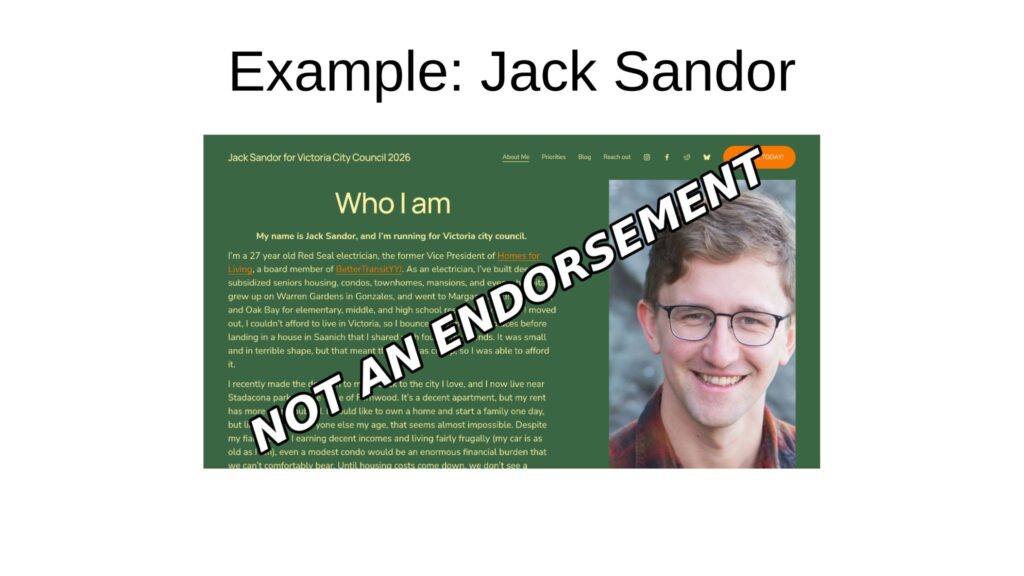
I'd like to demonstrate with the campaign of Jack Sandor, an independent candidate for council in Victoria I keep bumping into. This isn't an endorsement, by the way. Nevertheless, I encourage you to have a look at his campaign website, which is a good starting point for those looking for a model to build their own platform. Objectively speaking, I say he has a shot at winning.
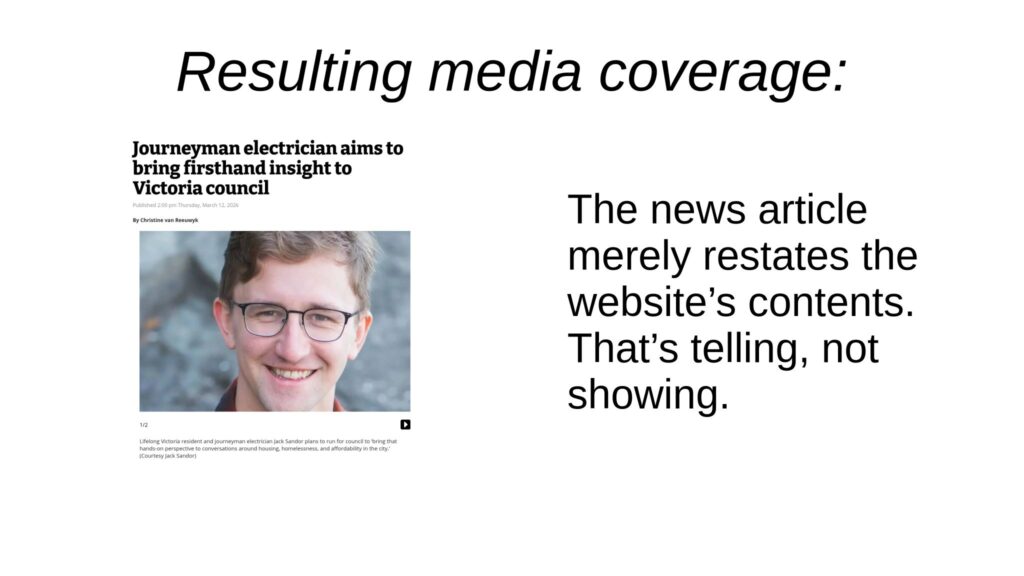
His campaign's main drawback though is that it's telling, not showing—and it shows in the resulting media coverage. If you merely send a press release with a link to your campaign website, news articles shall read like a resume, which is far from exciting. Nobody likes reading a resume. And that means he'll need to knock at many doors and shake a great number of hands to compensate.
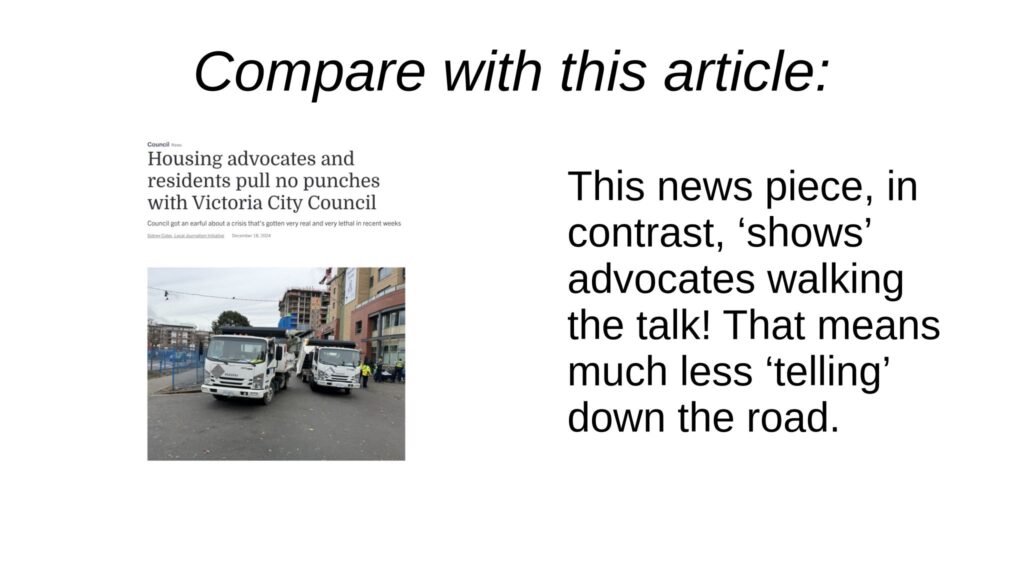
This is the kind of media coverage an advocate should strive for. In this piece, housing advocates are shown taking on the City of Victoria's municipal council like it's some kind of punching bag:
Things got heated between community housing advocates, unhoused residents, and Victoria City Council last Thursday night. For members of the public who presented at the Dec. 12 meeting, it was an opportunity to express their anger, frustration, and deep sorrow in the face of the deaths of several of their friends and chosen family in recent weeks. Their grief and anger were palpable. And they were righteous.
Imagine for a moment these advocates running for office. They wouldn't have to do much to convince the electorate of their intentions, because they've already been shown walking the talk.
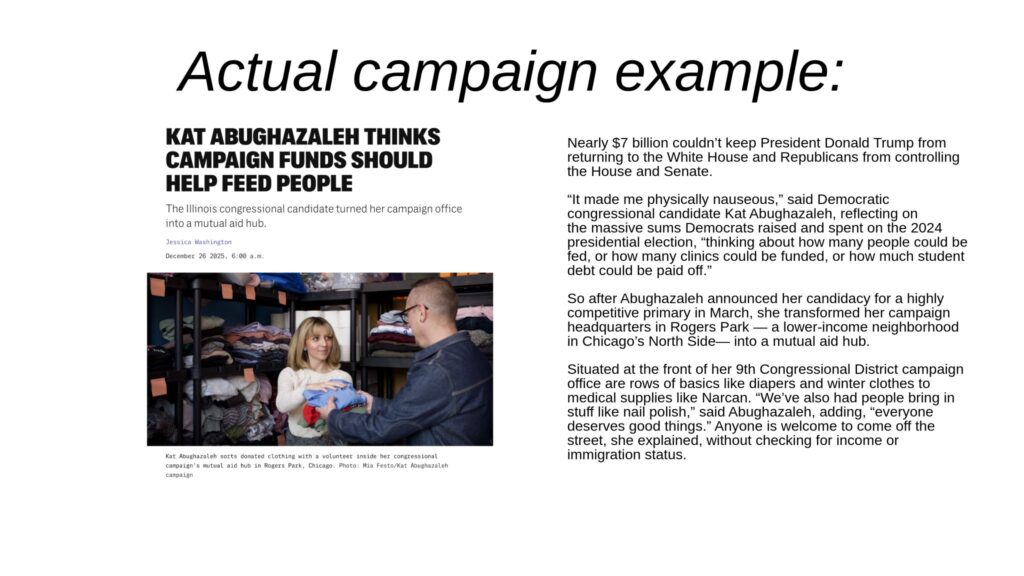
Actually, never mind using your imagination. I invite you to have a look at Democratic congressional candidate Kat Abughazaleh's campaign, which came with a brilliant idea: investing campaign donations into a mutual aid hub, at a time politicians come under fire for being out of touch with the concerns of ordinary Americans. The initiative was a hit! This is how an activist does campaigning. Take that, establishment candidates!
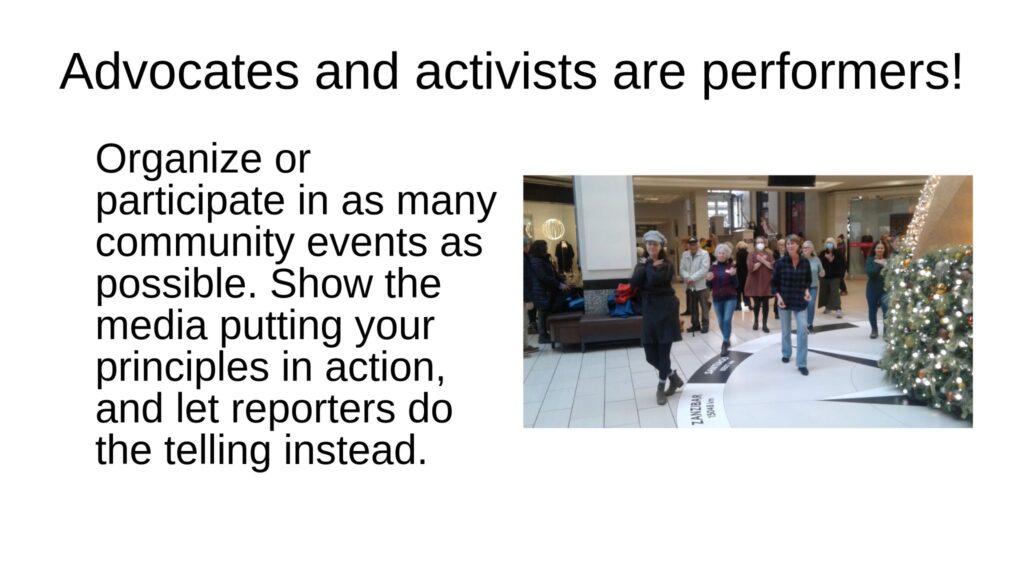
The above picture shows Elders for Ancient Trees, an activist group founded by Fairy Creek protesters supporting old growth forests. I volunteered for their campaign to promote the upcoming United for Old Growth rally. Their chosen approach was to reach out with flash mobs in shopping malls and food courts. At first I was sceptical; seriously, flash mobs??? Well, it was a hit! Crowds loved the concept, the media were all over it, even security guards were mesmerized! I swear those in attendance were snatching flyers off my hands, eager to find out what it was about!
This advice goes against the grain. We're being told that appeal to emotion is wrong, and rational arguments are the way to go. I beg to differ. Ultimately, humans are driven by instinct and passion. Win over voters by telling a story they can relate to.
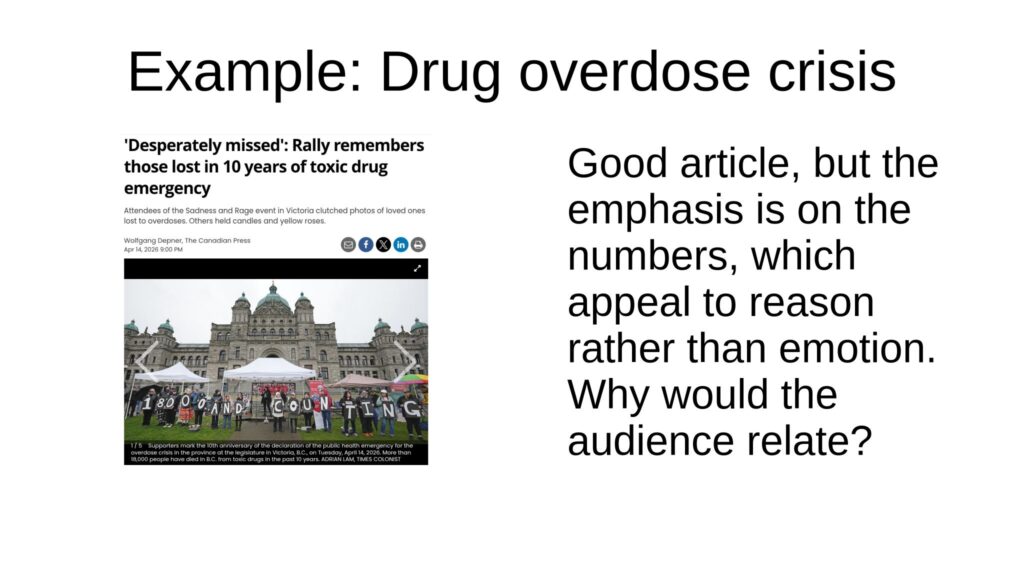
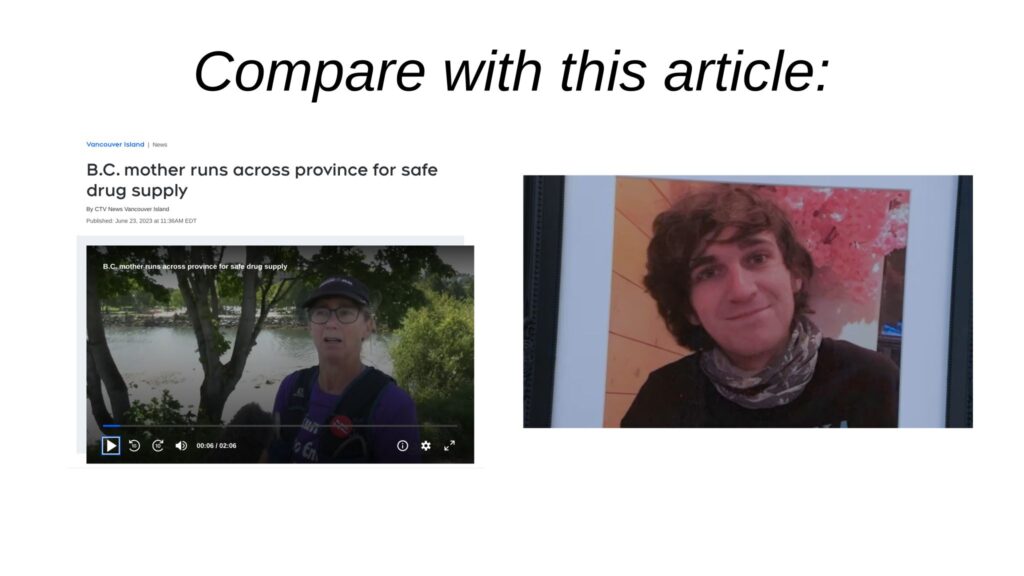
Not long ago the province commemorated the grim tenth anniversary of its opioid overdose state of emergency, which left 18,000 people dead with no solution in sight. There was extensive media coverage of the events, including a rally at the Legislature putting emphasis on the current tally of victims. This was good, but we can do better. Think about it for a moment: why would the public in general care about 18,000 strangers? Or to put it very bluntly: why would an apathetic public care about 18,000 stereotypical junkies? Because let's be frank: drug user advocates' worst obstacle is public perception.
So let me tell you the story of Jessica Michalofsky, an ultramarathoner who ran across the province to raise awareness of the crisis with rallies in municipalities along the road. Except her approach wasn't to emphasize the numbers: she instead took her dead son's picture with her, that of an emeritus law student with curly hair and a winsome face, the prodigal son every parent wish they had. This had a profound impact on the public, because it burst the bubble of many who harboured prejudice based on the junkie stereotype. People may feel indifferent at the deaths of strangers, but in general parents care about their own children, so what if they start wondering: this could be my child. Suddenly one dead person with a face prevails over that of 18,000 faceless ones.
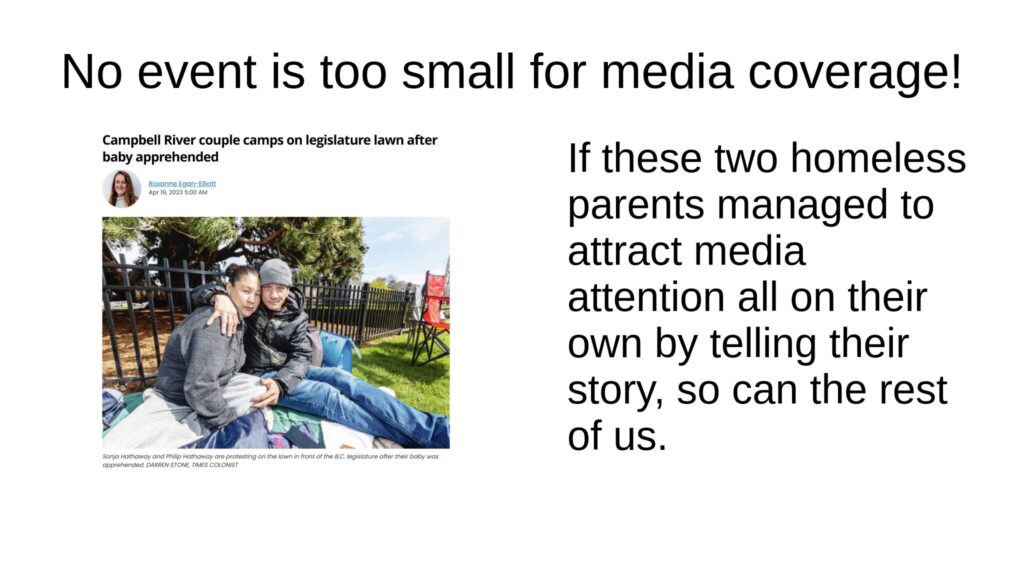
Okay, maybe you won't run across the province for your campaign. But then you don't need to go nearly that far in order to attract media coverage. All you need is a good story, like that of this homeless couple reduced to living on a makeshift boat on the Campbell River, whose newborn baby was apprehended by the government, and who decided to camp on the Legislature precincts in protest. The media were all over it!
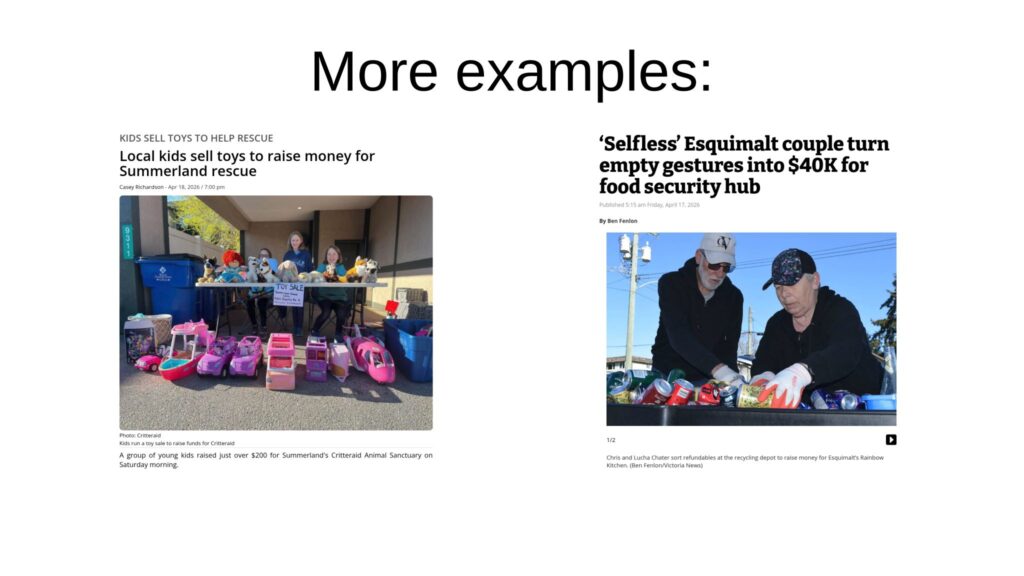
Here's two more examples for those who presume the media won't report on their bottle drive for charity:
Local kids sell toys to raise money for Summerland rescue
‘Selfless’ Esquimalt couple turn empty gestures into $40K for food security hub
Observe that the articles have been published just one day apart. That's because I just stumbled upon them reading the news. I see articles like those all the time. So send your press releases already! Put your principles in action, backed by a cool story, and the media will show up.
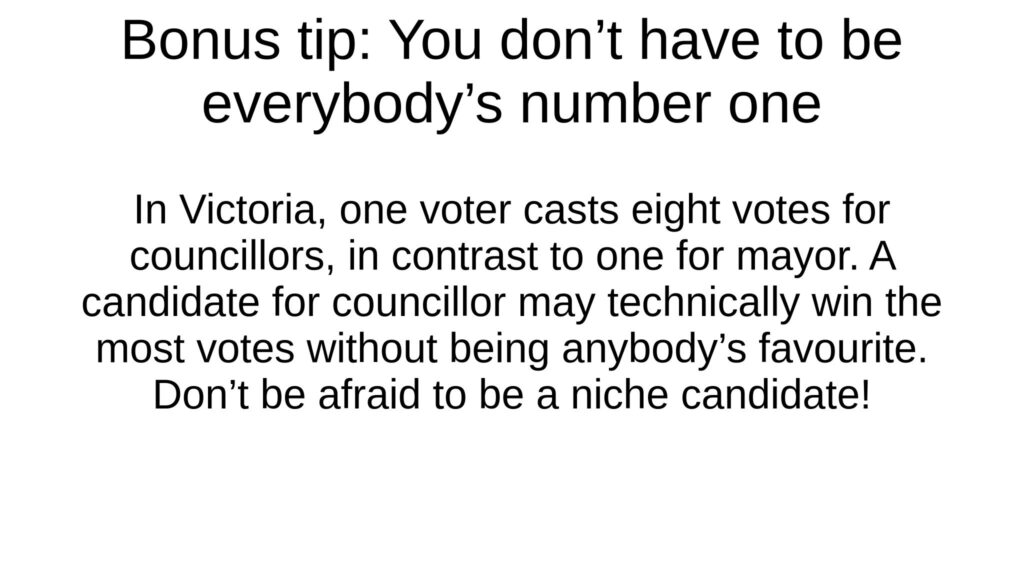
Bonus tip to those running for councillor: it's okay to be a niche candidate. Perhaps you wonder whether you can win because there are better candidates out there, but that doesn't really matter under a system in which voters cast multiple ballots. To illustrate the principle in mathematical terms, it is possible for a candidate to be every voter's second choice (or perhaps even eighth out of eight seats), and still win with the most votes!

Let me know if you have questions. And good luck campaigning!