
Introduction
Unjust laws exist; shall we be content to obey them, or shall we endeavor to amend them, and obey them until we have succeeded, or shall we transgress them at once?
Henry David Thoreau, Civil Disobedience and Other Essays (1849)
Have you ever reflected upon how the rights and freedoms you enjoy today came to be?
If you’re fortunate enough to live in a state whose government doesn’t disappear dissidents or shoot the mob anymore, you may have been taught a magical tale of meliorism in high school. Things just got better over time, of course. The Canadian government loves to cite women’s suffrage as an example of civil right obtained by civic engagement such as petitioning local representatives until they heeded the will of the people out of the goodness of their hearts.1
An objective look at History demonstrates otherwise, as it is replete with examples of peoples who fought, bled, and died so the system would treat them with a modicum of dignity. You may already know of many yourself, even though those stories tend to be either embellished or suppressed.
Likewise, you may have learned in civic class how the legislative and judicial branches of government operate on paper. Yet even mainstream news sources paint a more cynical picture, of a system bogged down by rampant corruption, crass incompetence, toxic ideology, and rabid partisanship. Stories abound of justice being rendered not because state actors suddenly decided to do the right thing, but under pressure from organized movements threatening indefinite escalation.
Just like the history of human rights is the history of wars and revolutions, so is the history of civil rights the history of demonstrations, occupations, barricades, national strikes, and civil unrest. It is the history of advocates who made precedents by breaking the law until the law caught up. It is the history of criminals who challenged the system until vindicated. It is the history of patriots who defied their government until they took over it. And it is the history of whistleblowers who courageously denounced illegal acts committed by their government until it was brought to compliance.
History shows that progressive laws are dictated by the people before they are enacted by the legislative branch of government, that they are enforced by the people against the executive branch of government, and that offences are prosecuted by the people on behalf of the judicial branch of government. There is nothing wrong with that; this is what power by the people, for the people, truly means. A state whose people forgets those fundamentals systematically descends into tyranny.
In the age of Trump and Putin, these findings have never been more relevant, and the need to fight back has never been more pressing. Generations past observe us from beyond the grave, urging us to defend the rights they fought for so we would enjoy them today. Will you be up to the task, or instead be found wanting?
What this book is not about
Given its catchy title, I expect many readers to pick it up for all the wrong reasons.
If nothing else, this work doesn’t teach how to commit the perfect crime for profit. Quite the contrary, most lead actors in this book selflessly perpetrated their acts of civil disobedience in broad daylight, giving their names, and showing their faces, all to further noble causes. If you’re after ideas for your next heist, look elsewhere. Or better still, please consider a more honourable career path.
Also, this is the furthest thing from a so-called sovereign citizen guide. If you’ve been approached by a cult promising you immunity from prosecution by mastering a cabalistic grammar supposed to mesmerize the courts into believing you fall outside their jurisdiction, run lest you get infected by its lunacy. I recommend reading Meads v. Meads2 for a thorough analysis of the phenomenon and ample evidence every single attempt at pleading those arguments in court fails miserably.
Even falling short of the above, some fools might riffle these pages seeking tips to weasel out of their legal obligations because they don’t feel like complying with the law. Although it shouldn’t have to be said given the title, allow me to point out this work isn’t to be construed as legal advice, quite the contrary. Any competent lawyer will warn against embracing the strategies that follow, even when representing activists actually engaging in civil disobedience; see Civil Disobedience and the Law for an extensive discussion of the topic by an American federal judge credited with ending segregation.3 Proceed at your own risk, and don’t come crying if the courts disagree with your defence.
Given these warnings, you might wonder why anyone in their right mind would peruse this work. If you don’t already have the answer by now, this book may not be for you. If you’re still not convinced by the end of Chapter 1, you might as well put it down. Sweet dreams.
Who am I?
I used to be nobody. Then I faked it till I made it.
When I made the jump into activism in 2022, I was unhoused due to an invisible disability. Believe it or not, homelessness was the least of my problems; in my case like in most, that was merely the culmination of a lifelong failure to navigate the system. Whenever I reached out, for help or redress, I was systematically ignored, dismissed, gaslit, or retaliated against. The rest of the time, I was outright ostracized and bullied. And in retrospect, the people who presumed to help me throughout my life proved to be the most toxic of all.
I could merely argue that it was unfair. Since childhood I’d been a boy scout, either literally or figuratively. I didn’t know how to earn people’s respect, so I ended up being looked down upon and exploited. Instead I admit being guilty of all the good I ever did by being pathologically nice.
When I finally blew a fuse, I’d been rotting at a meth cloud-, bed bug-infested transitional shelter for four years. I was among the first admitted when it opened, yet among the last two of that wave to leave. I found it incomprehensible that I, a model resident who got along with everyone and volunteered on the front lines to boot, was left behind when my turn came to get housing and services. I was powerlessly watching myself getting passed by disruptive residents who in contrast weren’t ready for housing, yet moved upward without the support they needed because the establishment wanted to get rid of them, with predictable results.
Likewise, I grew frustrated at the sight of the system’s incompetence and bigotry. Every day I witnessed people getting hurt, sometimes spectacularly, by conceited staff, advocates, and public officials presuming to know better than their clients, their advice sometimes as preposterous as taking hard drugs “just once” to get a positive blood or urine test in order to get disability benefits with a spurious diagnosis of substance use disorder. I regularly denounced people in charge for breaking the rules and even the law, leading to severe and graphic injuries, even death, without finding a channel receptive to my grievances and that of the people I advocated for. The staff didn’t care. The parent nonprofit didn’t care. The government didn’t care. The media didn’t care. Guess how the cops and security detail felt about it. There was no accountability.
In the end, I had to admit I didn’t know how to advocate for myself or others. Yet I wasn’t powerless, merely meek. At some point it dawned on me that if I wanted things to change I would have to earn society’s respect the hard way. I would have to rock the boat. I would have to stop being so damn nice to everyone—especially authority.
Thus began my rebellious phase. In the coming months I started speaking my mind and raising my voice. I rage quit volunteering and made a point of doing so. I broke rules like everyone else and dared those in charge to hold me accountable. I even got into scuffles with law enforcement, and retaliated with legal complaints. For once in my life I felt good about myself.
Even then, I knew I still had to learn how to do it right. I wanted to effect social change, yet I was still unhoused, shit broke, chronically in pain, tired, and sick. I had no relevant experience, training, or education. I had no charisma to speak of and no social network to reach out to, if only due to being extremely introverted. My only assets were a budget laptop computer and the second cheapest tablet on the market—and my brain. My goals were lofty indeed, yet I had reached rock bottom so I had nothing to lose by giving these a shot.
Thus I became an activist blogger (ahem, “citizen journalist”), following only one rule: I am not allowed to chicken out. In the following three years, I documented hundreds of protests on the Rulebreakers blog. I participated in civil disobedience actions, from mass jaywalking and blockades to spending nights in protest encampments. I helped organize disruptive demonstrations, and whispered wicked suggestions in fellow activists’ ears. I engaged in legal observation and breathed on cops’ necks. I became a legal advocate in a private capacity, and sat down as an equal with lawyers. I shook politicians’ hands, and interviewed for the mainstream media. I ended up advocating for causes as eclectic as that of drug users, transgender people, eating disorder patients, old growth forests, and Palestine liberation. Amusingly, only a rare few in my confidence knew the full scale of my activities, even though I cost the taxpayer a small fortune through sheer mischief, and not once did I get arrested nor sued as a result of my activism.
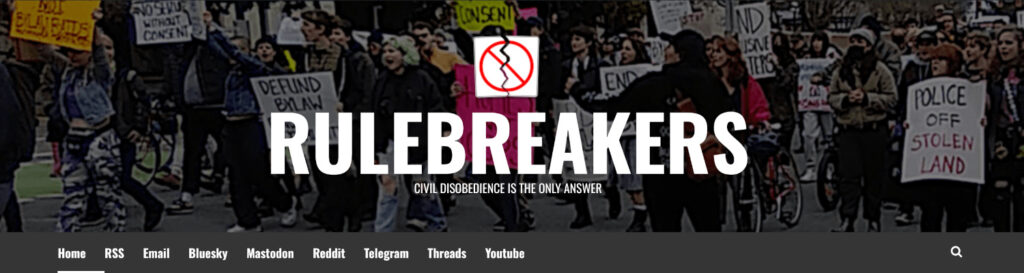
Sadly, I had to take a months-long break, as those years took a heavy toll on my person (see Chapter 12). But I don’t regret any of it one bit. People may never believe just how much influence I wielded as a hobbyist living off welfare in a supportive housing complex (I finally earned housing with obnoxious behaviour!), but the most incredulous of all will always be me; even now, I can still hardly believe that when I look at my own reflection in a mirror, I am no longer looking at a docile piece of livestock.
If I could pull it off, so can you. So buckle up, because I’m about to show you how to do it right, and it will be a wild ride. At the same time, it’s a nice refresher for me as well as I plot a comeback after reflecting at length on what I did wrong so you don’t have to.
Chapter 1: Pioneers of civil disobedience