
Chapter 1
Pioneers of civil disobedience
Would you tell me please, Mr. Howard, why should I trade one tyrant three thousand miles away for three thousand tyrants one mile away? An elected legislature can trample a man’s rights as easily as a king can.
The Patriot (2000)
Civil rights are a rather modern concept.
One could arguably date their inception all the way back to Antiquity. Elementary rights and the principle of natural justice may be traced to the Code of Hammurabi, however cruel it may seem by contemporary standards. Likewise, the right to vote was enshrined in Ancient Greece, albeit in a very narrow fashion. In the Middle Ages, England’s Magna Carta codified basic civil rights and for the first time in History curbed the powers of a monarch, thus setting the foundations for modern constitutional law.
Yet the rights and freedoms peoples of modern democracies enjoy nowadays are about as recent as the radio and television. Just like these inventions, civil rights surged in earnest roughly a century ago and have evolved across generations. Just like telecommunications have come in iterations, each making previous ones obsolete, so have civil rights enactments been amended or replaced over decades. Just like Generation Z folks can hardly imagine living without Netflix and YouTube on flat-screen monitors, so is it difficult for them to imagine living without freedom of expression and movement, the right to vote, the right to challenge one’s detention, or the right to petition the government for redress. And just like telecommunication networks quickly became a battleground for control of political discourse, so is civil rights legislation under perpetual assault by regressive forces.
Seriously, take a moment to appreciate these prerogatives people in relatively free countries naïvely take for granted. Then project yourself a century ahead, and imagine just how prejudiced our generation may look like to future ones as they in turn reflect upon our mistakes and failures. Because this chapter will take you back to when those rights were earned, by visionaries who could only imagine them.
These battles are indeed perpetual, and no country on Earth is truly innocent. Even Canada, lauded as a paragon of human rights, has throughout its history been a colonial genocidal state no better than any that has in contrast been demonized by historians. This country has been built on the forced assimilation of First Nations, their children abducted to residential schools to be indoctrinated in the colonial mindset and their cultural heritage to be wiped out, leaving in their wake evidence of countless horrors from sexual violence to mass graves.1 The last of these boarding schools closed in the 1990s; that was merely three decades ago.
Civil rights legislation we take for granted is often just as recent. The sacrosanct Canadian Charter of Rights and Freedoms was only enacted in 1982, and its previous iteration the Canadian Bill of Rights in 1960. Before these, Canadians didn’t even have the right to life, safety, and security of the person.
For example, section 179 of the Criminal Code, outlawing vagrancy, was only found unconstitutional in 1994 by the Supreme Court of Canada (ironically not in an actual vagrancy case),2 and the provision remained dormant in the Code until 2019. Even nowadays, indigence remains largely illegal, although no longer outright criminalized, and the right of the homeless to shelter from the elements is under constant assault by municipalities throughout the country, some hell bent on rolling back legal precedents affirming it.
Likewise, therapeutic abortion used to be a criminal offence in Canada until 1969, and even that revision was ruled unconstitutional in 1988 by the Supreme Court of Canada.3 Before these developments, pregnant women often faced impossible choices in which they and medical practitioners alike were reduced to life-threatening acts of civil disobedience while facing imprisonment. To this day, abortion remains the topic of political debate, and in the United States is outright threatened following the Supreme Court’s 2022 Dobbs decision, overturning landmark precedents.4
And it hasn’t been very long since gay sex was decriminalized. It took Everett Klippert’s failure to appeal his dangerous sexual offender status before the Supreme Court of Canada in 1967,5 over a conviction for consensual sex among men, for public outrage to compel Criminal Code revisions decriminalizing homosexuality in 1969,6 while the offence of gross indecency proper lingered until 1987.
Even these minimal rights remain far from universal. Venture abroad, beyond tourist enclosures, and you will find regions in which basic human rights are mere whispers, if not urban legends. From medieval theocracies to Orwellian enclaves, many states treat their citizens like chattel and ruthlessly stifle the merest waft of dissent—often with the complicity of those same First World countries, including paragon-of-human-rights Canada.
The civil rights revolutions
This book argues, from its very title, that civil rights were earned with civil disobedience. While it may make some people frown, the statement is hardly controversial. Many iconic characters, once labelled terrorists for their radical platforms, are nowadays celebrated by governments worldwide, some even having earned the Nobel Peace Prize. Speaking of which, allow me to enumerate a few recent laureates:
- 2023: Nargez Mohammadi, for her fight against the oppression of women in Iran and her fight to promote human rights and freedom for all. She was arrested 13 times and sentenced to 31 years in prison and 154 lashes.
- 2022: Alex Bialiatski, for documenting the human rights abuses of Belarus’ Lukashenko regime. He has been incarcerated since June 2021 and since sentenced to ten years in prison for financing actions violating public order.
- 2021: Maria Ressa, for exposing the abuse of power, use of violence and increasing authoritarianism of Phillipines’ Duterte regime, particularly its murderous anti-drug campaign.
These are indeed a sample of a sample, all but a rare few among those deserving awards ever to be recognized. More illustrious examples, which you’ve certainly heard of and probably studied in high school, include Nelson Mandela, Desmond Tutu, Mahatma Gandhi, Rosa Parks, and Martin Luther King. Throughout this book I commend their example with apprehension, sometimes even advising against their chosen course of action. This isn’t necessarily to be interpreted as an act of censure, however. It is easy for those living comfortably in peaceful countries, enjoying rights and freedoms earned by others, to criticize the actions of pioneers who lived through turbulent periods and learned lessons the hard way, without the benefit of hindsight.
My point, however, is that most of these figures arguably did not get away with their actions. Remember this book’s title: “How to break the law and get away with it” [emphasis added]. Belated vindication isn’t good enough; our goal is to outsmart the system, and that means improving upon our predecessors’ formulas to take advantage of the rights and freedoms we’ve been granted, even as they come under attack.
Drug policy
Protest is like begging the powers that be to dig a well. Direct action is digging the well and daring them to stop you.7
Ann Livingston
Before proceeding any further, I would like to make a parallel between law and language. Both are codified and applied stringently, yet neither is the ultimate authority they are often portrayed as. While linguists may normalize languages, they do not by themselves build them, they merely keep up with their contentious evolution. New words are added to dictionaries every year due to popular use by younger generations, even as they make older generations cringe.8
The same goes for law, which is usually made on the ground by activists until the text of the law is revised to reflect established practice—quite literally by this Los Angeles activist who got arrested and charged with vandalism in December 2025 for painting crosswalks at dangerous intersections.9 The only notable difference between them is that there is no actual ‘grammar police’ whereas governments take themselves a bit too seriously in enforcing their prerogative.
One perfect example is drug policy, which has been pioneered by outreach workers and rogue medical practitioners long before governments begrudgingly scaled back their strictures to allow for what most people are guilty of or even owe their lives to. Of course alcohol prohibition in the United States comes to mind, although for the purpose of this work I would rather focus on Vancouver’s Downtown Eastside (DTES) hard drug crisis.
The government of British Columbia declared a public health emergency pertaining to the opioid overdose crisis in April 2016, in response to the explosion of deaths resulting from unregulated street drug use.10 The month before, Health Canada had reclassified the lifesaving medication naloxone to make it available without a prescription. Nowadays the black kit is ubiquitous, even mandatory in many workplaces in Ontario under the Occupational Health and Safety Act (OHSA),11 and is credited with saving countless lives from overdoses of the powerful opioid fentanyl. Public acceptance only grows with news coverage and public inquiries into overdose deaths, such as that of a student at the University of Victoria in January 2024.12
Prior to this, however, the use of naloxone outside of clinical settings was illegal, and while this recent development may look natural, it actually resulted from decades of DTES activists forging a relationship with multiple levels of government, by either working with them or fighting them, in order to get things done. Ann Livingston, a veteran activist who’s been at the forefront of the drug policy debate since the 1990s, once commented: “My whole premise for health care is that you have to break the law or you don’t get anything.”13 She gave a lecture in June 2023 titled How Drug User Mobilization Changes Drug Policy: Compassion, Organizing & Empowering People Who Use Drugs, Civil Disobedience & Research14 which expands on the idea that Canada’s drug policy was forged by criminals set on saving lives.
Let’s rewind all the way to needle exchange programs. While politically correct sources set Canada’s first sanctioned program in Vancouver in 1989, it actually started the year prior as an unsanctioned initiative run by John Turvey, a recovering heroin addict on a mission to curb the transmission of HIV among people who use drugs; only then did every level of government decide to sanction and fund the endeavour.15 Livingston, in her lecture, reasoned it was easier to gain government approval for an initiative that was already underway than to merely submit an unimplemented idea. Turvey would later be admitted to both the Order of Canada and the Order of British Columbia for his advocacy.16
The community started organizing in earnest in 1998 with the founding of the Vancouver Area Network of Drug Users (VANDU), which has since sparked multiple grassroots programs, academic studies, and court challenges.17 For instance, it was pivotal in the creation of Insite, North America’s first sanctioned supervised injection site in 2003,18 and in the legal saga that ensued when Health Canada rescinded its exemption under the Controlled Drugs and Substances Act in 2011, a decision which the PHS Community Services Society escalated all the way to the Supreme Court of Canada.19 VANDU was in contrast unsuccessful in its human rights challenge of a neighbourhood security program run by the Downtown Vancouver Business Improvement Association (DVBIA), the gist being that it unduly targeted people with disabilities (including of course substance use disorder patients) and those of indigenous descent, both groups disproportionately represented among the homeless population of the DTES.20
British Columbia’s public health emergency being nearly ten years old with no end in sight,21 the struggle to save the lives of DTES drug users continues, fought on multiple fronts. One is that of the defunct Drug User Liberation Front (DULF),22 a compassion club whose founders Jeremy Kalicum and Eris Nyx were recently convicted of drug trafficking after distributing tested drugs from the black market in order to avoid contaminated supplies, the primary cause of overdoses. The convictions are on hold pending the outcome of a court challenge of Health Canada’s decision to refuse DULF an exemption to the Controlled Drugs and Substances Act.23
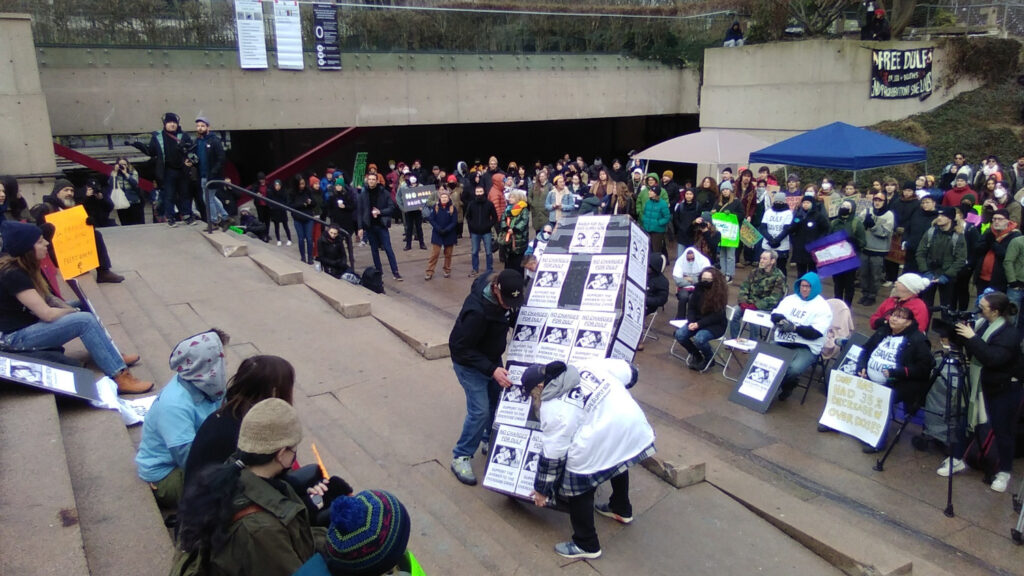
Another front is that of psychedelics, led by the Strathcona Tea Society’s Medicinal Mushroom Dispensary advertising products containing psychoactive substances such as psilocybin at its brick-and-mortar store. In a hilarious twist of events, the City of Vancouver recently failed to close the store, the Provincial Court ruling in July 2024 that the municipal inspector did not collect evidence the store was actually selling products containing psilocybin.24 Even a police raid and blanket seizure in November 2023 did not put the store out of business;25 the society in fact presumes to recover the money the government claims for civil forfeiture as the proceeds of crime.26
Some battles instead end tragically. For instance, Jerry Martin died of an overdose in June 2023, just weeks after his own attempt at a store selling a safe drug supply (this one mobile, instead of a brick-and-mortar storefront, or a clandestine venue) was immediately shut down with a police raid and arrest for drug trafficking. He looked forward to challenge his arrest in court,27 but alas the dead have no standing to file constitutional objections, even though paradoxically there can be no stronger argument supporting a claim of violating one’s right to life, safety, and security of the person guaranteed by the Charter.
The war on drugs isn’t fought only in Vancouver. In June 2015, the Supreme Court of Canada ruled in favour of the Victoria Cannabis Buyers’ Club, in a decision which asserted the legality of edible medical cannabis products28 and paved the way to the legalization of cannabis in October 2018.29 The compassion club’s legal troubles are far from over, however, as it is appealing a $3.2-million fine issued by the Community Safety Unit for selling cannabis without a license.30
More recently, a group of rogue health care professionals called Doctors for Safer Drug Policy has repeatedly operated unsanctioned overdose prevention sites near hospitals across Vancouver Island (quick geography lesson: the city of Vancouver is on the mainland, across the Strait of Georgia from Vancouver Island), starting in November 2024.31 One of them resigned from Island Health in February 2025 after being placed on administrative leave over her public advocacy work.32
The Section 504 sit-in
A more disruptive example of this dynamic is illustrated in the short documentary The Power of 504, which is readily available online,33 and in my opinion should be part of mandatory civic education in school because it shows the last available civil remedy when petitioning one’s local representative fails.
Section 504 of the Rehabilitation Act of 1973 in the United States was a landmark victory for the rights of people with disabilities, which was meant to prevent discrimination against the disabled, at least by institutions receiving federal funding, and would become the precursor to the modern American with Disabilities Act (ADA). The text of Section 504 began as follows:
No otherwise qualified individual with a disability in the United States, as defined in section 705 (20) of this title, shall, solely by reason of his or her disability, be excluded from the participation in, be denied the benefits of, or be subjected to discrimination under any program or activity receiving Federal financial assistance or under any program or activity conducted by any Executive agency or by the United States Postal Service.
It was a modest step forward, which should nevertheless have rejoiced disabled people across the country. Instead, it proved to be a hollow victory, since by 1977 Section 504 had yet to be implemented, due to what could only be construed as obstructionism; the ultimate slap in the face was when Secretary of Health, Education, and Welfare (HEW) Joseph Califano set up a task force to “study” the implementation of Section 504, which did not feature anyone with a disability. It’s like a committee on women’s rights without women, or on Indigenous rights without Indigenous people.
So disabled people decided to organize mass protests across the country. Of particular significance was the sit-in that took place in a federal building in San Francisco starting April 5 until Califano stopped procrastinating and signed the regulations on April 27.
Try to picture in your mind cramming about 150 disabled protesters with limited mobility occupying a building not meant to be accessible by them to begin with, and having them stay 22 days with scarce access to sanitation and arguably even supplies, besieged by law enforcement pondering its next move with utmost circumspection while itself beset by supporters and journalists. And yet the protesters were dead set on staying until Section 504 was signed and implemented. Of course that worked both ways: HEW Secretary Joseph Califano was himself besieged during the whole time, and his stalling tactics quickly wore off.
A news announcer immortalized the standoff as follows: “They’re tired. They’re grubby. They’re uncomfortable. But their spirits are soaring.”34
The brilliant aspect of this strategy was precisely that the protesters had mobility impairments, which made the prospect of removing them by force particularly complicated and perilous—the building’s inaccessibility worked both ways, after all—while buying them considerable sympathy capital. Another aspect that was crucial to the sit-in’s success was public support, including logistics implemented by political and charitable organizations, and of course the considerable media coverage which would put unbearable pressure on the federal government.
Everybody a felon
Can you guess who else is a civil disobedience pioneer? You are, my dear readers, who live in barbaric times by the next century’s standard, experiencing struggles that shall only be settled generations down the road. Expect those generations to be embroiled in battles for rights that are difficult to fathom by contemporary norms, just like we shriek in horror whenever some backwater country such as Uganda brings back the death penalty for sodomy from the dustbin of History.35
There is plenty to choose from in the morass of overreaching laws that make every single one of us a criminal, to the point that civil rights lawyer and Harvard University professor Harvey Silverglate famously wrote at length about how the average American obliviously commits three felonies a day.36 In my estimation, this figure may actually be an understatement, especially nowadays under the exponential explosion of regulations surrounding technology and evolving social norms (more about that in Chapter 7). Ask the Florida man who in late 2025 wrongfully spent a night in jail and faced a misdemeanor charge because his rental car’s license plate frame partially obscured the first letter of “Sunshine State” how he feels about this.37
Not convinced? I’m about to demonstrate how every one of you, my dear readers, is a felon and a sex offender, even by contemporary democratic standards, by opening as an example the unseemly Pandora’s box of child pornography legislation. To be sure, citizens of conscience are nearly unanimous about child pornography being an obscene scourge, and rightfully so. The point of contention here is the pertaining legislation, and its occasional rabid enforcement, which has landed lots of unwary folks in legal trouble. This led the Supreme Court of the United States to strike down the Child Pornography Prevention Act of 1996 as unconstitutionally broad, citing the potential to criminalize award-winning motion pictures like Romeo + Juliet (1996), American Beauty (1999), and Traffic (2000).38
For example, take a look this story of an Arizona couple which in 2008 took pictures of their three babies playing during bath time, and had those developed at Walmart. This shockingly led to the police opening an investigation for sex abuse and the government assuming custody of the children. While no charges were ultimately filed for failure to prove criminal intent, the parents sued Child Protection Services for constitutional violations, in a Kafkaesque legal saga which lasted ten years.39 You’ve read this right: these innocent folks had to fight for every parent’s sacrosanct right to take pictures of their naked babies in the bathtub. My own parents would be branded sex offenders under that legal theory, and so would yours I bet, or yourselves.
Still not convinced? Let’s discuss teen sexting then, an emerging phenomenon which certainly wasn’t envisioned by lawmakers who defined child pornography offences in olden days, or even sextortion ones more recently. And yet examples abound of teenagers being threatened and even prosecuted as sex offenders for sharing nude pictures of themselves—paradoxically making each of them both the victim and the perpetrator40—such as this story from Knoxville in Iowa, in which as many as 25 high school students were investigated by the police for privately trading nude selfies and consequently faced misdemeanor charges.41 On that basis, about half of teenagers nowadays would be branded sex offenders.42 Believe it or not, this sexting teens legal shitstorm has been raging for many years and shows no sign of abating.
And if you think innocent perpetrators can just get away with it by keeping their private pictures, well, private, think again. Nowadays the risk of warrantless electronic device search and seizure by border authorities has made such levity particularly perilous.43 Imagine law enforcement confiscating your phone and sifting through your intimate pictures or questionable pornographic material looking for incriminating evidence, because this may indeed land you in jail next time you go through customs.
This by the way illustrates how the impact of seemingly innocuous civil rights intrusion by the state amounts to more than the sum of its parts. American women were reduced to this realization in the aftermath of the Supreme Court’s aforementioned 2022 Dobbs decision which overturned precedents guaranteeing the right to abortion, when advocates reflected on the potential for online period tracking apps to provide evidence supporting abortion charges should the data be shared with state governments.44 To spell out the liability, this may even lead to criminal charges for miscarriage in certain states, either on suspicion that an illicit abortion took place or simply for improper disposal of human remains.45
Lavrentiy Beria, head of Joseph Stalin’s secret police, is commonly quoted stating: “Show me the man, and I’ll show you the crime.”46 This reduces everyone of us to a closet civil disobedience activist. The law just needs to catch up in acknowledgement that everyone is born a felon—even as it struggles not to regress back to the dark ages nor to devolve into a digital dystopia.
Chapter 2: Vox populi, vox Dei