
Chapter 8
Beware the partisan politics swamp
Write in ‘None of the above’ on your ballot. Don’t vote for any of us. We’re assholes. We’ll only make things worse.
Brewsters’ Millions (1985)
Never trust a politician.
It shouldn’t have to be said. Everybody knows politicians are self-serving bastards, compulsive liars, and rabid pack animals unworthy of trust. This has been the object of countless scandals and endless satire, from Antiquity to this day. I dare go as far as saying that anyone of voting age who still believes what any politician says should undergo compulsory cult deprogramming—my apprehension toward curbing civil liberties be damned.
This isn’t hyperbole. We live in the post-sanity era of Donald Trump, a demented fossil who somehow mesmerized over 77 million American voters into sending him back to the Oval Office in 2024,1 despite his outright calling for an insurrection rather than conceding defeat in the 2020 presidential election.2 A people that believes any part of whatever this convicted felon and raving lunatic farts with his mouth deserves a collective diagnosis of paranoid schizophrenia and prophylactic red pills shoved down everybody’s throat.
And this phenomenon isn’t limited to the United States of America. Think Brazil’s former president Jair Bolsonaro, who was charged with plotting a coup d’état, yet still enjoys massive support from his base calling for his release.3 Think Peru’s former president Pedro Castillo, who declared a state of emergency in order to prevent his impeachment by Congress,4 yet his supporters massively rallied behind him after his arrest.5 Think South Korea’s former president Yoon Suk Yeol, who also declared martial law after attempting to manufacture a scuffle with North Korea,6 yet remained popular enough for his supporters to riot in retaliation.7 And all of these crises occurred within the past five years, in democratic countries.
The masses know they’re being bamboozled by politicians, yet they keep asking for more. I call this collective insanity. Pioneers of voting rights must be turning in their graves.
And activists are by far the biggest suckers of all, going as far as volunteering to get these sleazebags elected. Think Turning Point USA, with over 650,000 lifetime student members scattered over 3000 college and university campuses, all dedicated to supporting Republican politicians—including of course Donald Trump—and whose polarizing founder Charlie Kirk became a martyr for the cause when he was assassinated in September 2025 at a political rally.8
In principle, I never join an organization openly supporting candidates for office, and neither should you. Yet activists are advocates. Advocates are diplomats. And diplomats shake hands with the enemy. Which means as an activist, you will shake hands with politicians. Keep in mind though that these people aren’t your friends, so be wary of being used by them for political purposes; try to use them for your purposes instead, and make them the suckers.
If you can’t beat them, join them
Have you ever wondered why our leaders are the worst to begin with? This is of course a question pondered since Biblical times, specifically in Judges 9:8–15:
The trees set out to anoint a king over themselves. They said to the olive tree, ‘Reign over us.’
“But the olive tree said to them, ‘Should I stop producing my oil, with which they honor God and man by me, and go to wave back and forth over the trees?’
“The trees said to the fig tree, ‘Come and reign over us.’
“But the fig tree said to them, ‘Should I leave my sweetness, and my good fruit, and go to wave back and forth over the trees?’
“The trees said to the vine, ‘Come and reign over us.’
“The vine said to them, ‘Should I leave my new wine, which cheers God and man, and go to wave back and forth over the trees?’
“Then all the trees said to the bramble, ‘Come and reign over us.’
“The bramble said to the trees, ‘If in truth you anoint me king over you, then come and take refuge in my shade; and if not, let fire come out of the bramble, and devour the cedars of Lebanon.’9
In short, we have the leaders we deserve, because we don’t run for office ourselves. For all our bravado, in the end we’re cowards.
Of course you may think you can’t run for office. I myself could come up with fifty different excuses, starting with being a disabled government suckup living in a supportive housing complex, who can hardly take care of himself, and at this rate may not live to the age of retirement. Well, I’m about to run for office anyway, because I’m tired of trying to figure out what exactly it is going to take to break our elected representatives’ will to fight—only to be replaced by the next wave of wannabe autocrats. And if you think my campaign is a Hail Mary, well I knew someone who ran for Victoria’s city council while homeless. So what’s your excuse.
You may argue that you don’t know anything about politics. I say that if you know anything about activism, that’s a good start. From there I would only recommend one political treatise: a manga titled Sanctuary, by Fumimura and Ikegami. It’s about two Japanese men who, back when they were mere orphan boys, survived Cambodia’s Khmer Rouge regime by fleeing a forced labour camp until they reached the Thai border. Out of dismay over Japan’s contrasting state of decadence, they choose to take over the country with a wild gamble: one takes the high road and becomes a politician, the other the low road and does all the dirty work as a yakuza. The following panels highlight the clear link between politics and activism:

Seriously, an activist is a criminal who gets away with it. Activism and politics aren’t so different from karate, or organized crime for that matter, so you already know the basics. Read the whole manga for details (English translation published by Viz Graphics, for those of you who can’t read Japanese).
To expand on this angle, consider the duality between political and militant branches of revolutionary movements, such as Ireland’s Sinn Féin and the Ireland Republican Army (IRA), or the Colombian Communist Party and the Fuerzas Armadas Revolucionarias de Colombia (FARC). Likewise, it is common for environmental activist groups to ally with their local Green Party, for example. A political branch provides activists with legitimacy, without which they would be exposed in the court of public opinion, just like without such support armed revolutionary groups would be mere terrorists and criminal gangs.
Of course you’re waiting for the catch. If it were so simple, then activists would have long done it and taken over the world, right? Well, in a sense they did take on the world, and that’s where the picture gets murky. Because you should indeed never trust a politician, even one with an activist background. Seriously, not even Nobel Peace Prize laureate Maria Corina Machado, Venezuela’s opposition leader bravely standing up to the Maduro regime—if only because she’s aligned with Donald Trump and shockingly dedicated her prize medal to him,10 in the misguided political gamble that the enemy of her enemy is her friend.
David Eby versus Anjali Appadurai
In October 2022, I attended a press conference at the Legislative Assembly of British Columbia in Victoria, called by British Columbia New Democratic Party (BC NDP) leadership candidate Anjali Appadurai in response to her candidacy being rejected by the party executive mere hours before the scheduled vote, thereby electing Premier David Eby by acclamation in a blatantly antidemocratic fashion.11
Since the event started hours late, I had ample opportunity to chat with Appadurai’s supporters, mostly volunteers of the political activist group Dogwood, some of whom had been ardent supporters of Eby in the old days of the NDP, only for him to become their biggest disappointment.
David Eby rose to prominence as a civil rights lawyer, first working for the Pivot Legal Society, then as the executive director of the British Columbia Civil Liberties Association (BCCLA). He continued to champion progressive values and social justice as Attorney General under then Premier John Horgan, who a few years later left politics amid public backlash,12 and Eby was propelled upward to premiership by the resulting vacuum.13
But by then the NDP was no longer an upstart party championing progressive values. It had grown into the establishment, and repudiated its previous ideology in favour of corporate agendas. Eby’s reversals on the opioid crisis and carbon tax in particular had his erstwhile supporters feeling outright betrayed by a former paragon of justice.14
This paved the way to Anjali Appadurai’s candidacy for party leader, who ran primarily as a climate activist and espoused a vision of returning the NDP to its roots.15 For this purpose she harnessed Dogwood and 350.org to crowdfund her campaign, a point of contention with the party leadership which called out the tactic as a breach of election law and used it as an excuse to terminate her race, perceived as a hostile takeover.16 Appadurai’s supporters seethed at this assertion, rich indeed coming from a party actually hijacked by corporate interests.
Appadurai accepted the decision with philosophy, and decided to remain in the NDP in an attempt to change the party from within.17 This gave me the impression that she wasn’t actually serious about championing the values of her supporters and instead prioritized her career prospects; otherwise she would have left the party in outrage and started her own political faction, or challenged her disqualification in court. Her supporters may have indeed been suckered into backing the next David Eby instead, as I’m about to explain.
Steven Guilbeault
Perhaps the above two don’t really count as activists in your playbook because they didn’t rock the boat hard enough. So let’s make our next subject someone who rose all the way from stunt performer to environment minister.
Steven Guilbeault started his career in 1992 by joining the Canadian Human Rights Foundation (nowadays Equitas), an organization training human rights defenders worldwide. He then moved on by co-founding Action for Solidarity, Equity, Environment and Development (ASEED; nowadays Équiterre), and later joined Greenpeace’s crusade against climate change. Already by then his résumé dwarfed that of David Eby prior to the latter’s foray into provincial politics, and he was just getting warmed up.
Guilbeault rose to fame for two spectacular actions. In 2001, he climbed the CN Tower (at the time the world’s tallest construct) with a fellow activist and dropped a banner reading “Canada and Bush Climate Killers” from 340-metre high, for which they were charged with trespass and public mischief and received conditional discharges.18 Then the next year he, as part of a Greenpeace crew, climbed Alberta Premier Ralph Klein’s home roof to install solar panels, and dropped another banner reading “Solar Fights Drought. Kyoto Now” (alluding to the Kyōto Protocol, an international treaty to reduce greenhouse gas emissions).19
He went on to work for the government of Québec in various capacities. By the time he made the controversial decision to run for office under the banner of the Liberal Party of Canada in 2019,20 he was already proving impossible to ignore in political circles, and immediately earned the position of Canadian Heritage minister upon being first elected.21 Talk about a dream career path for a modest activist.
But the dream wouldn’t last, as multiple controversies tarnished his reputation among supporters. For starters, he backed the Online Streaming Act, which was sharply criticized for its potential to stifle free speech on social media by classifying those platforms as online broadcasters for the purpose of the Broadcasting Act. Former commissioner of the Canadian Radio-Television and Telecommunications Commission (CRTC) Peter Menzies lamented that “granting a government agency authority over legal user generated content—particularly when backed up by the government’s musings about taking down websites—doesn’t just infringe on free expression, it constitutes a full-blown assault upon it and, through it, the foundations of democracy.”22
Guilbeault was promoted to environment minister in 2021, a tenure which also proved contentious. The next year he reluctantly approved the Bay du Nord offshore drilling project, about as popular among environmentalists as shigella infections.23 Naturally, Ecojustice immediately filed a legal challenge to the legislation, doing so on behalf of the Sierra Club of Canada and… Équiterre, which Guilbeault co-founded as mentioned earlier.24
In an ugly breakup with Prime Minister Mike Carney, Guilbeault resigned as environment minister in late 2025 over an Alberta energy deal which he denounced as the last straw.25 While it’s nice to see him finally get a backbone, the morale of the story is that the only ethical course of action for an activist politician who joined an establishment party is to indeed resign.
Mohamed Morsi
Here’s a parallel with some of the pioneers mentioned in this book, especially Nelson Mandela (see Chapter 1), if not for the fact that this one instead disgraced himself upon reaching the apex of power. Both Mandela and Morsi had a poor upbringing, then pursued a Western education, became activists challenging the establishment’s civil rights violations, were branded criminals and spent time in prison, only to rise as presidents of their respective countries. If only Morsi had died at that point, he would be fondly remembered as yet another folk hero who deserved a posthumous Nobel Peace Prize, would there be such a thing.
One could argue that Morsi began his political career with the best of intentions, being to advance religious freedom in Egypt, harshly curbed under secular military dictatorship. He got elected to Parliament in 2000, officially as an independent since the Muslim Brotherhood was outlawed.26 Following the fall of the Hosni Mubarak in 2011 during the Arab Spring wave of civil unrest and revolutions that swept the Middle East, Morsi and other formerly ‘independent’ politicians formed the Freedom and Justice Party and seized power in the country’s first democratic elections, espousing a platform of “freedom, social justice, and equality” inspired by Sharia law.
Never in my knowledge has such a golden opportunity to advance social justice been more appallingly squandered than by the Morsi presidency.27 The Egyptian people had high hopes for the new government, millions having one year ago braved the military regime of Mubarak by massing at Tahrir Square in Cairo in January 2011.28 They certainly did not expect to come back in June 2013, barely one year after Morsi’s election, demanding his resignation—and ironically the return of military rule.29
But Morsi just couldn’t help himself, and his own autocratic ambitions quickly surfaced. He assumed absolute power pending the ratification of the upcoming republic’s constitution,30 a decree which he had to rescind amid public outcry.31 The president nevertheless alienated his allies by acting like a dictator,32 concentrating power in the hands of the Muslim Brotherhood and pushing for a disproportionate role for Sharia in the legislative process. His tone-deaf approach to governance earned him the derogatory moniker of “new pharaoh” by detractors fearing the utter collapse of secular society and the rule of law, while in contrast failing to placate the hardline Salafist faction which formed the main opposition.
Naturally he was himself overthrown in another coup d’état, and his diehard supporters, defiant to the end, were crushed in August at the massacre of Rabaa, where hundreds were killed or wounded.33 He was succeeded in 2014 by General Abdel Fattah el-Sisi, who ruthlessly ruled Egypt henceforth by outlawing unsanctioned protests and resuming persecution of the Muslim Brotherhood.34 As for Morsi, he died in prison in June 2019,35 years into a judicial saga which had him condemned to lengthy prison sentences and even death, the latter which was overturned amid allegations of glaring irregularities in the proceedings, decried by human rights groups worldwide.
Some political commenters have since attempted to redeem Morsi,36 but I will always remember him as yet another opportunistic politician who conspired to replace one dictatorship with another and failed because he was too dense to read the room.37 Let that be yet another reminder that politicians should never be trusted, even when they champion civil liberties—and the alternative is military dictatorship.
Rainbow Eyes
Still looking for a unicorn? Then at least take your chances with one that remains an activist even as a political leader. Which takes me to Green Party of Canada deputy leader Rainbow Eyes.
Indigenous activist Angela Davidson rose to prominence with repeated acts of civil disobedience at Fairy Creek between May 2021 and January 2022, by disrupting forestry company Teal Jones’ old growth forest cutting activities. She was subsequently convicted of contempt of court for defying an injunction and sentenced to 60 days in jail, reduced to 51 days by the Court of Appeals.38 She further appealed to the Supreme Court of Canada, on the grounds that the Court of Appeals decision insufficiently weighed the Gladue39 factors, which pertain to the lasting impacts of colonialism on indigenous peoples;40 the court declined to hear the case.41
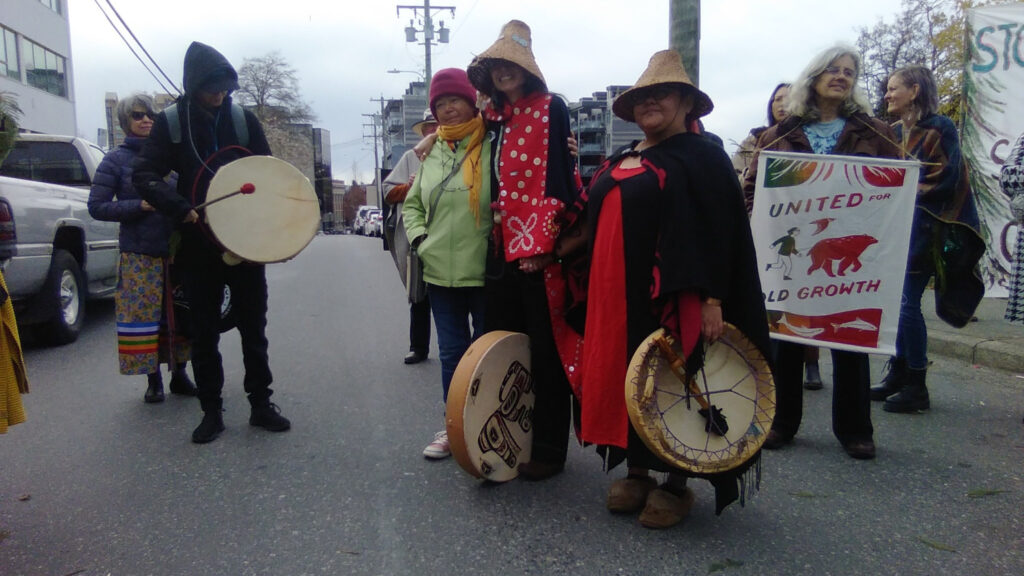
I met Rainbow Eyes in person at the Nanaimo Courthouse in April 2024, on the first day of her sentencing hearing. She struck me at first glance as someone incapable of malice. It is worth noting that, although she ran for Member of Parliament for the Northwest Territories in 2025, she utterly lost the election (in fourth place, getting just one percent of the votes), and has actually never held public office. I am inclined to conclude that such a unicorn lacks crucial traits to actually win an electoral race—unlike Green Party of Canada leader Elizabeth May, whose reputation was marred by allegations of workplace bullying.42
Trust me instead?
But then I’m the exception, trust me. I’m an earnest activist politician, with the fighting spirit needed to break through in the political arena. My bedside book is Il Principe by Niccolò Machiavelli—in medieval Italian at that—so I know how to win and be a compassionate ruler. Of course I never lie, and those who claim otherwise either misunderstand or misrepresent me. Seriously, I am a rainbow unicorn. There’s never been a rainbower unicorn in the history of this country, and naysayers are the worstest of the worst. So make this country greater than ever by voting for me!
Oh, you’re concerned about the statements I made first thing in this chapter? Come on, there’s no way I would actually have anyone of voting age who still believes what any politician says undergo compulsory cult deprogramming while shoving red pills down their throats. I was obviously just kidding. It’s all part of the game.
Right?
Chapter 9: All Cops Are Bastards