
Chapter 9
All Cops Are Bastards
Tom Ludlow: “What happened to just locking up bad people?”
Captain Jack Wander: “We’re all bad, Tom.”
Street Kings (2008)
ACAB. Spend any long in activist circles, and you’ll see that acronym all over. Because law enforcement officers are lawbreakers’ natural enemies.
While distaste of cops is nearly unanimous, activists differ greatly on how to approach them. On one end are advocates embracing diplomacy and even entertaining a cordial relationship with the police, in an attempt to lull it into complacency. On the other end are those who bristle at the slightest suggestion of dialogue and brand outliers as outright traitors.
I stand somewhere in the middle. An activist is an advocate. An advocate is a diplomat. And a diplomat shakes hands with the enemy. If you’re serious about taking on the system, you will shake hands with cops, however repugnant the prospect. As a legal advocate, I did shake hands with cops, even as I heckled them.
The police’s reputation for recruiting bastards is well deserved. Even discounting the wealth of studies asserting a higher prevalence of psychopathic traits among police recruits,1 it should be considered common sense that law enforcement is an attractive career prospect for schoolyard bullies and authoritarian predators alike.
Just here in Victoria, both police and bylaw enforcement officers have denounced their respective workplace environments as toxic.2 Our Royal Canadian Mounted Police (RCMP) has been the subject of more scandals than I care to list, including complaints of rampant nudity, sexual harassment, and bullying at its Ottawa explosives training unit;3 female officers suffering shocking levels of sexual assaults;4 and allegations of gratuitous brutality in suppressing Fairy Creek protests.5 I swear I could write a whole book on police misconduct committed in Canada in recent years alone.
This is of course to be expected. Law enforcement officers’ job description is to go after the worst that society has to offer, from child predators to serial killers, and from mobsters to terrorists. One has to be a psychopath to embrace the job, and an outright sadist to find fulfillment in it. The rare few cops I met who didn’t give that creepy vibe instead gave me the impression they had chosen the wrong line of work, and were indeed the first ones to rage quit complaining of a toxic workplace.
The police’s relationship with activists in particular can turn outright corrosive when undercover officers infiltrate and undermine activist groups. The most infamous of them was Bob Lambert, a British officer of the Special Demonstration Squad who had sexual relationships with four women among those he investigated, and even fathered a child with one of them—even while he was married and had a family of his own. One of the victims would later declare that she felt “raped by the state”.6
No wonder activists indulge in healthy levels of paranoia whenever the police is concerned. But this shouldn’t stop you from engaging with them and even playing their game. If nothing else, their psychopathy means they feed on fear, so don’t show them you’re afraid and already they lose much of their power.
I would also encourage you to learn from their tactics. If nothing else, the police is strong at diplomacy, preferring to cajole and intimidate in equal measure rather than carrying out arrests. Cops are often depicted as brutes, but this is only a narrow aspect of their profile. In practice, they assert their authority mostly using soft power, from so-called ‘copaganda’ to negotiation, and repugn to use force on those who can be reasoned with or deterred. This comes down to pragmatism of course; with a ratio of one officer to hundreds of civilians, the police simply cannot enforce compliance with violence alone. The residents of Ferguson, Missouri, taught their local police department this lesson the hard way in August 2014, leading to the police chief’s resignation and belated reform within the department.7
Don’t talk to cops
Anyone who’s ever watched television knows of the right to silence. In the United States it’s been enshrined as the Miranda8 warning, and goes roughly as follows:
You have the right to remain silent. Anything you say can and will be used against you in a court of law. You have the right to talk to a lawyer for advice before we ask you any questions. You have the right to have a lawyer with you during questioning. If you cannot afford a lawyer, one will be appointed for you before any questioning if you wish. If you decide to answer questions now without a lawyer present, you have the right to stop answering at any time.9
It is indeed considered common sense that talking to cops, especially while formally interrogated, is a terrible idea. From a purely judicial standpoint, this is absolutely correct. In extreme scenarios, psychological pressure alone may lead suspects to confess to crimes they didn’t commit, which may prove extremely prejudicial in criminal proceedings. There even was this case of a California man who in August 2018 was coerced into confessing to murdering his missing father, the interrogators going as far as threatening to put down his dog unless he did, even though the suspect’s father was actually still alive; the municipality of Fontana settled the resulting civil rights complaint for $900,000.10
The United States Constitution’s Fifth Amendment guarantees the right not to incriminate oneself. As a corollary, consciousness of guilt may not be inferred from a suspect asserting one’s right to remain silent. Similar protections exist in most democratic countries, such as Canada under Articles 7 and 11 of the Charter of Rights and Freedoms.11
Seriously, folks: when in doubt, Shut The Fuck Up. Even dismissing the judicial dimension of this quandary, cops are continually attempting to extract information from activists, looking for a way to undermine their operations. I know from experience that they love asking casual questions while pretending to be everyone’s best friend, just to see how much they can glean out of someone, perhaps even looking for a potential informant—especially one who self-compromised after letting an incriminating detail slip in a moment of carelessness.
Do talk to cops
Wait a second: am I contradicting myself with these section titles? After all, I just wrote “Don’t talk to cops” and explained at length why it’s reckless to do so.
Nevertheless, I also stated that, as an advocate at least, you would shake hands with cops indeed. And that means you will talk to them as well, if only for diplomatic purposes. Don’t be afraid to play their game, because as I’m about to explain, the liability works both ways: cops shouldn’t talk to us either, and every time they do so they feed us with information we can use against them. Those of you who’ve had the good fortune to watch the documentary Stop The Sweeps Part I: Policing and Displacement in Vancouver’s Downtown Eastside know in particular that getting cops to talk to the camera can yield golden counter propaganda material.
I admit that the game is rigged in the police’s favour. But that only means we have to play the player instead of merely playing the game. Let’s take advantage of the fact that the system keeps overly smart candidates out of police forces, under the pretext that those who score too high on aptitude tests could get bored with police work and leave soon after undergoing costly training, but actually because it fears that smartass officers would have enough wits to question dubious orders or even blow the whistle. This is even enshrined in jurisprudence in the United States, following a September 2000 decision of the Second Circuit Court of Appeals which allowed a such a policy to stand.12
Seriously, folks, why do you think the police likes to coerce confessions so much? That’s because most officers are too dumb to properly investigate crimes, whereas it’s so easy to break a weakling into admitting guilt.13
It follows that, if you’re of above average intelligence, you can befuddle the police with baffling ease. Believe me, not only aren’t they nearly as clever as they get credit for, many are downright blockheads, and their tactics can easily be turned around. For example, listen carefully to their questions, as these often reveal what they want to know and may amount to admissions that they don’t already know the answer. Also, their very questions can be reversed by answering with questions, thereby putting them on the back foot. Furthermore, I find in practice that many simply cannot process sarcasm, which can be used to undermine their confidence. And with compromising material, you can even make them fear you instead.
Of course I this advice comes with the following warning: Don’t try this at home kids, leave it to professional mentalists. If that’s not you, then either clam up or scrupulously stick to the script. Because every time you mess up, someone might get hurt as a result—and that someone might be you. Remember to always stay sharp around cops, even in casual contexts, because messing with them is an extreme sport.
Beside mind games, another purpose to engaging with the police is de-escalation. Encounters with cops are common at protests, and may quickly degenerate without some quick-witted intervention. Keep in mind that the police is a paramilitary force, and police officers are heavily armed. Here in Canada, they walk around with pistols, sticks, mace, and Tasers, sometimes even assault rifles (I saw one at a Christmas parade, goddammit), and they are trained to use them.
Furthermore, in crisis situations, they are trained not to think, because hesitation means death.14 That means anyone perceived as hostile during an escalating incident may become the target of a reflexive weapon discharge. I strongly recommend defusing potential scuffles by telling tense cops that you won’t do anything reckless, just to get them to relax a little; this one short sentence may actually save your life.
Finally, there’s the matter of advocacy. Sometimes police officers do reckless things, especially when carrying out assignments they’re unfit for, like answering mental health emergencies, and ensuing situations may warrant the intervention of advocates in order to defuse them. Believe it or not, sometimes the police may even welcome the intervention of advocates, especially when the alternative is the use of force. This might have saved Chris Amyotte’s life in August 2022, who died when a Vancouver police officer fired a bean bag gun at him multiple times even though his only crime was to behave hysterically right after having been pepper-sprayed in a separate incident.15
I for one had to intervene, in spite of my reservations, when in May 2024 one of my neighbours expressing suicidal ideation was forcefully apprehended under the Mental Health Act by five cops, four literally piled on top of him, because I was genuinely concerned about his safety and egregious civil rights violations. The next time cops showed up for him, we were able to talk things out in a civil manner instead. This is one example in which goons initially resorted to brutality in part because they simply didn’t know how else to proceed, and in which engaging with them in good faith worked out in the end.
Legal observation
I’ve just mentioned that police officers carry enough gear around their belts to make Batman blush. While their arsenal is fearsome, activists don’t need nearly as much equipment to compete with them, as they are armed with the right to document and record law enforcement activities in public spaces, and all that’s needed is a cell phone camera or a notebook.
Legal observation turns the sacrosanct right to record the police in public spaces into a tool to keep it either honest or accountable. In the United States, the Fifth Circuit Court of Appeals affirmed this right under the First Amendment of the Constitution:
We conclude that First Amendment principles, controlling authority, and persuasive precedent demonstrate that a First Amendment right to record the police does exist, subject only to reasonable time, place, and manner restrictions.16
A similar decision was reached in Canada by the Ontario Court of Justice, affirming the right to record the police and declaring that an order by an officer not to record interactions between the police and the public can be construed as abuse of authority:
An officer who conducts himself reasonably has nothing to fear from an audio, video or photographic record of his interaction with the public. The public has a right to use means at their disposal to record their interactions with the police, something that many police services themselves do through in-car cameras and similar technology. The officer’s powers exist to allow him to protect the public and himself and to enforce the law; they do not extend to controlling the public record of what happened. The maintenance of that public record plays a significant role in the maintenance of the rule of law.17 [emphasis added]
Observe that the last sentence in this quotation directly support one of the premises of this book, which is that the citizenry plays a role in enforcing the law against the executive branch of government. This is the cornerstone of legal observation, enabling the citizenry to curb the excesses of executive power where the judiciary otherwise cannot reach. In other words, the legal observer becomes a witness, collects evidence, and may even be called upon to testify in court proceedings.
The fine prints require careful scrutiny of applicable laws in a given jurisdiction and thus exceed the scope of this book. I recommend anyone interested in becoming a legal observer to attend a training session, which may be accessible either online or in person. These may be hard to come by, as they are seldom broadly advertised, participants of course being wary of retaliation. But spend enough time among activists and such a training opportunity is bound to materialize. These typically last an hour or two and go through the basics of collecting evidence for use in legal cases.
The above notwithstanding, legal observers may be reduced to engaging in acts of civil disobedience in jurisdictions with ordinances restricting the right to record law enforcement interactions in public places by testing the limits of established precedents. For example, multiple US states have passed so-called buffer zone laws setting a minimum distance short of which observers may be compelled to step back, with the clear intent to deter or hinder recording.18 One such law was recently passed in Arizona, only for its enforcement to be blocked by a federal judge.19
Legal observation is currently a very hot topic across the United States, as it forms the first line of defence against civil rights violations by its Immigration and Customs Enforcement (ICE) agency’s masked goons prowling for easy pickings to snatch and deport without leaving a trace.20 This had compelled the Electronic Frontier Foundation (EFF) to issue in February 2025 a statement asserting the right to record ICE carrying out its duties and enumerating the legal basis supporting this stance.21
Nevertheless, ICE officers have earned a reputation for roughshod treatment of legal observers as the factions come in close quarters, especially when officers perform arrests in immigration courthouses, the latter practice being currently the object of a class-action lawsuit.22 In one such scuffle, a volunteer complained of being detained and left with bruises over dubious accusations of assaulting an ICE officer at San Diego’s federal immigration court in July 2025.23 Then in a tragic January 2026 incident in Minneapolis, another ICE officer was recorded murdering a legal observer in cold blood while she attempted to drive away from him.24 Allow me to reiterate my warning to remain sharp at all times around cops, even when exercising one’s legal prerogative in a public space, and to remind you that de-escalation may be your best defence in the event of a standoff.
Protest roleplaying
A well-organized protest has various roles assigned to participants whose duties pertain to police interaction or de-escalation. Of course the legal observer is one of them, even though in principle a legal observer does not engage with law enforcement officers.
This duty falls to a designated police liaison officer, typically the only person to engage with cops, and even then preferably only with the police’s own community liaison officer. These usually shake hands at the beginning of an event or engagement and settle the terms of the factions’ interaction, which include of course strict instructions to participants on either side not to approach the adverse faction, with the understanding that minimizing friction also reduces the risk of escalation and injury.
In a standoff, the police liaison may engage in negotiation with the police on behalf of protesters, although in practice this often amounts to a stalling tactic in order to achieve some objective or prolong a disruptive action. I documented one such action at an intersection blockade near the Legislature in Victoria in May 2023. The whole purpose of the talks was to buy artists enough time to complete commemorative artwork on the pavement and for the paint to dry up, after which participants dispersed in an orderly fashion.25
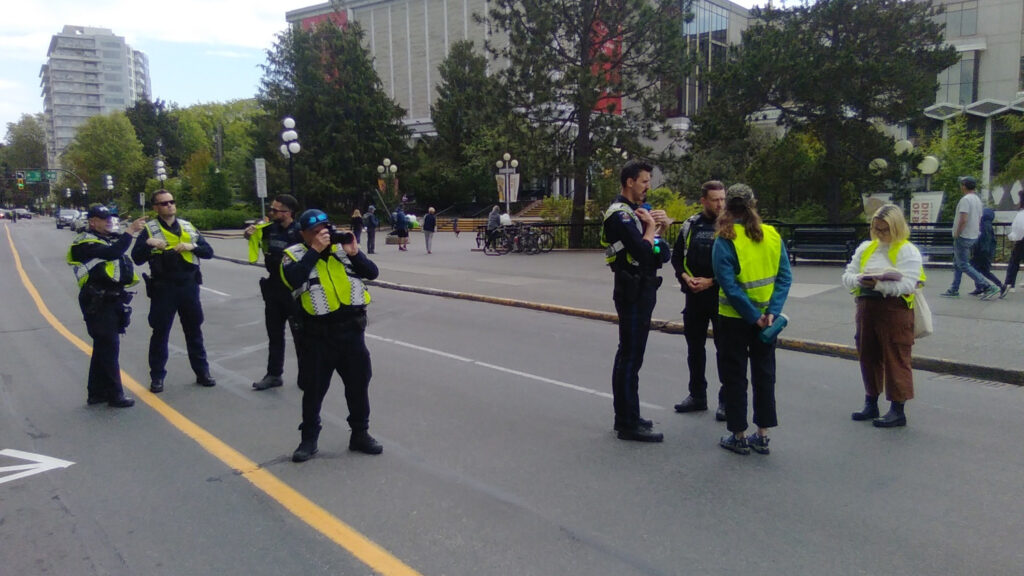
In contrast, wardens do not engage with the police but instead help keep the peace by preventing escalation by protesters, bystanders, and hostiles. In a sense, their role is to keep protesters and the police apart, even though in practice they have no more power than scarecrows wearing high-visibility vests. They are nonetheless instrumental in keeping the peace by dissuading participants from engaging in disorderly conduct.
Some high-risk events may warrant the deployment of street medics, especially when the use of crowd control ordnance such as tear gas or stun grenades is expected. Street medics are volunteers with varying levels of first-aid or medical training who treat the wounded at riots or when the police forcefully disperses a crowd.26 The scope of their practice is detailed in Riot Medicine, a public domain manual written by Håkan Geijer.27
Their role compares to that of medics on the front lines of an actual war, and are usually treated accordingly by the police. That being said, unlike legal observers they do not enjoy specific legal protection. The matter has been settled in the aftermath of Portland’s George Floyd protests in 2020, when protest medics failed to persuade the Oregon District Court to issue a restraining order against the city allowing them to treat injured participants without fear of retaliation by law enforcement.28
Fighting the police
The supreme art of war is to subdue the enemy without fighting.
Sun Tzu, The Art of War
In normal circumstances, I strongly advise against clashing with the police. It is typically far better trained, equipped, supported, and disciplined than even the sturdiest of protester factions, and may call upon nearly unlimited reinforcements when things go out of hands. Even in the rare instances in which rioters rout the police, the endgame is usually unfavourable to them unless they manage to either break the state or overthrow it altogether (like Bangladesh’s Monsoon Revolution);29 otherwise the outcome is far more likely containment, dispersal, and systematic repression by the state apparatus (like Hong Kong’s failed Umbrella Movement).30
Ranks of riot police in particular are known for being able to contain many times their numbers, with tactics such as shield walls, and rarely find themselves overpowered by a violent crowd, while its ‘less lethal’ crowd dispersal arsenal is known to cause severe injury or death—to the dismay of human rights observers deploring the use of tear gas under the domestic use exemption of the Chemical Weapons Convention otherwise banning it from battlefields worldwide.31
Which isn’t to say a disciplined force led by a tactician cannot pull it off. Allow me not to elaborate, within the scope this book, on the various tactics I would use were I reduced to taking on a sizeable police force, for obvious reasons. Just use your imagination.
Instead, I’d like to discuss a specific instance in which such a disciplined faction managed to hold its ground against a police force attempting to disperse it: Atlanta’s Block Cop City march in November 2023.32
Few protest grounds have been more staunchly challenged by the police and activists than the site for Cop City (officially the Atlanta Public Safety Training Centre), a police and firefighter training megacomplex decried as an escalation of the militarization of domestic law enforcement.
Confrontation between the factions made national news with the killing of environmental activist Manuel Esteban Paez Terán, better known as Tortuguita, in January 2023. Tortuguita was fatally shot inside his tent at a protest encampment that Georgia State Patrol troopers had been sent to clear. While the official rationale was that Tortuguita had opened fire on a trooper from inside the tent, body camera footage strongly suggests the injured trooper was actually the victim of friendly fire, and autopsy results show that Tortuguita died cross-legged with his hands up.33
Naturally, nothing enrages activists like the police wrongfully killing one of theirs, even by mistake, which could only make them bolder. The conflict escalated to its paroxysm in November 2023 with the 400-strong Block Cop City march, intended to reclaim the forest next to the construction site, even if that meant battling the police. Marchers this time had come forming ranks, wielding umbrellas, wearing masks, goggles, and chem suits, behind a banner doubling as a barrier.
The protesters marched toward the riot police ranks and even managed to gain ground. The officers had to use tear gas in order to stop the march, and even then one gas canister was thrown back at them. While the participants eventually dispersed, the factions were evenly matched and the scuffle proper ended in a draw.
As I stated already, I will not comment on the protest’s tactical deficiencies. It did suffer from one major strategic shortcoming, however: the participants had no realistic plan to hold their ground even if they had forced the police to retreat altogether. The January 2023 encampment takedown had already shown that the site could not be defended against a police raid, after all, so the entire endeavour was brave but futile.
This is why I’ve been arguing since Chapter 2 that a successful campaign against the government, and especially law enforcement, requires a sound legal and political strategy acting as a deterrent against the use of force, and is way more effective in holding one’s ground against the police than wielding umbrellas. To emphasize my point, I would say that the strong media presence was the protesters’ best defence on that day, by preventing the worst of police brutality, in contrast to the RCMP’s violent dispersal of Fairy Creek protesters in August 2021, for being in a remote area subjected to a media exclusion zone (see Chapter 2).34 Seriously, keep the use of force as a last resort; I myself save it for Chapter 11, near the end of this book, and only document it with reservations.
Chapter 10: When the mob says no