
Chapter 3
Welcome to the legal casino
Lawsuits are war, it’s as simple as that. And they begin the same way, with a declaration of war: the complaint. When you’re a small firm and they’re a big one, steeped in history and wealth like they always are, with their Persian carpets on the floor and their Harvard diplomas hanging on the walls, it’s easy to be intimidated. Don’t, that’s what they want, that’s what they expect, like all bullies. That’s how they win. I don’t run away from bullies.
A Civil Action (1998)
One might be wondering about the need for direct action at this point, even after studying the preceding examples. If all that’s required to compel legislative amendments is to sway the public, why not leave it to the courts instead, and plead our cases with constitutional arguments over there?
Of course this incredibly naïve line of reasoning supposes the judicial system is a fair and rational process which consistently reaches the right conclusion following a reasonable application of the rules, and that even if mistakes are made the system magically corrects itself on appeal. If you believe that, I have a bridge to sell you, and for a hundred bucks’ worth of iTunes gift cards1 I will have it delivered to your front yard or wherever.
Remember that in Chapter 1 I’ve exposed our repositories of laws as clusterfucks of nonsense which, if applied literally and systematically, would land everybody in jail for thousands of years—and I wish this were hyperbole. On that basis alone, no fair and rational process could deliver proper verdicts without a tremendous level of discretion.
This is only the start of the problem. In practice, the justice system, like all bureaucracy, isn’t meant to deliver justice, but to produce the illusion of recourse in order to keep the populace docile, funnelling its frustrations through a meat grinder of protracted proceedings devised to sap its energies, erode its morale, and drain its resources until all that’s left of supplicants is empty husks devoid of life. What else would you expect from a system commonly referred to as a circus, for being modelled after that of an antique empire legendary for its practice of having prisoners eaten by lions for the entertainment of the mob.

And even that isn’t the crux of the problem we face. When petitioning the government for redress from the government’s own excesses, we’re playing a game in which our opponent makes the rules and skews them in its favour. So we’re facing a party which breaks its own laws, sets the rules of arbitration, and cheats prior to and throughout the proceedings to boot, as if it were a game of Monopoly Cheaters Edition,2 and makes itself immune from many otherwise available remedies such as criminal penalties, such that we’re reduced to beg for taxpayer money, if that.
As if it weren’t enough, cases are adjudicated by human beings—which are faillible and, however learned, have a propensity to subconscious bias.3 Even then, the poor things are expected to apply rules consistently by taking into consideration a gargantuan mess of disparate decisions made by a multitude of adjudicators who can’t even agree on the meaning of plain language (as lawsuits over missing commas attest),4 much less thousand-page-thick bricks of legalese inked with molasses, rubber-stamped by sleazy lawmakers who often don’t even get to review the text before they vote the party line.5
And that’s without counting the most blatant judicial misconduct, which largely goes unchecked. For instance, in February 2022, reporters performed an extensive investigation into claims against Arizona’s Maricopa County Superior Court judge Erin O’Brien Otis, exposed by a whistleblower producing extensive and graphic evidence that she and her staff “frequently mocked and ridiculed people during hearings and trials by emailing each other cruel, racial, and obscene statements, jokes, and memes” in addition to having ex parte communications with defendants. Yet against all reason Arizona’s Commission on Judicial Conduct cleared her of all wrongdoings and dismissed the complaint with a terse order, all details of the non-investigation kept strictly confidential by law. While the allegations compelled her resignation prior to the decision, she went on to work as a prosecutor for the Maricopa County Attorney’s Office instead, and was only admonished by the state bar association, a mere slap on the wrist, for all discipline pertaining to her egregious conduct while on the bench.6
Honestly, it would be a huge improvement to just roll dice, if only for the benefits of fairness and expeditiousness. The justice system is a casino anyway, and taking on the government means playing against the house; sometimes you win, sometimes you lose, but in the end the house always wins.
So we’re not going to play the game on the government’s own terms; we’re going to outsmart the system, and if the adverse party breaks the rules, we’re going to break them too. Instead of whining that the system is unfair, let’s take advantage of the fact that the system is broken to elicit outcomes which it isn’t meant to produce. To expand on Chapter 2, let’s abuse judicial discretion by daring courts to deliver decisions which would undermine public confidence in the judicial system. After all, judges regularly face such quandaries, as Malcolm M. Feeley explained in the classic sociolegal treatise The Process is the Punishment:
Decisions made under a strict application of rules often lead to outcomes that few find palatable. The lifetime consequences of a record of conviction for a college student out on a Saturday night lark are difficult to accept; the courts frequently wink at such cases (and wish the police had not made the arrest in the first place). Suspending the driving license of a father of four who requires a car to get to work may be more difficult than suspending the license of an eighteen-year-old high school student. Sending a frail, effeminate man to a prison known for its brutal homosexuality may be unpalatable to some judges. Inevitably those who “apply” rules, however laudable and well-intentioned the rules are in principle, are at times confronted with the consequences flowing from their application. Even the most perfect system of rules must be applied in an imperfect world, and at times this gives rise to the impulse to ignore or circumvent it. But many are disgusted as well at decisions which free a “known criminal” on a technicality—because the evidence was weak or a crucial witness failed to appear—and these people take the opportunity, if it is available to them, to express their moral outrage. This can take the form of an insult by the auxiliary personnel or stern lectures by the judge and prosecutor.7
Welcome to the jungle, ladies and gentlemen. Get ready to hack your way through it.
The quasi-judicial backdoor
But before we contemplate beating the house at its own game, we first need to learn to navigate the legal system, because it isn’t nearly as welcoming as a casino.
By this point I presume none of you is a lawyer, because no lawyer should be reading this book past the introduction—or even the title. So you might wonder how to navigate the legal system without being a lawyer nor being able to afford one. This is actually a lot easier than many presume. When people think of the legal system, they picture the judicial system, that of law courts, with judges presiding over jury trials, impenetrable to anyone without a law degree. But this is only the tip of the iceberg. Most legal decision-making bodies instead belong to the quasi-judicial system, designed to be accessible without a lawyer. Here in British Columbia, we have among many the Civil Resolution Tribunal, for claims up to $5000; the Human Rights Tribunal, for claims of discrimination; the College of Physicians and Surgeons, for complaints against doctors; the Office of the Police Complaint Commissioner, to investigate police misconduct; the Office of the Information and Privacy Commissioner, for disputes over freedom of information; WorkSafeBC, for workplace-related complaints; and the Residential Tenancy Branch, for disputes between tenants and landlords. I’m skipping dozens more, just at the provincial level.
Perhaps you wonder how these differ from courts of law. Frankly, I could not formally explain the distinction without sounding anal-retentive, since they’re all institutions which arbitrate legal disputes between adversaries. Nevertheless, there are superficial differences, starting with the fact that quasi-judicial decisions are subject to review by the courts as a form of appeal. Naturally, the quasi-judicial system is more accessible, usually free but otherwise tremendously cheaper, with far simpler rules, especially pertaining to evidence. Its venues specialize in a narrow area of law, their respective jurisdictions usually limited to a single act. And technically their orders can only be enforced by the courts, although whether courts can enforce their own orders is a matter of debate.8 Otherwise many quasi-judicial bodies function similarly to a civil court of law, to the point that the distinction may be difficult for the uninitiated to grasp.
Of course accessible doesn’t mean easy, and the process may be opaque, but it’s a good start. An advocate without legal training can quickly memorize a given venue’s underlying enactments and rules, and assimilate the relevant jurisprudence, for these are far less extensive than the ocean of legal strictures civil courts have to contend with. Furthermore, since these are indeed meant to be accessible without a lawyer, few lawyers are familiar with them, and even fewer specialize in them, meaning that a lowly advocate can gain an edge over trained professionals; I myself specialize in the BC Human Rights Tribunal and I am confident I can take on any lawyer in a human rights dispute.
The path to legal advocacy
So what next? Do we just walk in through the front door and complain? Not so fast. The first requirement to file a legal complaint is standing. Not everybody is allowed to file a complaint over a given grievance, however legitimate; in principle, only a person with the proper legal prerogative, capable of asserting harm and entitled to redress, can come forward with a legal complaint. In vernacular, this means for example that only the owner of a given property can file a complain for theft, just like only the copyright holder can complain of copyright infringement, only the victim of slander or libel can sue for defamation, and only the employee who was fired can claim wrongful dismissal.
This causes a huge headache for advocates, because they by themselves lack standing, given that they advocate for third parties. For instance, Niki Ottosen of the Backpack Project filed a complaint against the City of Victoria at the Civil Resolution Tribunal, over the value of camping gear she’d donated to an unhoused person in September 2021 only for city employees to confiscate and destroy the items instead of returning these in the same condition they were taken. The complaint was dismissed in February 2023, primarily due to lack of standing, since she didn’t own the donated items that were allegedly destroyed.9
The catch of course is that an advocate’s client may also be unable to complain on their own behalf. Think of the homeless, the mentally ill, the elderly, the disabled, foreigners facing a language barrier, criminals under detention, or refugees kept out of the country. If people who have access lack standing, and those who have standing lack access, then how is anyone supposed to prosecute a claim?
The answer is to become a legal advocate. Usually the term is intended to designate trained professionals with a mission to help clients navigate the quasi-judicial system, but technically anyone can file a legal complaint in such a venue on behalf of someone with standing, thus becoming a legal advocate in a private capacity. Think of legal advocacy as the equivalent of legal counsel for adjudicative bodies falling short of the courtroom. I insist that legal advocacy does not require any qualifications; I myself have faked it till I made it by helping two homeless clients each file a complaint at the BC Human Rights Tribunal against the City of Victoria, and I’m still the advocate for one of them.
Of course there are ethical obligations that come with the role. Advocates have to play by the rules of the organization they’re filing complaints with, and act with the best interest of their clients in mind. Typically they are bound to confidentiality and must swear not to have any financial stake in the case. These duties come with a lot of power, however: that of retaliating against powerful parties they have no personal claims against. This is the contract which binds advocates with their clients.
If you’re serious about beating the house at its own rigged casino, you may also need to reach out to lawyers, which is another function of legal advocates. I’ve argued in the previous chapter that lawyers need advocates on the ground just like advocates need lawyers in court. A legal advocate, even an impromptu one, can bridge the gap by performing tasks usually the province of paralegals. Lawyers cannot be expected to do all the work by themselves, especially if they lack familiarity with a given context; they need people who know both the law and the facts of the case to do some basic groundwork, from compiling relevant documents to drafting affidavits, and only then do they write the complaint proper.
This makes all the difference when reaching out to civil rights advocacy organizations. A legal advocate doesn’t merely petition them as a supplicant, but offers to fight alongside them as an ally, offering expertise even lawyers may not have. As an advocate for the homeless, I’ve successfully carried out this strategy in order to gain a priority line with the British Columbia Civil Liberties Association (BCCLA). In fact, it worked way better than I had expected; I even got invited to a national encampment litigation strategy discussion group of legal professionals from all over the country. While not everyone was a lawyer, I’m pretty sure I was the only amateur on board who had never attended law school, and yet I was contributing to the debate as an equal. Okay, I admit I was so out of my league that I felt something akin to impostor syndrome, but hey, my persona forbade me from chickening out, and neither should you. So forge ahead like Erin Brockovich did,10 and fake it till you make it as well.
Fox et al. v. City of Victoria
Wearing the hat of a legal advocate is only the equivalent of chipping in at the poker table, however; this is nowhere near enough by itself to beat the house at its own game. To demonstrate the brutal reality of an actual legal fight in which people’s lives are at stake, I offer a personal account of a campaign that we advocates for the homeless waged against the City of Victoria, which ought to burst the bubble of anyone who thinks keeping the government accountable via the legal system can be done with the flick of a magic wand.
The rights of the homeless have come a long way since the enactment of the Canadian Charter of Rights and Freedoms in 1982. Multiple landmark court precedents have enshrined the unhoused’s right to shelter from the elements as a last resort, invoking Article 7 which guarantees the right to life, safety, and security of the person. The first was Victoria v. Adams,11 a legal saga which was put to rest in 2009 with the British Columbia Court of Appeal rejecting the preposterous notion that the City of Victoria could invoke Article 1 to overrule the respondents’ Charter rights in order to protect its parks, for being incompatible with the principles of fundamental justice. More would follow, such as Bamberger v. Vancouver,12 a judicial review which in January 2022 struck down a decision of the Park Board whittling down one park too many from the list of those in which emergency sheltering is allowed, for there not having been enough space remaining in shelters and other parks to accommodate the city’s homeless population.13
Yet the fight for the right to shelter is far from over, as in recent years municipalities across the country have conspired to erode the judiciary’s prerogative, by constructively or even blatantly violating court precedents; for example in Vancouver,14 Prince George,15 Abbotsford,16 Barrie,17 and Hamilton;18 furthermore, the government of Ontario has contemplated invoking the Charter’s notwithstanding clause to preclude court challenges to encampment evictions altogether, drawing public outcry from city council members across the province.19
Nowhere in the country is the battleground in the public’s war on the homeless hotter than here in Victoria, where the housing crisis hit the worst and shelter scarcity is dire.20 In the past few years, the Alto administration has waged a campaign of forced displacement against the unhoused community, with for avowed goal to offload them onto neighbouring municipalities while falling just short of shoving them off city limits altogether.21
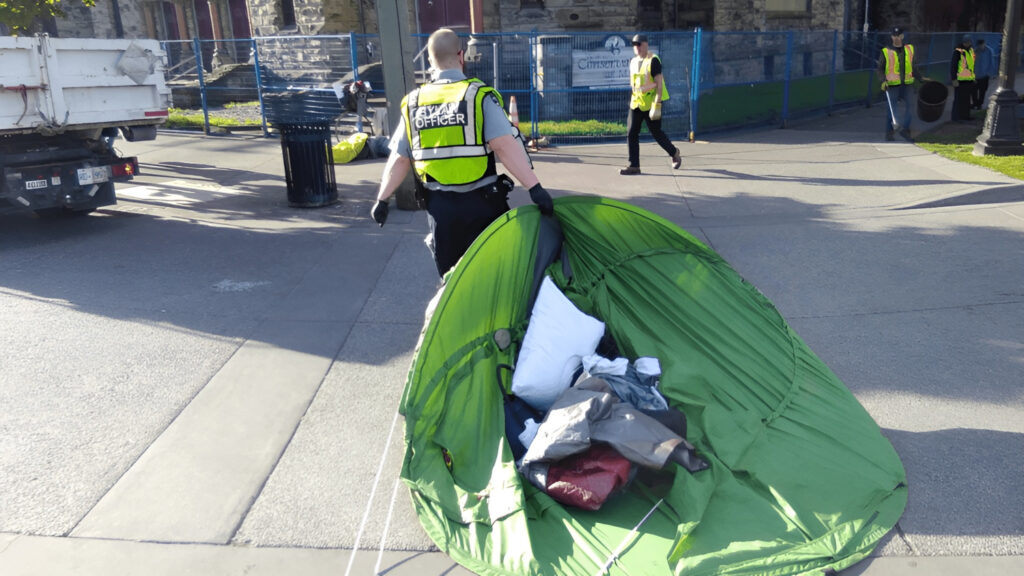
A comprehensive overview of the escalation would require a chapter all by itself. Let’s say that within these few years we’ve impotently witnessed the dismantling of several park encampments,22 the prohibition to shelter overnight in all but a few inaccessible parks in the city’s periphery,23 a crackdown on the notorious 900-block of Pandora Avenue which has since been largely fenced off like a ghetto,24 the closure of shelter space such as Tiny Town in a ball game with the provincial government,25 and a proposal to relocate it in a neighbouring municipality just as it reopened,26 the scuttling of the municipal Emergency Weather Response shelter protocol even with funding from BC Housing,27 the refusal to provide the 900-block of Pandora Avenue with a 24-hour washroom,28 and a project to turn the Centennial Square fountain into a splash park29 ostentatiously meant to chase away homeless people—to list only these. Instead, the council preferred spending millions of dollars a year, in Councillor Krista Loughton’s words, “to rearrange the deck chairs on the Titanic.”30
But worst of all, the crisis came with alarming inflammatory rhetoric spread by city councillors hell bent on exacerbating the situation. For example, in July 2024 Councillor Jeremy Caradonna made a sugarcoated plea to Prime Minister Justin Trudeau to declare a state of emergency, dispatch the army, turn the Bay Street Armoury into a concentration camp, and round up the homeless population for triage.31
Around that time, I was a legal observer with Stop The Sweeps Victoria. A few months ago, I’d assumed the mantle of legal advocate in a private capacity by helping a homeless person file a human rights complaint against the City of Victoria, and I would soon take a second client. But deep down I knew this would not suffice against the city’s imminent threat to close the last two accessible parks to overnight sheltering. Merely filing individual complaints was too little of a deterrent (compared to a collective one, as the CRAB Park encampment had done in Vancouver),32 and city officials basically called us legal observers’ bluff by ignoring us. Councillor Loughton even had the nerve to tell an unhoused person “why don’t you just sue us?” at one of our Irving Park community meetings in response to his argument that the municipality’s stance went against the jurisprudence.
So I began pushing for a court challenge of the upcoming Parks Regulation Bylaw amendment in July 2024, mere weeks before it was set to come into effect. No one else in our group wanted to hear of it, so I raised my voice and called a human rights law lecture on Pandora Avenue to explain my plan.33 This was way bolder than you may appreciate, since the police was on edge following the assault of a paramedic by an angry mob of homeless people not one block from the site I’d chosen.34 I swear that the cops responded by deploying fifteen agents in uniforms, while the nearby supermarket had hired at least eight security guards—and six counterprotesting NIMBYs with signs joined in. Believe it or not, our mere two dozens in attendance were outnumbered by the opposition.
The cops had braced themselves for chaos, thinking I might start a riot. Instead I gave the liaison officers a copy of a leaflet I’d prepared for advocates and the unhoused community, on which I explained how the city’s policy to prohibit overnight sheltering in municipal parks violated both Article 7 of the Canadian Charter of Rights and Freedoms and Section 8 of the British Columbia Human Rights Code. Officers have no gear around their belts nor tricks in their playbook to counter legal advocacy, which is why it’s so powerful against them.
Although our community of advocates differed greatly on how to proceed next, we reached out to civil liberties associations, getting the backing of both the BC Civil Liberties Association (BCCLA) and the Pivot Legal Society, which sent a joint letter to the city council warning them of legal jeopardy under Article 7 of the Charter.35 I myself served it in person to bylaw officers at Irving Park on the morning of August 1st, as an escort twice the normal size oversaw the expulsion of the campers before city employees fenced off the area.36 Not an hour prior, the sweep team had actually attempted to fence off Irving Park first, but a desperate old man with limited mobility and nowhere to go hung himself to a tree in protest,37 compelling the convoy to change course. The remaining Irving Park residents steadfastly refused to budge and sent a letter of demands to the municipal council,38 although they would eventually be cleared a few weeks later nonetheless.

Even then, fellow advocates were against filing a Charter challenge at the BC Supreme Court, given we lacked resources and the backing of a lawyer, objections which were reasonable but I was way past reasonable at that point. So I broadcast a call on a mailing list of unhoused residents interested in participating in a lawsuit against the city, supplemented with every civil rights advocate and lawyer whose email address I knew, and basically announced that we would be doing it, even if that meant I’d do it myself with just one complainant. My plan was to keep it minimalistic, since time was of the essence; we’d stick to rock-solid precedents such as Adams and Bamberger, and rely only on evidence which was either public or available on the record. I went as far as preemptively labelling anyone who would advise restraint a coward and telling them to save their objections for that old man who’d just hanged himself to a tree at Irving Park.
This was worse than desperation; it was bonkers, even by my standards. But my tantrum got the attention of Alex Kirby of the BC First Nations Justice Council, who had been the legal counsel for Bamberger, and he offered to help. His recommended approach was to file a petition for judicial review instead, offering the argument that a municipal bylaw was an administrative decision. I breathed a sigh of relief then; a judicial review is a lot quicker, cheaper, and easier to prosecute than a normal lawsuit, since the standard of review is mere reasonableness39 and for better or worse only evidence on the record is admissible. Finally we had a shot at retaliating.
I say this, but this was no ordinary petition for judicial review. I’ve filed two by myself for personal complaints so far, each of which took me just a few days of work; in contrast, I spent a couple weeks working on that one just for the groundwork, like building a detailed chronology of events with sources, transcribing council meetings, and scouring official documents for any tidbit we could use, all the while literally running across town keeping in touch with our petitioners and trying to find new ones, so other members of the team could draft the affidavits and our legal counsel the petition proper. If I had been reduced to doing it all on my own after all it would have taken months, and I wouldn’t have done nearly as well as our lawyer did—especially when it comes to constitutional law, which is way out of my league. Tensions ran high among the team but I have to admit we did an outstanding job putting it all together in just a month. By October 2024 we were ready to file and serve the respondent.
You think we were all set by then? Not so fast. If nothing else, scheduling a hearing for a major case like this typically takes about six months, and indeed our petition was to be heard in April 2025. That’s a whole winter for the homeless people who’d been displaced to spend in the cold without shelter, and we weren’t invoking Article 7 of the Charter for show; people do die or suffer life-altering injuries on the streets all the time, especially in winter. Furthermore, I expected the municipal council to respond by amending the bylaw prior to the hearing as a stalling tactic, which would then push the hearing another six months down the road. Even then, judges usually take two or three months to issue a decision for a case of this magnitude, which would take us to the winter of 2026, and even if we prevailed the respondent might appeal, or drag its feet in implementing the judge’s order. In other words, time played against us.
I ended up slamming the door on our legal team for feeling underappreciated, especially factoring in that I’m a disabled person with terrible constitution and yet I’d burned myself out so hard that I ended up developing a MRSA infection in October which came uncomfortably close to killing me. On the bright side, that meant I could act independently, which suits my character better anyway.
My plan to turn the game around was to build a homeless encampment right by City Hall, the best location in town for such a purpose and the very last place the council wanted to see one, especially since it would be right next to its illuminated winter village with a Ferris wheel;40 time would then play against the respondent and compel it to negotiate a settlement. That being said, I couldn’t just call a protest tent city over there without getting the green fenced off, while discreetly building commitment for such a stunt would have taken months.
So I sent a media advisory to announce the encampment would be at the Victoria courthouse playground instead, the only downtown park on Crown Land, beyond the reach of municipal bylaw enforcement. Such an encampment was set up in 2015 and lasted about nine months,41 until dismantled after a BC Supreme Court judgement declared it unsafe; residents were nevertheless spared long enough to be relocated to available shelter space (more about that in Chapter 4). That encampment is said to have cost the province three million dollars in legal fees and cleanup expenses.42
While the announcement itself was bonkers, the threat was plausible because I’d spent several months assuming the persona of legal advocate, and that sounded like the kind of loophole one would exploit. Also, it sent an unspoken threat to the courthouse at which the petition would be heard, compelling whichever judge would preside over the proceedings to think very carefully about the consequences of striking down the petition over a technicality.
In any case, it worked so well that the provincial government fenced off that playground instead, whereas the municipal council suspected nothing when the crowd assembled at Centennial Square right by City Hall for a march to the courthouse that was never meant to take place. Sadly, we didn’t have the numbers to hold until morning, but a dozen of us did pitch our tents on the green for the night.43 Had we achieved critical mass instead, the council would have had little choice but to capitulate, for being caught between a rock and a hard place; clearing the encampment by force would have been too risky since the municipality might have incurred massive Charter damages for enforcing a blatantly unconstitutional bylaw with mass arrests.44
Things quickly went downhill from there. Days after the protest, one of our three petitioners died in circumstances beyond suspicious, right after granting Victoria News an interview.45 One other was retaliated against by the sweep team so hard that she feared for her life in the aftermath of his death, to the point of having to go into hiding;46 in the end, the municipality would even kill her dog out of spite. I swear that tempers flared so hot, I sent a raging email to council members’ personal email addresses, copying the Victoria Police Department, stating that should another client of mine die, Councillor Caradonna would get his wish to see the military deployed in town, only it wouldn’t be for a humanitarian mission—and I wasn’t bluffing; riots have started for less indeed (see Chapter 11).
The council did amend the Parks Regulation Bylaw in March 2025, just as I had predicted, pushing the hearing all the way to November 2025.47 The hearing lasted a whole week, during which both the BC Human Rights Commissioner and the Office of the Deputy Attorney General were granted leave to intervene.48 I attended all five days of the hearing, listening to mind-numbing constitutional law arguments which almost made me lose my mind. The parties seriously argued over whether there was sufficient evidence that the petitioners’ Charter rights were engaged (even though one of them had died dammit, but the dead lose standing), whether Google Maps printouts were admissible as evidence on the record (the distance between parks wasn’t in dispute, so who the fuck cares), whether the municipal council vote was actually a quasi-judicial decision as opposed to an administrative one (this is patently absurd, as a municipal council is nothing like a tribunal), and even whether there were court precedents asserting the right to empty one’s bladder and bowels under Article 7 of the Charter (no comment). And don’t get me started on the debate over how to interpret Vavilov because even now I still don’t understand what the parties disagreed on.
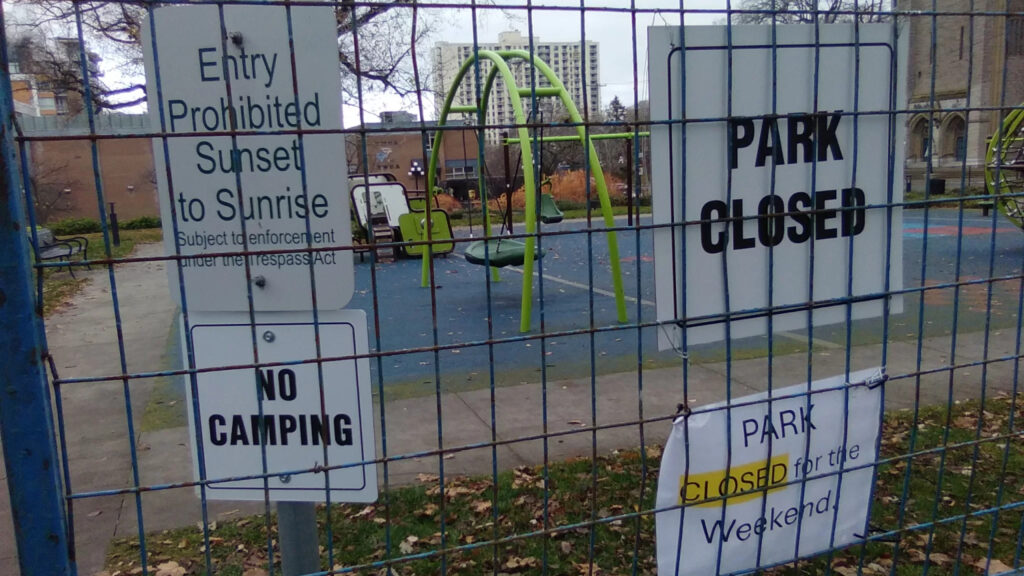
The decision has yet to be rendered at the time of this writing. I do not look forward to it, because even if the surviving petitioners prevail on the merits and obtain the order sought, the harm is already done, so we’ve lost this battle. The dead do not return to life, injuries may never heal, and trauma never disappears. The displaced may never return to where they were once chased from, especially given the municipal council’s fallback strategy of building ‘park improvements’ such as playgrounds wherever the homeless set up camp.49 In short, it isn’t good enough to win in court; genuine victory entails breaking the enemy’s will to fight. And in this respect, we failed.
La Maison Qui Rend Fou (The Crazy House)
I’ve opened this chapter by explaining why it would be naïve to merely trust in the judicial system to carry out justice. By this point you might on the contrary wonder why anyone in their right mind would bother at all; allow me then to conclude this chapter by answering that you need to watch more cartoons.
Astérix is the protagonist of a famous Franco-Belgian comic book series by Goscinny and Uderzo, about a besieged village of diehard Gauls resisting conquest by the Roman Empire with the help of a druid who supplies them with a magic potion granting them supernatural strength. In the animated movie Les 12 travaux d’Astérix (1976), Julius Caesar was so exasperated by his countless failures at subjugation that he magnanimously challenged them to prove they were gods with twelve labours mirroring those of Hercules, which Astérix and Obélix took on.
One of these labours was to obtain Pass A38 from La Maison Qui Rend Fou, an office building with a mission to drive people insane. Anyone who shrugs this off as an administrative formality manifestly has never attempted to navigate a bureaucracy, a notion Astérix himself would quickly be disabused of. After hours of being driven upstairs and downstairs, left and right, seeking in vain to collect all the prerequisites to obtain Pass A38, Obélix was driven so mad that he literally ran out of his pants, leading Astérix to the realization that a change of strategy was in order.
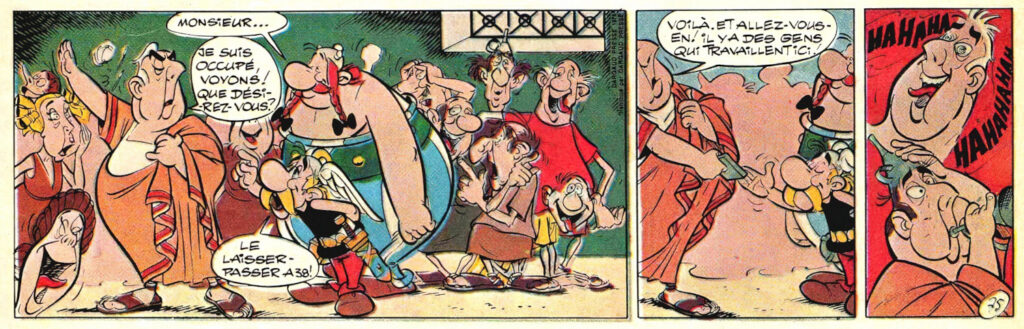
So the companions went back to the second counter, where Astérix instead asked for Pass A39—not A38, A39—as announced in memorandum B65 which just came out and nobody had heard about. This compelled one clerk after another to ask around and navigate their own morass of a system, until everyone was driven crazy in turn and gathered cavorting downstairs in the atrium—everyone but the prefect they had met by chance at the entrance, who held Pass A38 all along.
Morale of the story? If you want to beat the house, don’t just learn to navigate the system in order to stop it, turn the system around by forcing the house to navigate its own system in order to stop you. You think I’m taking cartoons too seriously? Stay tuned then, because that’s the topic of the next chapter, which shows just how cartoonish reality can get.
Chapter 4: Way of the cockroach