
Chapter 4
Way of the cockroach
A nuclear war, if it comes, will not be won by the Americans. It will not be won by the Russians. And although it has been so ordained by Mao Tse-tung, it will not be won by the Chinese. The winner of World War III will be the cockroach.1
1965 advertisement sponsored by the National Committee for a Sane Nuclear Policy
I’ve got terrifying news for you: we are losing the war on cockroaches.
For starters, we are outnumbered, as the world cockroach population likely exceeds one trillion, compared to humanity’s mere eight billion. They are among the most resilient lifeforms on this planet, enough to outlast us in the event of a nuclear winter.2 They are notorious for crawling through the narrowest of crevices in search of food or shelter, and also for being among the most difficult household pests to exterminate. They evolve much faster than humans, to the point that the Blattella germanica species has emerged alongside human civilization just a couple thousand years ago, as it is absent from any natural habitat; moreover, it has already developed resistance to multiple pesticides.3 As if it weren’t enough, cockroaches carry countless deadly foodborne pathogens like Salmonella and Escherichia coli which they spread onto unsuspecting humans.4 Billions of dollars a year are spent globally to combat the inexorable, as we’re indeed continually losing ground to the invader.
Were cockroaches to gain gestalt awareness and turn on humans all at once, we would be overrun instantly, as there is no ordnance in our arsenal which can counter this creeping doom. We would be eaten alive by the most disgustingly resilient swarm imaginable.
The same goes for lowly citizens versus their presumptuous governments. Common folks outnumber public servants by ratios comparable to the above example, and when they turn into angry mobs, governments fall overnight—even when the military is ordered to shoot the mob. When advocates rally crowds and activists spearhead insurrections with innovative tactics, entire countries’ disgruntled populations can turn into unstoppable swarms. It’s just a matter of connecting those virtual synapses together to take on the system as one coordinated entity.
This chapter takes inspiration from the humble cockroach in order to teach you how to play dirty. We’re going to study how to exploit the tiniest of loopholes and crawl under our targets’ skin as we lead the charge against our tyrannical overlords. Fair warning: follow tactics so creepy that they will make you sick in the stomach and throw up its contents onto these pages. Trust me, the nausea will pass, and in the long run you will develop a taste for foul play, just like humans can overcome the initial distaste of eating fried bugs. Worse still, I promise you will come to enjoy gloating about it.
Asymmetric warfare
Fighting a larger, stronger, more advanced, or numerically superior enemy is called asymmetric warfare, and has been the object of extensive study since the dawn of civilization. The most famous example goes back to Antiquity, with the battle of Thermopylae in 480 BCE Greece, at which a force of three hundred highly disciplined Spartans held their ground for three days against the full might of Xerxes’ Persian Empire, despite being outnumbered by three orders of magnitude. In modern History, the best examples might be Hernándo Cortés’ conquistadors subjugating the Aztec Empire at the Battle of Tenochtitlán in 1521 with small numbers but vastly superior weaponry and tactics (plus smallpox), or conversely the Battle of Isandlwana in January 1879, in which 20,000 Zulu warriors with little more than traditional battle gear overwhelmed a disciplined 1700-strong British force armed with rifles.
On a larger scale, I would like to draw your attention to the ongoing war in Ukraine, which started in February 2022 with Russia’s ill-fated ‘special military operation’ meant to capture the Ukrainian capital in a matter of weeks.5 Yet four years on, against all expectations, the defenders hold their ground against a country many times their homeland’s size, with a much larger population and more numerous fighting force, previously reputed for being the second most advanced military power on the planet;6 they even inflicted over a million casualties in the process.7 The Ukrainians’ revolutionary tactics have almost broken the might of the Russian military, most notably by nearly wiping out the latter’s modern tank fleet8 using aerial drones costing only a minuscule fraction of these,9 but also by crippling the enemy’s energy infrastructure10 and depleting its treasury.11 Analysts even anticipate the imminent collapse of the Russian Federation at this rate of attrition,12 which would make this invasion the single most disastrous military campaign in History, surpassing Napoleon’s invasion of Russia in 1812.
So don’t be intimidated by the government’s size and resulting power imbalance; revel in it. To the cockroach, a larger enemy makes a bigger and juicer target with a lot more to lose and no means to defend everywhere nor predict the next raid. Take inspiration from guerilla tactics by engaging the enemy only on your own terms, by compensating for lack of strength with cunning, and by patiently waiting for it to make mistakes out of overconfidence or frustration.
The joy of indigence
When I tell acquaintances that I’m writing a book titled How to break the law and get away with it, their knee-jerk answer is to be rich. They have a point indeed, as the rich have a way to turn entire countries into lawless plutocracies; just look at Trump’s America for the most disgusting example imaginable.13
But for the purpose of activism, I would rather be homeless and shit broke, because that means having no seizable income nor assets, therefore nothing to lose. Believe it or not, this appraisal forms the very basis of this chapter.
Indigence is a legal term for being unable to afford court fees. People receiving welfare or disability benefits are typically exempt from fees for legal filings, which might otherwise be ruinous. Also, the indigent are generally eligible for legal aid and are automatically assigned a defence attorney in criminal proceedings. While having no resources to fight a much larger opponent in court may seem an insurmountable handicap, the McLibel case which we discussed in Chapter 2 shows on the contrary that the larger party is the one with the more to lose; besides, note that the defendants in that case were not indigent, which indeed played against them since they nevertheless could not afford a lawyer.
Naturally, few entities line up to sue indigent respondents who can navigate the legal system, because that’s just not worth the expense. The litigation might cost them a fortune with the outcome ever uncertain, and even if they won, any award would have to be suspended due to inability to pay, and might even be altogether dischargeable with bankruptcy. While in principle the losing party pays the winning one’s legal costs, there is ample precedent shielding poorer parties from this rule as long as their arguments aren’t frivolous, such as the British Columbia Court of Appeal deciding as follows in VANDU v. DVBIA (mentioned in Chapter 1):
In the circumstances of this case, we conclude that it is appropriate for the parties to bear their own costs, both in this Court and in the court below. This litigation raised issues of general public interest, in which VANDU had no personal, proprietary, or pecuniary interest. The case involved difficult questions of first impression. It was not frivolous, abusive, or vexatious.
While we acknowledge that the resources of the DVBIA are limited, and that it is a not-for-profit organization, we have no doubt that it has the financial capacity to bear its own costs. We accept the submissions of VANDU that an order for costs against it would leave it in difficult financial circumstances.14
Use this to your advantage by bullying parties which must bear their own costs and have everything to lose in a protracted legal battle. I’ve casually pulled it off in a dispute with the City of Victoria over $75 in fees I’d paid for a Freedom of Information (FOI) request which was retroactively denied as an unreasonable invasion of privacy. I raised the issue of the fees by calling the decision a breach of contract and announced my intention to take it to the Civil Resolution Tribunal (CRT). The next day I was offered a ‘courtesy’ refund, which came as no surprise since fighting an indigent party over a paltry seventy-five bucks would have been financially absurd; besides, it had learned the hard way in an earlier dispute at the CRT that, barring exceptional circumstances, it could not recoup its legal fees even if it did win against a party that isn’t indigent.15

Squatter’s rights
To exemplify this, let’s discuss squatter’s rights, a term which might strike some of you as a hoax or an oxymoron—or an animated Disney movie produced in 1946—but is actually a genuine sphere of law, albeit a muddy area. Indeed, squatters have rights, and countless ways to abuse the system, sometimes leading to the most flabbergasting of outcomes.
For starters, did you know that it is possible to legally acquire someone else’s land if the owner isn’t paying attention? The term is adverse possession, which allows for an elegant solution to property abandonment, honouring a tradition going back to the Roman Empire. The conditions are fairly consistent from one jurisdiction to another, at least in Canada and the United States. The gist is that a property can be claimed after ten years (actual duration may vary) by a third party which diligently maintains it over that period. Basically, if you own a summer cottage in the countryside and leave it unattended over a long period, others may move in, and ultimately claim it as their own. No kidding.
There is extensive jurisprudence attesting to this right. My favourite case is that of a couple which effectively annexed land belonging to the city of Toronto in Ontario by building a fence around it, genuinely believing it was part of their own lot. The municipality belatedly claimed its property back and ordered the couple to vacate it. The couple first offered to buy the land but the city refused. They instead claimed adverse possession in a legal saga which concluded by the Supreme Court of Canada ruling in its favour in September 2025.16 Recent legislative amendments at the provincial level have been enacted in response, to make adverse possession claims a lot more difficult; Alberta has abolished them altogether.17
Let’s expand on this by analyzing what happens if the property is claimed back within the statutory period instead. Surely this becomes a plain case of criminal trespass, right? Not so fast. There is currently a wave of serial squatters whose solution to the housing and affordability crisis is to move into unoccupied homes and change the locks.18 By the time the homeowner notices and police intervenes, it’s too late: the squatters produce a forged tenancy agreement—and why not government-issued ID while they’re at it—to claim they’re actually renting the property.
Of course anyone’s knee-jerk objection would be that forging a lease agreement is crassly criminal. In principle though, the police calls it a civil matter and pulls out, typically referring plaintiffs to the local rental board, which of course denies jurisdiction since the crux of the dispute is that the occupants aren’t actually tenants. Owners have to take their grievances to court and wait months or years for the fraudsters to exhaust every appeal since the court system moves at a snail’s pace. By the time bailiffs show up to evict the squatters, they’ve moved on to their next target after living rent-free all this time. And even if the system were persistent enough to press charges by then, it may prove extremely challenging even for authorities to keep track of weasels moving from one jurisdiction to another without disclosing their next address.
In an extreme case captured on camera by reporters, a homeowner in Queens, New York was arrested for illegal eviction in March 2024 after a man who had moved into her property and changed the locks in February called the police on her for changing the locks back, claiming to have entered into a tenancy agreement with a landlord.19 In New York, squatters used to have rights after thirty days, and it was against the law to turn off the utilities, change the locks, or remove their belongings. Those protections were narrowed down to holdover tenants in April 2024 following this incident,20 yet another example of civil disobedience resulting in a belated legislative amendment.
Of course the picture isn’t always this clear cut. One problem is that, in the age of Craigslist and Airbnb, squatters may actually be good faith actors who have fallen for online rental scams,21 as a Baltimore family found out the hard way when it was confronted by a homeowner after they had moved into a home they believed to have legitimately rented from a landlord who had posted an ad on social media in May 2025.22
Another issue is that many are otherwise homeless people with nowhere to go and nothing to lose,23 such as a wheelchair-bound grandmother in British Columbia’s Fraser Valley who went public in July 2023 over being reduced to squatting the basement of an empty house after being renovicted and unable to afford rent anywhere.24 This partly explains why the police is loathe to arrest squatters and instead leaves such matters for civil courts—or legislatures—to sort out.
Considering the hassle and expense of suing to evict squatters and overstaying tenants, plus the excruciating delays in hearing complaints, it is understandable that many owners end up paying squatters to vacate their property, in what’s commonly referred to as ‘cash-for-keys’ settlements.25 One such case was that of a first-time homebuyer in Guelph, Ontario, who agreed to pay each squatting resident thousands of dollars to vacate his house within a month, nearly a year after purchasing it.26 The deal was finalized days ahead of a Landlord Tenant Board (LTB) hearing whose outcome would likely have been unfavourable anyway since the squatters weren’t overstaying tenants, and would not have been final even if successful.
And if you think any of these is the worst case scenario, think again. In December 2025, an Altadena homeowner has threatened to sue the California Department of Fish and Wildlife for negligence, after it gave up on evicting a black bear squatting his basement for the winter;27 ultimately, volunteers with the BEAR League, a nonprofit based in Lake Tahoe, chased out the bear in roughly 10 minutes using paintball guns…28 only for it to find refuge beneath another house half a mile away.29 At least human squatters can be sued; just try suing a black bear instead, or getting a bailiff to enforce an eviction order against it.
Occupy Homes
By now you may be wondering what this chapter’s link to activism is. I’m getting to that, starting with a movement to counter the wave of foreclosures that followed the 2008 financial crisis and drove millions of Americans out of their homes after falling victim to predatory subprime lending.
Inspired by Occupy Wall Street, activists formed groups such as Occupy Our Homes whose bargaining tactic was to occupy homes that had been foreclosed by banks, in order to prevent their occupants’ eviction and compel mortgage modification as alternatives to eviction. This was squatting on steroids, with dozens of protesters either camping on the lawns or occupying the homes proper.30 I’ve shown in the previous section just how difficult it could be for a homeowner to evict overstaying residents; now imagine those big banks having to evict dozens of John and Jane Does on top of that. Honestly, I would rather deal with the basement-squatting black bear; at least the bear can’t sue me back for illegal eviction.
One battleground was the property of Bobby Hull, a former Marine who could no longer afford his Minneapolis home after health issues impaired his ability to work in 2009. Hull was set to be evicted in February 2012 after Bank of America foreclosed his home, but 75 Occupy Minneapolis protesters intervened in December 2011, bringing with them a “Foreclosure Free Zone” banner which emboldened the embattled resident to stand his ground.31 Fearing escalation, Bank of America offered Hull a mortgage modification which allowed him to remain in his home.32
Also in Minneapolis in the same period, the movement successfully defended the home of Monique White from U.S. Bank after she fell behind on her own mortgage payments in 2009. Thirty Occupy Minneapolis protesters stepped in—quite literally, as in camping in her living room and kitchen, soon even spilling out on her lawn.33 What complicated matters in this case is that the house had just been sold to government-backed mortgage company Freddie Mac, which meant White had to negotiate with two financial institutions amid uncertainty over the status of the sale. It would seem the sale fell through as a result, since U.S. Bank offered to modify her mortgage, days after an address she gave in April 2012 to the bank’s annual shareholder meeting, before two thousand in attendance, appealing to the CEO to help her stay in her home.34 She reported thinking at the time: Yeah, they have more money than me, but they’re no different and no better than me.
Did you really think that we’d sunken to the worst possible lows earlier with ‘cash-for-keys’ settlements paying overstaying tenants to leave?35 Those financial institutions instead forgave large portions of overstaying residents’ mortgages, effectively paying them to stay in their homes, because they had even more to lose by pressing for eviction via the judicial system against the will of the mob. Not bad for swarms of cockroaches pitting themselves against Wall Street loan sharks and bloodsucking lawyers.
Tenant solidarity
By the way, this kind of tactic has also been used in response to illegal tenant evictions. In December 2023, Toronto’s York South-Weston Tenant Association intervened when a landlord illegally locked a tenant out who had just been evicted without getting notice of an LTB hearing.36 The association staged a sit-in at the landlord’s office which lasted four days, during which the police declined to remove the protesters, asserting only its role to keep the peace. As for the tenant, she was able to return to her apartment during the standoff, under close guard by neighbours. The landlord yielded and allowed her back in, pending an expedited LTB hearing, no doubt apprehensive of having to evict an overstaying tenant amid widespread opposition. The union seized the opportunity to call for rent controls, which would decrease the incentive for such sneaky eviction attempts.
This wasn’t by any means the York South-Weston Tenant Association’s only instance of hard bargaining. In October 2024, tenants of multiple buildings concluded a sixteen-month rent strike after reaching an agreement with the landlord over above guideline rent increases allowed under Ontario’s 2018 rent control rollback.37 During that period, tenants withheld the rent, daring the landlord to evict them all. I’ve already shown the difficulty of evicting even one overstaying tenant; imagine hundreds of them.
In August 2024, the LTB put an end to the dispute by ordering both the tenants to pay due rent and the landlord to perform overdue repairs. Tenants declared victory in this regard, as they’d won major concessions given the buildings’ state of disrepair and pest infestations. Naturally, the adjudicator overseeing the case begged to differ:
The stories published by the media involving my order on August 1, 2024 do a disservice to tenants in this Province by suggesting to them that rent strikes work and are worth what appears to have been described by the Canadian Press as the ‘gamble’. While a rent strike may put (temporary) economic pressure on a landlord, it also exposes the tenants to the very real risk of being evicted, and their credit ratings and ability to find new rental accommodations will be adversely impacted. Rent strikes are not worth the ‘gamble’ and the focus of tenants faced with landlords who are not complying with the RTA should be on exercising their rights under the RTA and not risking their housing by engaging in rent strikes.38
This politically correct opinion notwithstanding, I’ve never heard of a rent strike resulting in such severe adverse effects to tenants, so I’m siding with the Canadian Press on this one.
Chrissy Brett
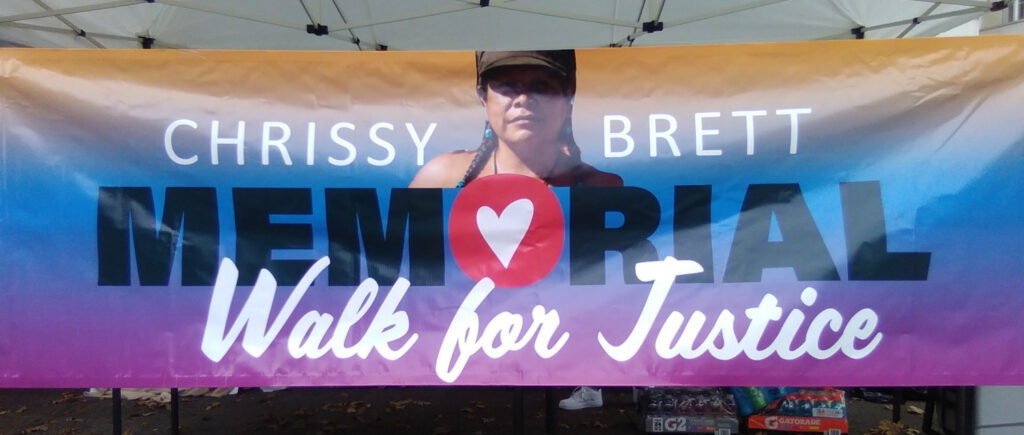
I would like to dedicate this section to a relentless champion of squatter’s rights, the right to housing, and indigenous rights,39 by honouring the memory of Chrissy Brett, who died in July 2022 after setting more tent cities for the homeless than I can count,40 across the Greater Victoria Area and Vancouver. Rarely have I seen such a staunch activist, both beloved of advocates yet reviled by the general public, for coming up with sites from which fellow unhoused folks would be difficult to uproot, or if one attempt failed then hop onto the next site before the authorities were done clearing the previous one.
Really, I cannot come up with an exhaustive list of sites where she and her troupe pitched their tents, for she might have taken the list to the grave. The media report many between 2015 to 2020, such as those of Victoria’s courthouse grounds,41 Oak Bay City Hall,42 Willows Park,43 Regina Park,44 Ravine Way,45 Goldstream Provincial Park,46 West Saanich Road,47 Cattle Point in Oak Bay,48 Oppenheimer Park,49 CRAB Park,50 and Strathcona Park;51 even the media struggled to keep up. Wherever she went, controversy, and the police, followed; she even got arrested in July 2018 in Regina Park for obstructing authorities52 and again in June 2020 for violating an injunction.53
For the purpose of this chapter, I would like to focus on the Victoria courthouse encampment (mentioned in Chapter 3), because it devolved into a legal showdown due to being located on Crown land, beyond the reach of municipal bylaws, hence local law enforcement. The tent city was set up in November 2016 on the green space near the courthouse, to the consternation of neighbours who quickly lamented that incidents surrounding drug use were migrating to their area, but courthouse security only asserted its prerogative as far as the facility proper, which left no one legally able to carry out an eviction of this magnitude.54
The campers dug in, invoking their own prerogative under Article 7 of the Charter, and making their primary demand to be housed amid acute affordable housing and accessible shelter space shortages. Thus began the legal battle between the provincial government and dozens of indigent respondents, including Brett; they received pro bono help from a pair of local lawyers while the Together Against Poverty Society agreed to cover a portion of related material costs.
At a March 2016 hearing, the province sought an injunction to remove the encampment from its premises, describing it as a public nuisance and a fire hazard. Unfortunately for the plaintiffs, however, the judge hearing the complaint had a history of ruling in favour of encampment residents,55 and unsurprisingly declined to grant its request. His decision, which he issued the next month, rejected the province’s claims,56 starting with that of irreparable harm should the injunction be declined as follows:
The plaintiffs permitted the Encampment to exist for many months before seeking injunctive relief. The expenses detailed above can all be quantified. While I accept without reservation the reality that the expenses will almost certainly be unrecoverable from the defendants, I note that the Supreme Court of Canada remarked in RJR-MacDonald57 that one party’s impecuniosity does not automatically decide the application in the opposing party’s favour. The fact remains that most of the damages alleged by the plaintiffs have already crystallized. Any further costs or damage that would be occasioned by the ongoing presence of the Encampment would, as I will discuss below, simply take place somewhere else in the City or Victoria if the injunction sought were issued.
The core argument supporting the decision, however, was the lack of shelter options for the defendants, which took precedence over lesser concerns such as loss of enjoyment of green space or the impact on the neighbourhood. The judge also considered claims related to health and safety of the defendants reduced to living in squalid conditions, only to find once again that granting the injunction would only move the problem elsewhere, while in contrast that conceding the community one large space to gather made the defendants feel safer. He was more receptive to the fire hazard, but dismissed it on the grounds that encampment residents were working with fire services in mitigating them.
Pivotal to the decision was Brett’s affidavit pertaining to life at the “SuperIntent City” (SIC), which is partially quoted in the decision so I reproduce it verbatim:
Ms. Brett’s evidence shows that, by and large, the residents of the Encampment have not been hostile with local authorities. Rather, through the informal leadership structure they have developed, they have attempted to build bridges with the Victoria Police Department, Victoria Fire Department, and other service providers. They have made efforts to respond to the legitimate concerns of those authorities. Ms. Brett attested that:
3. I have created protocol with government officials to ensure the integrity and self-governance for and by the residents of SIC over the affairs of their daily lives. I have a good working relationship with members of the Victoria Police Department (“VicPD”), the Victoria Fire Department (“VFD”), the Ministry of Children and Families (“MCFD”), and Island Health Authority (“Island Health”). We all work together to address the issues faced by the residents of SIC. These agencies have agreed to deal with SIC through senior, experienced, designated employees, who have been able to build positive working relationships with some of the residents. This has been an enormously important experience for SIC residents who invariably have had, in their past, very significant conflicts with those in authority.
…
13. Local authorities from the fire department came to SIC after we lit the sacred fire. Staff and members of the local Victoria Fire Department (VFD) have always been friendly and cooperative with camp protocols and over the course of the encampment were seen to be keenly aware of the struggles of the homeless residents. They asked for a permit and as the fire is a sacred tradition I advised that we would not be seeking a permit. The staff of the VFD then permitted the sacred fire to continue unhindered. We kept a schedule of firewatchers and made every effort to ensure safety around fire concerns.
14. On or about January 8, 2016, VFD about the warming fire. I told the VFD representative that it was important that we have a fire at that time to keep people warm, and provide them with something warm to drink. In response to the concerns raised, however, we reduced the size of the warming barrel by half.
As long as the encampment leadership worked with local authorities, they would get the backing of the judiciary. This forced the province to find housing for the encampment residents after all. That being said, the decision had left open the door to another application for injunctive relief should conditions on the ground deteriorate, and the province did so again, arguing among other concerns that overcrowding at the swelling encampment had made the fire hazard untenable.58 This proved the main decisive factor in granting the injunction this time, followed by the entrenchment of criminal activity which made the encampment unsafe for both residents and neighbours. The tent city was to be dismantled by August 2016, whether or not the defendants had been offered housing by then.59
According to the government, three hundred residents had been offered affordable housing, including a hundred which moved into a newly renovated building60 that would later become notorious for its decrepitude and perpetual cockroach infestation61 but nevertheless constituted a huge improvement over sheltering outdoors. The province ended up spending three million dollars in legal expenses and cleanup costs, to say nothing of what it invested to convert facilities into supportive housing.62 The government learned its lesson: early, client-centered intervention should take precedence over costly court battles and evictions, the latter which in contrast merely move the problem around.63
In the end the encampment residents’ dirty tactics prevailed, in spite of their court loss. And they owe their victory to strong leadership under Brett, which put together a sound legal strategy, reached out to civil rights advocates and lawyers, opened diplomatic channels with the police and fire departments, and pleaded its case to the media, going as far as building a website chronicling life in a domestic refugee camp.64 As for the angry neighbours, rallied under the Mad As Hell collective,65 their consolation prize was a campground on the courthouse’s green,66 which would inspire a future iteration of the Victoria municipal council to build such an improvement wherever the homeless set up camp.
The necessity defence
So far this chapter has dealt mostly with civil matters. In this section I would like to shift the focus to criminal acts of civil disobedience with the necessity defence, which has been invoked time and again in court cases by defendants who broke the law and defied court orders in desperate attempts to influence public policy.
The defence has been successfully pleaded in criminal trials across the globe. The Supreme Court of Canada itself has explicitly acknowledged it in 1984 when it upheld the British Columbia Court of Appeal decision to grant cannabis smugglers a new trial over the trial judge’s decision not to allow the defence that the defendants, initially headed for Alaska, were forced to seek refuge on the Canadian shoreline to make lifesaving repairs amid severe weather conditions:
Conceptualized as an “excuse”, however, the residual defence of necessity is, in my view, much less open to criticism. It rests on a realistic assessment of human weakness, recognizing that a liberal and humane criminal law cannot hold people to the strict obedience of laws in emergency situations where normal human instincts, whether of self-preservation or of altruism, overwhelmingly impel disobedience. The objectivity of the criminal law is preserved; such acts are still wrongful, but in the circumstances they are excusable.67
That being said, Canadian courts haven’t been sympathetic to this defence, and it has rarely been successful. It was notably denied to Robert Latimer by the Supreme Court of Canada in 2001 as he sought to justify the mercy killing of his severely disabled daughter. In its decision, the court set forth the following criteria to be met:
The defence of necessity is narrow and of limited application in criminal law. The accused must establish the existence of the three elements of the defence. First, there is the requirement of imminent peril or danger. Second, the accused must have had no reasonable legal alternative to the course of action he or she undertook. Third, there must be proportionality between the harm inflicted and the harm avoided.68
Environmental activists have persistently invoked the necessity defence, especially pertaining to climate change, arguing that the looming menace of global environment disasters indeed constitute imminent peril to humankind and that there were no reasonable legal recourse. This defence has been successful in multiple cases in the United Kingdom, for instance in 1999 by Greenpeace activists accused of destroying genetically modified corn crops;69 once again by Greenpeace activists cleared of wrongdoing by a jury after scaling a 200-metre chimney at a power station in October 2007 in an attempt to shut the station down;70 and in 2019 by Extinction Rebellion activists for spraying “Divest from oil and gas” on the walls of Kings College London.71 British juries have indeed been sympathetic to this defence, even when instructed to ignore it, in blatant examples of jury nullification (see Chapter 2).
In contrast, Canadian courts have shown utter hostility toward its application to direct action. The British Columbia Court of Appeal in particular has eviscerated it when it rejected the appeal of Trans Mountain Pipeline protesters for defying a court injunction in March 2018, stating the trial judge did not err when he stated there was no “air of reality” to the defence of necessity:72
A significant impediment to application of the necessity defence in the context of planned protest activity, which was the case here, is the deliberate nature of the conduct that grounds the offence. Theoretically, and factually, it is difficult to reconcile this type of conduct with the fundamental premise underlying the defence, namely, that it excuses wrongfulness only for those “who, although morally blameworthy, acted in a morally involuntary manner” […]
Overall, the courts have rejected the environmental activists’ arguments mostly for two reasons: the defendants’ actions, while morally justifiable, rested on remote and speculative eventualities irrespective of scientific evidence, and they had not exhausted their legal recourse, including swaying public opinion by less disruptive means. This is of course to be expected, since the courts may indeed never condone violations the law, and will only excuse them in the last extremity.
I would not give up on the defence of necessity altogether, though. I argue, within the scope of this chapter, that it would likely succeed if applied to a different category of causes such as drug policy, for which the peril is demonstrably immediate given the current state of emergency invoked by British Columbia over the opioid overdose crisis, having killed thousands of people over the years (see Chapter 1).
In fact, I was prepared to invoke the defence of necessity myself should I get arrested for standing my ground after setting up a homeless encampment right by Victoria City Hall in December 2024 (see Chapter 3). Indeed the homeless face life-threatening perils while their right to shelter from the elements is being violated, and legal recourse via the courts is prohibitively slow; even a request for an emergency injunction may take a month to be heard and another month to be decided. Remember that one of the petitioners for the judicial review of the Parks Regulation Bylaw died within weeks of the filing, months ahead of the hearing, without any plausible legal recourse. Furthermore, I had already persuaded the BC Human Rights Tribunal to fast track two complaints filed on behalf of homeless clients who had asserted their genuine belief that they would not survive until the hearing at this rate.
It is my conviction that Canadian courts could be made to revise their stance should they be presented with persuasive cases invoking Article 7 of the Charter, even in the absence of standing, when the threat to someone’s life, safety, and security is undeniable, such that it can occur so suddenly that seeking redress via the legal system is an unrealistic prospect. And there can be no more convincing defendants in this regard than the indigent, who face nearly insurmountable barriers in accessing the legal system to begin with. The necessity defence deserves another chance; it’s just begging for the right cockroach to invoke it in the right case.