
Chapter 2
Vox populi, vox Dei
There being no natural or divine law for any form of government, or that one person rather than another should have the sovereign administration of affairs, or have power over many thousand different families, who are by nature all equal, being of the same rank, promiscuously born to the same advantages of nature, and to the use of the same common faculties; therefore mankind is at liberty to choose what form of government they like best.
The judgment of whole kingdoms and nations, concerning the rights, power and prerogative of kings, and the rights, privileges and properties of the people (1710)
I’m sure you know the court of public opinion. It’s like the black market, where we Canadians go to buy and sell dangerous articles like raw milk (which under federal law carries hefty fines and the threat of jail time).1 Both exist and actually run the place, yet of course the government is loathe to acknowledge them. In the end, the mob determines what is fair and just, the edicts of the ruling class be damned.
The Roman Empire’s unparalleled longevity may be attributed to this insight, rather than to rule by cruelty and feats of arms. Both acknowledging the power of the mob yet fearing its excesses, it created a system of checks and balances channelling public discontent, which inspired the constitutions of modern democracies and keeps fuelling political debate to this day.2 There is actually a word for this underlying force: ochlocracy, or mob rule, which I mean to strip of its derogatory connotation; let’s think of it as power by the people, for the people instead—for better or worse—as the ultimate safeguard against the system’s own excesses and failings.
For this purpose, this chapter sets the foundations for successful direct action, every aspect of which meant to sway public opinion, either by persuading the crowd or by shaming it out of fighting. From this point forth, think not of disruptive protests as individual performances, but as instruments in larger campaigns building momentum to promote avant-garde ideas.
Of crucial importance is having a supporting legal strategy to vindicate one’s actions. Some activists think of civil disobedience merely as breaking the law, but as I’ve demonstrated in the previous chapter with examples such as the Section 504 sit-in, the point is often to uphold the law instead. It would not have been proper for disability advocates to occupy a government office right away; their campaign’s success rested on asserting the Rehabilitation Act and escalating from there until they had exhausted all legal and political recourse.
If you wish to succeed in your own endeavours, then embrace this particular dimension of activism and learn the law until you know it better than the Pope knows the Holy Bible, then start preaching it to the crowd like it’s the newest gospel. Reach out to civil rights advocates, and shake hands with lawyers. Plead your case with lawmakers, and use the judiciary as a tribune to air your grievances to the public. Only then think about rocking the boat in earnest.
Truly, if you sway public opinion, then every other concern shall become purely academic. The letter of the law won’t matter anymore, nor the rulings of the judiciary. Follows a famous court case illustrating this principle.
The McLibel case
The United Kingdom has notoriously harsh defamation law. Unlike in most developed countries, the burden of proof falls on the defendant, and the plaintiff doesn’t even have to demonstrate that the claim is false. Prior to the Defamation Act of 2013, the regime was even worse, to the point of having a chilling effect on public speech; at least nowadays the plaintiff has to prove serious harm was caused, and may also have to show malice on the defendant’s part. Under previous legislation, the defendant was guilty until proven innocent, and the financial burden of mounting a defence represented a nearly insurmountable deterrent against criticism of any wealthy individual or corporation, thus compelling anyone on the wrong end of such an action to issue a public apology and retraction.
That is, until the so-called McLibel case showed the perils of trying an abusive defamation case in the court of public opinion. This the iconic fast food chain McDonald’s found out the hard way when its infamous attempt at silencing environmental activists backfired in the most dumbfounding fashion, to the point of being the object of a documentary published by Spanner Films in 1997, later extended and broadcast on television by the British Broadcasting Corporation (BBC) in 2005.3
In 1986, a small group of activists assembled under the independent banner of London Greenpeace (not affiliated with Greenpeace International) produced and distributed a flyer titled What’s Wrong With McDonald’s? denouncing the corporation’s business practices. It claimed the food was unhealthy, which nowadays would strike anyone as common sense, especially since the release of the Super Size Me (2004) documentary. The flyer also alleged mistreatment of animals, which should come as no surprise given that the fast food chain sold cheap burgers and chicken nuggets. It went on with accusations of workplace abuse and sweeping environment impact—and of course of exploiting children in its unhealthy marketing strategy.
None of these claims would have been considered controversial anywhere but in a British court of law, which at the time offered the perfect tribune for corporations to silence its critics, and McDonald’s naturally took advantage of it to go after the activist group in September 1990, accusing its members of libel. While most of the defendants opted to apologize and retract their statements in order to avoid costly litigation, Helen Steel and David Morris refused to be cowed. From a litigation strategy standpoint, that was insanity, since the game was rigged in the plaintiff’s favour, which threatened them with nothing short of financial ruin.
But the litigation proper was only one dimension of the upcoming legal battle. Of course McDonald’s was quick to argue that the defendants should be denied a jury trial, and indeed the case was heard by a single judge. Nevertheless, the corporation couldn’t prevent media coverage of its proceedings, and a David versus Goliath legal case pitting one of the world’s largest corporations against two self-represented litigants denied legal aid and a jury trial drew massive sympathy capital, which would help relieve the pair of the burden of mounting a defence.
The trial started in June 1994 and the complaint would only be decided in June 1997, making it the longest civil case in English history.4 Throughout this period, the plaintiff ironically offered the defendants the ideal tribune to air their grievances against it.
The judge ultimately ruled against the defendants regarding some of the claims, such that the plaintiff caused destruction of rainforest, dispossessed Latin America farmers, or was responsible for starvation in the Third World. The decision however made some important concessions even in claims it rejected.
For example, while it dismissed the conclusion that McDonald’s diet was as unhealthy as the flyer stated, it did find that “the small proportion of McDonald’s customers who eat McDonald’s food several times a week will take the very real risk of heart disease if they continue to do so throughout their lives, encouraged by the Plaintiffs’ advertising.” It found likewise that “McDonald’s advertising and marketing makes considerable use of susceptible young children to bring in custom, both their own and that of their parents who must accompany them, by pestering their parents” even as it set aside allegations of food poisoning. And while it determined that the animal cruelty claims were exaggerated, it did concede that statements “relating to the restriction of movement of battery hens, broiler chickens and chickens who have their throats cut while still fully conscious are sufficient to justify the general charge that the First and Second Plaintiffs are culpably responsible for cruel practices in the rearing and slaughter of some of the animals which are used to produce their food.” Same for McDonald’s labour practices, of course, such as paying low wages and being hostile to unionization.5
This of course isn’t the kind of outcome any corporation with sound management wishes for, even if it prevails on half of its claims, because it amounts to deciding that the company is actually half-guilty of the unconscionable business practices it is being accused of, which is any marketing department’s worst nightmare; seriously, such a pyrrhic victory is even worse than losing given its implied cynicism. This must be why McDonald’s declined to collect the £60,000 award against Steel and Morris, to say nothing of its court costs; while it won decisively in a court of law, it ended up crushed in the court of public opinion, and asserting its prerogative any further would only have worsened its image.
The legal saga would go on for years,6 with an appeal that reduced the award to £40,000 (not that McDonald’s would collect a penny anyway). The defendants even took the case to the European Court of Human Rights, which found that they had been denied a fair trial and ordered the UK government to compensate them with more than €82,000 including expenses. The court’s decision also stated that English defamation law violated Article 10 of the European Convention on Human Rights guaranteeing freedom of expression;7 it compelled the UK government to introduce the Defamation Act of 2013, which raised the bar for libel claims. Furthermore, Steel and Morris were awarded £10,000 by Scotland Yard over accusations that the latter had disclosed confidential information to McDonald’s which enabled the legal proceedings in the first place.8
In response to evolving demand and public perception, McDonald’s has made significant efforts to rebrand itself as a responsible company offering sustainable beef and cage-free eggs alongside healthy menu options such as salads, fruits, whole grains, and yogurt. While it still has a long way to go in order to please advocates,9 at least it has abandoned the unhealthy practice of silencing its critics with lawsuits, if only because its original business model was no longer economically sustainable. And the turning point was a lawsuit against two lowly activists who just wouldn’t roll over and beg for mercy.
Jury nullification
I wasn’t the best because I killed quickly. I was the best because the crowd loved me. Win the crowd, and you’ll win your freedom.
Gladiator (2000)
I’ve mentioned that McDonald’s lawyers were apprehensive of a jury trial. Of course it had nothing to do with the case being overly technical. Rather, the company most likely wished to prevent jury nullification.
Ask the courts what this ‘jury nullification’ thing is, and you will be told that it does not exist—just like the court of public opinion and the black market. Judges frequently warn defence attorneys against even broaching the topic before a jury.10 In a rare acknowledgement, the Supreme Court of Canada has contemplated the question in R. v. Latimer, however, and offered the following definition:
The term “jury nullification” refers to that rare situation where a jury knowingly chooses not to apply the law and acquits a defendant regardless of the strength of the evidence against him. Jury nullification is an unusual concept within the criminal law, since it effectively acknowledges that it may occur that the jury elects in the rarest of cases not to apply the law. The explanation seems to be that on some occasions, oppression will result either from a harsh law or from a harsh application of a law.11
Even then, in its analysis it adopts the predictable stance that “as a matter of logic and principle, the law cannot encourage jury nullification.” On the other hand, neither can the judicial system prevent it altogether, since jury deliberations are kept strictly confidential even from the courts, and jury verdicts are delivered without a rationale, which means that as long as jurors keep mum about the scheme, they can hardly be found to have engaged in misconduct.12 Therefore even calling it a “rare situation” as above is presumptuous; in reality, we have no idea how common the practice is.
That being said, prospective jurors have in the past openly declared that they refused to convict a defendant, usually when the law in unjust or sentencing would be unconscionable. For instance, in December 2010 several potential jurors in a pool for a trial over charges of cannabis possession for the purpose of trafficking openly objected from the onset to convicting someone over a tiny amount of weed; the prosecution dropped the misdemeanor possession charge in a plea deal with the defence which in return conceded the felony trafficking charge.13 In another case, a New Orleans judge had to abort proceedings in October 2019 after the court failed to form a jury in another cannabis trafficking case, again after too many candidates in the pool voiced their opposition to criminalizing cannabis; this time the prosecution agreed to downgrade the felony charge to a misdemeanor.14
The city of Houston also hit a brick wall in January 2024 in its failed prosecution of a Food Not Bombs volunteer who repeatedly fed the homeless in contravention of a municipal law. Similarly to previous examples, the court failed to find any candidate juror willing to convict the defendant of such an offence,15 which should have come as no surprise given that 24,000 people had just signed a petition asking that the law be struck down.16 In a previous incident in June 2023, a jury found another Food Not Bombs volunteer not guilty of the same offence, most likely an instance of jury nullification; the defendant retaliated with a federal lawsuit challenging the constitutionality of the municipal ordnance.17
Jury nullification is widely believed to have resulted in three acquittals and one mistrial of Dr. Jack Kevorkian, between May 1994 and June 1997 in Michigan, on charges of murder for assisted suicide of patients with medical conditions which were extremely debilitating yet fell short of fatal.18 For several years authorities had attempted to stop Kevorkian, nicknamed ‘Dr. Death’, from carrying these out, to no avail; Oakland County prosecutor Richard Thompson commented in 1993 that “he’s basically thumbed his nose at law enforcement, in part because he feels he has public support.”19 Kevorkian pushed the envelope too far when, in November 1998, he videotaped himself euthanizing a Lou Gehrig patient and had the footage broadcast by CBS News;20 this brazen performance, widely denounced as poor taste, would ultimately get him convicted of second degree murder.
The topic arises in even more serious cases. Such an eventuality may materialize in the upcoming trial of Luigi Mangione for the murder of UnitedHealth CEO Brian Thompson in Manhattan in December 2024.21 Not that there is any doubt that Mangione did perpetrate the offence, or that premeditated murder is generally unconscionable. The catch is that Thompson was universally hated for UnitedHealth’s modus operandi of denying valid health insurance claims out of rabid greed.22 Moreover, ammunition casings found at the crime scene were engraved with the slogan “Deny, Defend, Depose” inspired by Jay M. Feinman’s 2010 book Delay, Deny, Defend: Why Insurance Companies Don’t Pay Claims and What You Can Do About It.23
Mangione became a folk hero overnight among people who resented the health insurance industry’s ignominious business practices, many of whom outright celebrated Thompson’s death,24 leading many observers to wonder whether the court would be able to find enough candidates to assemble an impartial jury, much less secure a conviction despite overwhelming evidence of guilt.25 In a tacit acknowledgement, the federal charge of murder was stunningly dismissed in January 2026 for being incompatible with that of stalking (which nevertheless carries a maximum penalty of life in prison).26
As you can see, the public is the last arbiter of whom gets convicted in court, not judges. And jury nullification is only the last line of defence against unconscionable prosecution, as the remainder of this book shows. That is why pleading one’s case before the court of public opinion is paramount for activists, and curiously why violating the law does not dispense from studying the legal system, quite the contrary. Anyone who convinces the public that the law is wrong and must be taken into one’s own hands may become nearly untouchable.
Rallying public support
Indeed, I cannot overemphasize the imperative for a sound legal strategy in order to plead a case in the court of public opinion. Just like nothing undermines an activist platform like being labelled criminal or even terrorist, nothing bolsters it like counterclaims that the rival faction is committing fundamentally illegal acts, especially human rights violations.
In the next chapter I discuss the path to legal advocacy. You want to win over the public to your cause? Start by joining forces with civil rights advocates and lawyers. And I don’t mean begging those organizations for help; I mean championing their causes and fighting alongside them as allies. You may think it cannot be done because you’re not a lawyer and you know nothing about law. Well, you don’t need to be a lawyer, just to teach yourself the rudiments of the legal system. Besides, lawyers need advocates on the ground just like advocates need lawyers in court, so think about what you can offer them precisely because you’re not a lawyer (more about that in Chapter 3).
Another way is to appeal to intellectual authority by reaching out to academics. As I’ve discussed in the previous chapter, this proved instrumental in softening governments’ hardline drug policies. Bureaucrats are receptive to academic research published in illustrious peer-reviewed journals, and courts accept expert testimony. This is particularly important for environmental activism, because the prospects of prevailing in court without teaming up with researchers is nil. This line of thinking led veteran climate activist James Hansen to call for a wave of lawsuits against large polluters, arguing that litigation and political mobilization are more effective than protests.27 I beg to differ on this last point: litigation and political mobilization act in synergy with protests, neither being ultimately effective without the other.
Then comes political support, which I broach with reservations (see Chapter 8). When fighting the government in particular, you need to reach out to lawmakers one way or another, and not necessarily by dumping manure at their campaign offices. If you want to change the law, think about how to secure the votes for your amendments to pass, starting with of course who shall bring the motion to the legislature floor. While you may be thinking petitions, I’m more into handshakes; I would prefer the support of one elected representative championing my cause in earnest to one million electronic signatures that don’t really count in the end.
By the way, do you know who can conquer the hearts of millions? Artists, especially musicians. Observe that each chapter features the title of a song. Several of these have frequently aired at protests, some even been the object of live performances. My favourite example is Quiet by MILCK, a previously obscure artist who suddenly walked in the limelight after organizing a flash mob performance at the Women’s March to Washington in January 2017, to draw attention to society’s tacit acceptance of sexual abuse.28 Another performance, which I attended, was at the February 2025 United for Old Growth Rally here in Victoria, British Columbia, where Canadian music legend Neil Young made a surprise appearance and even played two songs, drawing national media coverage to the event.29
Finally, there’s of course the mainstream media, whose reach is unparalleled and influence paramount. This is so important that I’m devoting Chapter 6 to it. The topic comes last on this list because the media are interested in stories rather than causes, therefore an organized campaign is far more likely to get them interested than advocates cold calling them without first building any momentum.
While I’m at it, I recommend reaching out to activists across causes, in order to bolster one’s numbers and increasing one’s reach even further. Some causes have proven unexpectedly attractive to unrelated organizations, such as Palestine liberation which gained the backing of environmentalists, Indigenous peoples, and even queer activists. A particularly potent pool of support for any cause is the labour movement, larger unions rivalling political parties outright.
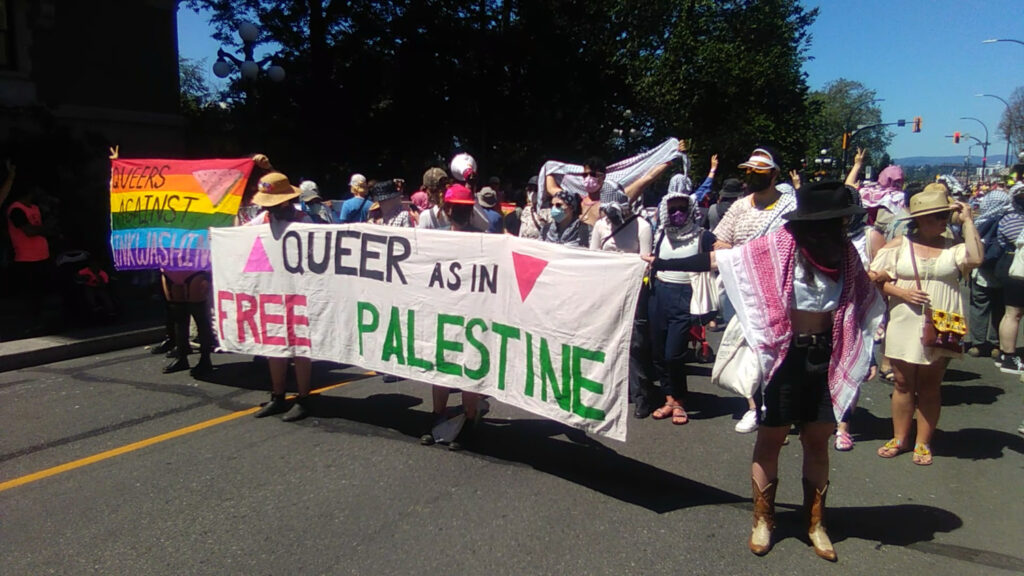
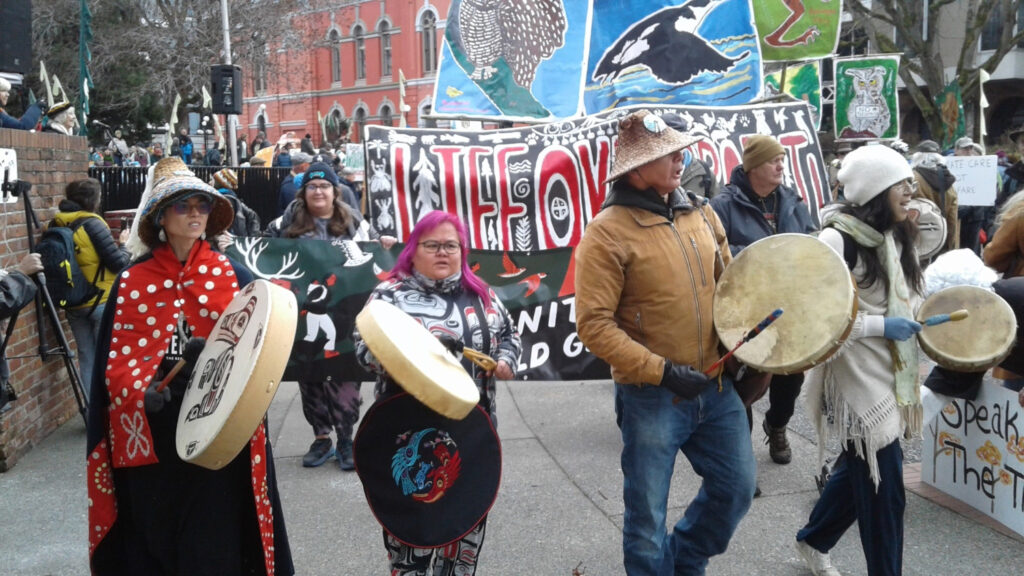
Perhaps you don’t think even such a concerted campaign can win concessions from governments. Let’s look at it the other way round then, and reflect on what forms political repression takes in a totalitarian government takeover. For example, Putin took the Russian Federation down the dark path of neo-Soviet experimentation,30 for whose purpose he undermined the judiciary’s independence and outlawed protests;31 passed constitutional amendments including a reform affirming the primacy of domestic statutes over international human rights law;32 stifled academic research by censoring liberal voices;33 cracked down on advocacy groups by designating them as foreign agents;34 rigged the electoral system;35 retaliated against his political rivals, such as of course Alexei Navalny who died in prison in February 2024;36 charged artists such as Pussy Riot37 with hooliganism;38 and of course muzzled the press by criminalizing independent reporting and blocking foreign media.39 Short of a violent insurrection, those voices are precisely what governments worldwide fear, otherwise they wouldn’t bother suppressing them to begin with.
The remainder of this chapter illustrates this principle with examples good and bad, showing the power of campaigning in the court of public opinion in support of direct action, and in contrast the perils of neglecting these factors in rushing to stage disruptive protests without a strong underlying platform.
Palestine Action
In October 2023, Palestinian resistance group Hamas conducted a terrorist raid on Israel, killing over a thousand civilians and abducting hundreds more,40 in retaliation for decades of arbitrary detention of Palestinian civilians by the Zionist regime.41 The attack was widely condemned worldwide, and would have resulted in an overwhelming wave of sympathy for Israel, in spite of its own record of human rights violations, were it not for the brutal way the government responded. In a matter of weeks, the Israel Defence Forces (IDF) carried out a campaign of genocide which killed tens of thousands of innocent civilians, forced the displacement of nearly two million more, and quickly reduced the entire Gaza strip to rubble.42
Months went by with no end to the conflict in sight, to the consternation of virtually every person of conscience across the world, leading South Africa to accuse Israel of genocide before the International Court of Justice.43 The crisis led to global mobilization against Israel by protesters, eclipsing even those of previous generations that opposed the Iraq war, South Africa’s own apartheid regime, and the Vietnam war. The Israeli themselves massively took to the streets, albeit in support of the hostages instead of out of sympathy for the Palestinian people; that being said, they too opposed the war and sought a negotiated settlement,44 a rare point of agreement among factions in the most divisive political standoff since World War II.
This polarization proved particularly acute between the British public and its government, whose staunch support of Israel goes back to the Balfour Declaration of 1917;45 in contrast, weekly marches across London drew hundreds of thousands of voices clamouring for a ceasefire.46 No amount of demonizing rhetoric and repression on the government’s part, from unfounded allegations of antisemitism to labelling protests “hate marches”,47 dampened support for the cause of Palestine liberation—though certainly not for lack of trying;48 instead it emboldened activists and drove them to employ more radical tactics.
Enter Palestine Action, a decentralized direct action network formed in 2020 which focused its attacks on weapon manufacturer Elbit Systems and its subsidiaries for building ordnance used in the IDF’s carpet bombing of the Gaza strip. The group’s tactics quickly escalated beyond merely disruptive to outright criminal, ranging from vandalism to sabotage; an activist was even accused of striking a police sergeant with a sledgehammer during an August 2024 raid.49 Over time, the network attacked the Bristol factory so persistently that Elbit Systems closed the facility altogether in 2025.50
I’d like to take a step back to emphasize Palestine Action’s radical tactics,51 which went far beyond spraying red paint on walls, to the destruction of facilities and assault on the police. These raids were unquestionably criminal, and brazenly so. In normal circumstances, those antics would turn public opinion squarely against such vandals, and had the government responded rationally, the group might just be sharing pariah status alongside Hamas by now, even among Palestine’s supporters.
But the government indeed underestimated the potential for public backlash by doubling down on repression. It spuriously designated Palestine Action a terrorist entity and pressed terrorism charges against the ‘Filton 18’ actors behind the aforementioned August 2024 attack which injured a police officer.52 This had civil rights advocates most concerned,53 both because it inflated mere criminal incidents into terrorist attacks and because associating with an activist group protesting corporate complicity in genocide suddenly sufficed to land someone in prison. The outrage was such that over two thousand protesters, including environmental activist Greta Thunberg,54 had themselves arrested on purpose holding signs professing their support for Palestine Action and denouncing genocide.55
To make matters worse, the prosecution left the Filton 18 languishing in pretrial detention indefinitely, prompting some of the accused to start a hunger strike in protest, thus adding a speedy trial to their litany of demands.56 Not only had the government failed to break the activists, its own authoritarian tactics drew further consternation.57 Meanwhile, the ban on Palestine Action was being challenged in court, the group’s legal counsel arguing that such proscription was repugnant to the tradition of the common law and contrary to the European Convention on Human Rights.58
Palestine Action would not have succeeded at breaking Elbit Systems, nor at securing support in the court of public opinion, solely by wielding sledgehammers and smashing facilities to bits. It harnessed an unprecedented wave of public outrage over both the government and corporations’ complicity in genocide in order to pressure them with direct action which normally wouldn’t be tolerated by civil society. The leaders worked with lawyers from the onset, and came up with a legal strategy to put the government on the defensive with a challenge to its terrorist entity status, making the authorities look like the villains instead. Their approach also compelled media coverage of a crisis which otherwise might have faded due to self-censorship and public fatigue. The group produced a documentary titled To Kill a War Machine (2025) which the publisher took down shortly after release due to the group’s proscribed status but remains available from unofficial sources. It even secured broad political support with an open letter by Jeremy Corbyn, signed by 51 members of Parliament and the nobility, urging the Secretary of State to meet with the hunger strikers’ legal counsel.59
Finally, six of the defendants were acquitted in February 2026 of aggravated burglary at the Bristol factory, while the jury deadlocked on the charges of violent disorder, criminal damage, and causing grievous bodily harm with intent.60 This hung jury may be the result of an attempt at jury nullification via the necessity defence (see Chapter 4), with a wink from the judge, given that a juror made an inquiry in this direction.61 None of those defendants were convicted of any offence at the conclusion of this trial, and the outlook for the remaining ones is excellent given the local media coverage’s praise of the verdict.62
Furthermore, the High Court ruled days later that the ban on Palestine Action was disproportionate and consequently unlawful.63 The ban remains in effect pending appeal.
Of course ongoing developments show the limits of even such a powerful front against a government with an extensive history of suppressing dissent. That being said, the current regime is reaping a heavy political toll for its obstinacy.64 Repression has morphed the movement into Prisoners for Palestine, which combines Palestine Action’s tactics with civic engagement and more hunger strikes; allegedly 500 activists have expressed interest in its direct action training.65
Fairy Creek
Old growth forests protection is an issue which resonates so strongly with British Columbians than its support transcends generations. One of Canada’s largest civil disobedience battlegrounds was Clayoquot on the west coast of Vancouver Island. The campaign, dubbed the War in the Woods, culminated in 1993 with the arrest of over 800 people at a logging road blockade in protest over clearcutting in the area.66 The activists earned significant concessions as a result, such as a Memorandum of Understanding between them and Iisaak Forest Resources Ltd. that no logging would occur in areas that hadn’t already been harvested,67 and also the establishment of several conservancies protecting remaining areas.68
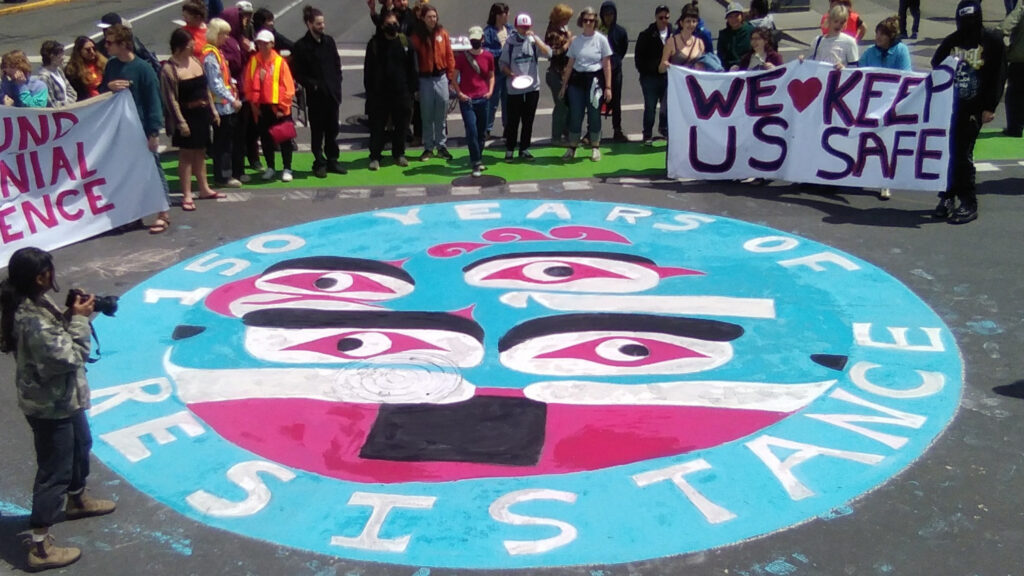
But even this campaign paled in comparison to Fairy Creek three decades later, which in turn usurped Clayoquot’s previous record for the largest act of civil disobedience in Canada, with nearly 1200 arrests by December 2021.69 The conflict opposed the Rainforest Squad, which supported Pacheedaht Elder Bill Jones’ call for old growth forest protection, to logging company Teal-Jones and the Pacheedaht First Nation band council which adamantly commanded the protesters to go home. In a rare instance of internecine conflict within indigenous communities spilling into the open, Elder Jones denounced Indian Band Nations as instruments of colonialism.70
BC Supreme Court granted Teal-Jones an injunction,71 which the protesters openly defied, standing their ground even as the Royal Canadian Mounted Police’s (RCMP) Community-Industry Response Group (C-IRG) massed around them. The conflict escalated around August 2021, amid allegations of widespread excessive force against the protesters.72 Journalists covering the protest, such as photographer Colin Smith dispatched by the Victoria Buzz,73 were arrested by the RCMP for violating media exclusion zones in spite of a court order for the media to be granted access back in May.74 According to multiple Fairy Creek protesters I’ve had the good fortune to exchange with a few years afterward, the officers intentionally caused a media blackout, exploiting the remoteness of the area, in order to clear protest areas expediently and with impunity, which is partly why accountability over police brutality proved so elusive.75
Excoriating media coverage poured out in spite of these tactics,76 later compelling BC Supreme Court Justice Douglas Thompson to decline to renew the injunction granted to Teal-Jones, on the grounds that doing so would amount to condoning the many civil rights violations committed by the RCMP in enforcing the injunction and thereby undermine public confidence in the judiciary:77
On the other hand, methods of enforcement of the Court’s order have led to serious and substantial infringement of civil liberties, including impairment of the freedom of the press to a marked degree. And, enforcement has been carried out by police officers rendered anonymous to the protesters, many of those police officers wearing “thin blue line” badges. All of this has been done in the name of enforcing this Court’s order, adding to the already substantial risk to the Court’s reputation whenever an injunction pulls the Court into this type of dispute between citizens and the government.
In the current circumstances, I am not persuaded that the balance of convenience favours extending the injunction. The factors weighing in favour of extension do not outweigh the public interest in protecting the Court from the risk of further depreciation of its reputation. It is not just and equitable in all the circumstances of the case to make the order sought. I exercise my discretion by declining to extend the injunction. The interim extension order that I made at the close of the hearing on 17 September 2020 shall expire at 4:00 p.m. today, 28 September 2021.78
This explicitly states that the courts’ overwhelming concern is to preserve their reputation, to the point that it may even compel a judge to refuse to uphold the law in the face of blatant injustice. Alas, this specific decision did not survive appeal,79 reducing the judge to allowing the injunction extension after all. Even then, he wrote in his reconsideration decision:
I have come to understand what at first blush seems counterintuitive: the people I have sentenced value and appreciate the importance of obeying the law. Not a single person of the more than one hundred I have sentenced has previously committed an offence. They are highly intelligent people, non-violent and principled by nature. They are not naïve and misguided dupes of some shadowy organization aiming to break down the rule of law. They are not trouble-makers with nothing better to do. Most are well educated with fulfilling and important jobs, often in occupations focused on helping others. Most have a notable history of volunteer service. Their motives are altruistic and compassionate.
These intelligent people are not oblivious to the importance of the rule of law. They understand the role of the law in promoting and safeguarding peace and order. At the same time, they hear the sounding of clear warnings by IPCC scientists and others, and they fear that on the present course the future will be profoundly disordered for our species and others. They perceive that their conventional efforts to focus the attention of society’s leaders on this existential issue have failed. They have decided that these desperate times call for desperate measures.80
The Rainforest Squad filed an appeal to the Supreme Court of Canada, which declined to hear the case. Nevertheless, a future instance of the highest court may eventually set a precedent in favour of those among us intelligent activists who have likewise decided that desperate times call for desperate measures.
In the meantime, sympathetic judges may still exercise their discretion in a way that transparently reflects this perspective, as long as they don’t boldly state so in their decisions since the judiciary may never openly admit to bending the rule of law in favour of personal convictions, even in the face of public indignation. For example, the same judge later tossed out the charge of criminal contempt against a protester by invoking the ludicrous pretext that the RCMP failed to read the full text of the injunction prior to the arrest,81 forcing the prosecution to withdraw remaining charges against nearly 150 defendants.82
Public scrutiny of the RCMP’s enforcement tactics at Fairy Creek persists years after the protesters have been dispersed. The Civilian Review and Complaints Commission (CRCC) declared in a September 2024 report that arresting a hiker for declining to be searched after crossing into an unreasonable exclusion zone was itself unreasonable, as was the officers’ practice of removing their name tags to avoid being identifiable, and that of wearing ‘Thin Blue Line’ flag patches widely perceived as racist for having been introduced during Black Lives Matter protests in the United States.83 A systemic investigation by the commission into C-IRG conduct in the enforcement of multiple environmental protest injunctions is ongoing.84
Actual relief via the BC Supreme Court has in contrast been unsuccessful. A class-action lawsuit claiming rampant police misconduct in enforcing the injunction was dismissed in June 2025 for being overly broad,85 despite a strong parallel with an action against the Toronto Police Service Board pertaining to arbitrary detentions during the 2010 G20 summit.86
Resistance against old growth logging continues, the latest battleground being the Walbran Valley, also on the west coast of Vancouver Island.87 In September 2025, the BC Supreme Court granted an injunction to Tsawak-qin Forestry Inc. as it did for Teal-Jones, albeit with reservations over serious police enforcement overreach at Fairy Creek.88 As for Teal-Jones, it was reduced to declaring bankruptcy in 2024, citing among other factors in its decision “a costly protracted demonstration at the logging site of one of [its] forest licences”.89 Just saying.
Ottawa’s Freedom Convoy and its aftermath
That was the good, in spite of its quirks. Here come the bad and the ugly, for the most part.
The COVID-19 pandemic remains one of the most polarizing crises in modern History, which at its nadir was nearly impossible to discuss rationally, as fear got the worst out of people and made them say the damnest things. I’ve heard undignified vitriol and inflammatory rhetoric pervade mainstream political discourse, from both sides of the debate, that I wish never to hear again, and that most of those who lived through the period would rather not recall—especially the rampant anti-Asian racism.90
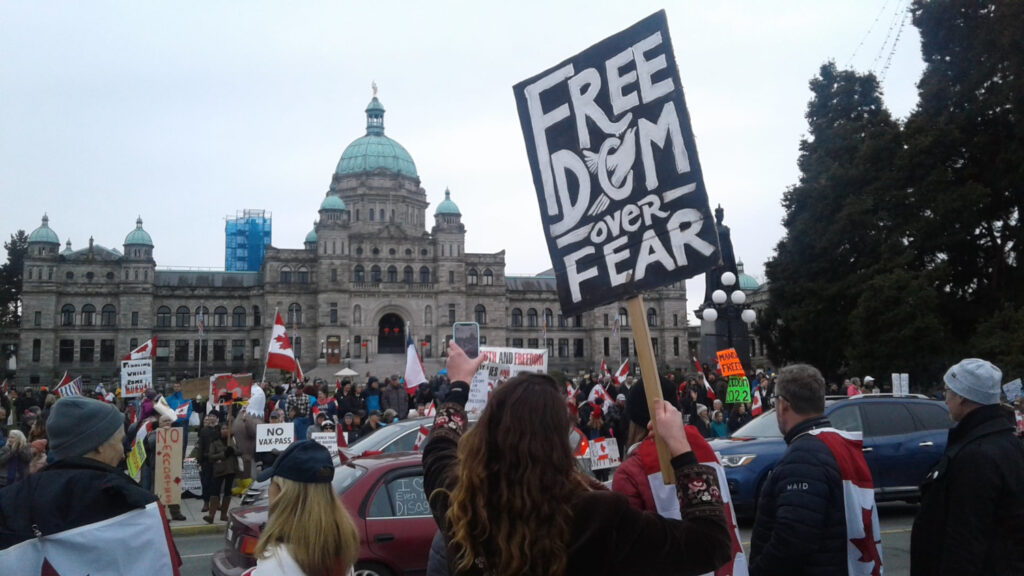
Since tempers have cooled down, I shall conclude this chapter with a rare nonpartisan analysis of Ottawa’s Freedom Convoy protest and ensuing movement, because I cannot think of a better example of actors with legitimate grievances and a huge sympathy capital scuttling themselves with a toxic legal and political strategy, to the point of becoming pariahs in the court of public opinion. Of course that may be attributed in part to the presence of unsavoury characters among the movement’s leaders, including notorious transphobic preacher Artur Pawlowski whose public appearances I ended up protesting in 202491—although it’s difficult not to feel sympathy for the Devil given he was charged with feeding the homeless in violation of pandemic restrictions.92
The Severe Acute Respiratory Syndrome Coronavirus 2 (SARS‑CoV‑2) emerged in the Wuhan region of China in late 2019,93 and in a matter of months spread throughout the entire planet, just like the Influenza virus a century prior. Due to its novelty, the world population was virtually defenceless to the airborne infection and millions died as a result, predominantly elderly and immunocompromised people but also a significant swathe of otherwise healthy individuals. This led the World Health Organization to declare a public health emergency in January 2020,94 soon followed by virtually every nation, which worked in concert to slow the spread of the virus and devise a strategy to achieve herd immunity, primarily with the rapid introduction of experimental mRNA vaccines.
In the meantime, governments worldwide assumed emergency powers and improvised a response by issuing disparate public health orders curbing civil liberties, measures so severe democratic countries normally resort to these only in war time.95 At first public reception was nonetheless overwhelmingly supportive, in spite of lockdown orders, travel restrictions, and bans on public assembly, as concerned citizens stood firmly behind health care workers working on the front lines of a global catastrophe seen only once in a lifetime.96
This wouldn’t last, however, as authorities struggled to articulate a coherent rationale behind their improvised public health orders, which led to confusion,97 resentment,98 and of course rampant disinformation.99 Flurries of scandals by public officials flouting their own pandemic rules,100 such as British Prime Minister Boris Johnson holding parties at 10 Downing Street,101 and French ministers dining at secret restaurants,102 fuelled widespread cynicism and accusations of ruling class hypocrisy.
Then came the first approved vaccines, distributed with mandates aimed at ostracizing those who would refuse inoculation. While of course disinformation played a significant role in vaccine hesitancy,103 so did governments’ coercive and overtly hostile approach, French President Emmanuel Macron going as far as admitting he meant to ‘piss off’ the unvaccinated (the actual French term he employed literally means smearing with fecal matter).104 This cavalier attitude would backfire spectacularly with the emergence of the virus’ omicron variant rendering existing vaccines virtually ineffective at preventing its infection or transmission,105 combined with reports of rare adverse effects of vaccination proving debilitating or even fatal.106 As a result, the issue became extraordinarily divisive as experts and governments alike struggled to rationalize those mandates,107 especially as they competed with alternative media outlets spreading misinformation, fuelling panic, and echoing conspiracy theories.108
In Canada, the last straw was the plethora of restrictions placed on international travellers by the federal government, some of which had civil rights advocates duly alarmed. From resentment over the mandatory isolation period upon returning from abroad to complaints of chilling detention conditions at secret quarantine facilities109 and the continued detention of travellers who had already tested negative for the virus,110 to say nothing of the polemic over so-called ‘vaccine passports’ meant to turn the noncompliant into second-class citizens,111 and having to deal with an ArriveCAN app plagued with prejudicial technical issues,112 the federal government had to fend strong headwinds of public dissatisfaction and predictable legal challenges113 as it already struggled to reassure the public over the scale of civil rights suspensions114 amid fears of a ‘forever emergency’ that would normalize these.115
So when over a hundred truck drivers, dubbing their initiative the Freedom Convoy, took to Ottawa from across the country in January 2022 and occupied the downtown area near Parliament with the goal of ending federal pandemic mandates,116 pleading their case before the court of public opinion should have been a slam dunk, and it initially was one given the many thousands of protesters emulating the concept in cities throughout the country and beyond.117 Instead the organizers’ legacy borders on infamy,118 and not solely due to their personal character as I’m about to explain.
In fact, the debacle began with Canada Unity’s Memorandum of Understanding119 listing the organizers’ demands, wrapped in a pseudo-legal contract flirting with Meads v. Meads120 territory, which I warned about in the introduction. Even worse, the demands far exceeded the mere repeal of federal pandemic mandates, extending to those beyond federal jurisdiction, and outright called for the resignation of the federal government should it fail to comply, which of course went completely overboard and gave the government ammunition to call the protest an insurgency. Had Canada Unity instead made a cogent argument based on the Canadian Charter of Rights and Freedoms and international treaties, worked with reputable civil rights advocacy groups, and simultaneously petitioned the federal government for redress via the court system, it would have made a much better impression on the public.
The campaign’s political strategy was just as deficient, largely because the lack of a proper legal stance and cohesive messaging left the door open to American far-right political influence, such as the backing of notorious right-wing provocateur Tucker Carlson whose opinion of Canada is nothing short of incendiary.121 This in turn made radicals feel welcome among their numbers, even at the top of Canada Unity’s structure, many pushing forward agendas that actually ran counter to civil liberties.122 While far from all of these folks were fascists, common sense dictates that “you are what you eat” and likewise that the movement was whom it associated with or welcomed support from.
The government used draconian measures to break the siege, starting with the unprecedented invocation of the Emergencies Act to freeze the organizers’ funds. Mounted police officers brutally dispersed the remaining protesters,123 arresting over a hundred and drawing worldwide consternation as one demonstrator was allegedly trampled by a horse.124 Even then, the organizers failed to reap any sympathy capital, much less vindication, from the resulting outrage, for those reasons.
There were many legal challenges to federal and provincial pandemic restrictions, and much to learn from them. On the bright side were a few which were sensible enough to resonate with the public, successful or otherwise, like a judicial review of the Emergencies Act invocation before the Federal Court, which in January 2024 declared it an unreasonable violation of Charter rights,125 as did the Federal Court of Appeal two years later.126 In one other case, the Ontario Court of Appeal overturned a lower court decision affirming the constitutionality of a provincial ban on peaceful protests, thereby declaring it an unreasonable violation of Article 2 of the Charter.127 Also, a challenge to Newfoundland and Labrador’s pandemic travel restrictions on nonresidents, in which intervened both the Canadian Civil Liberties Association (CCLA) and the British Columbia Civil Liberties Association (BCCLA)128 (quick geography lesson: the two provinces are at opposite ends of the country, roughly 4000 km apart), was nonetheless struck down in February 2026 by the Supreme Court of Canada in a split decision.129 And an unsuccessful petition for judicial review of federal restrictions on air and rail travel based on vaccination status, only dismissed due to mootness, was championed by former Premier of Newfoundland and Labrador Brian Peckford.130
Yet for each of these, many more frivolous challenges have been thrown out with scorn. Among the worst, Action4Canada’s 391-page lawsuit before the BC Supreme Court, cram-full of eccentric claims laden with conspiracy theories, was dismissed as prolix and “bad beyond argument”; worse still, the plaintiffs even had the nerve to appeal.131 Likewise, a class-action lawsuit brought forward by the Canadian Society for the Advancement of Science in Public Policy was tossed out by the BC Supreme Court in October 2025 as an abuse of process,132 with the following rationale:
It is conceivable that a carefully focused and drafted legal proceeding could challenge those measures, including seeking damages awards for losses flowing from any of those restrictions found to be unlawful. Unfortunately, this particular proposed class proceeding, framing these particular claims, with this particular proposed class and sub-classes, as constantly reformulated by the plaintiff some eight times since its initial filing, suffers from so many self-inflicted problems, as outlined in these reasons, that the present claim is not the one.
The judge put it better than I ever could. These lunatic advocacy groups scuttled themselves with godawful legal strategies, plain and simple, and in the process lost face before the court of public opinion even though a large portion of the public, and even the judiciary, would otherwise be receptive to their arguments.
The nascent movement’s self-injury extended beyond the courtroom. In the aftermath of the Freedom Convoy, supporters rallied into a political faction called We Unify, which didn’t learn a thing from their public relations debacle by adopting a big tent policy of embracing everybody, only to welcome the worst. While there were sensible voices who promoted civil liberties among the lot (including Brian Peckford mentioned above), many were instead extreme social conservatives (like Artur Pawlowski, also mentioned above), alt-right influencers, or just plain attention-seeking trolls. One was Lauren Southern, who was barred from multiple countries, including the UK and Australia,133 for gratuitous hate speech against Muslims and queer people.134 Another was Lauren Chen, an obnoxious influencer who was summoned before a House of Commons committee over allegations that she acted as a proxy for a covert Russian disinformation campaign.135
The organization’s political ambitions were thwarted for good when I led a campaign with 1 Million Voices For Inclusion, a transgender activist group, in a failed attempt to cancel its Reclaiming Canada conference at the Victoria Conference Centre in June 2024.136 Nevertheless, its brand was irrevocably tarnished, to the point that it would never again be welcome on the city of Victoria’s public property.137 The ultimate irony is that I stood alongside some of these folks in protest back in 2022, sharing their grievances, only to chase them out of town two years later. Talk about losing in the court of public opinion.
Chapter 3: Welcome to the legal casino