
Chapter 6
The mainstream media conundrum
Democracy dies in darkness.
The Washington Post
Activists and the mainstream media enjoy a strained relationship.
We activists plead our cases before the court of public opinion, which means reaching out via every medium available. But the media have only superficial interest in causes. Large media outlets are usually run by governments or for-profit corporations, which means they may be slanted toward propaganda or cater to commercial interests—especially that of advertisers. And that means superficial coverage, tainted by politics and constrained by the false promise of impartiality.
Furthermore, various circumstances may compel the media to self-censor altogether, from the threat of government retaliation to that of public backlash. This we have seen recently in coverage of Palestine, in the instances that follow:
- Canadian Broadcasting Corporation (CBC) employees have denounced the network’s anti-Palestine bias, including heavy censorship of interviews;1
- Over 100 British Broadcasting Corporation (BBC) staff have denounced their employer’s bias toward Israel, evidenced by its presenting claims by the Israeli government as fact without investigation and its use of double language to describe victims of the conflict;2
- CTV News has forbidden the use of the word ‘Palestine’ in its coverage altogether, according to internal email and multiple employees;3
- The New York Times’ lobby was even the target of a sit-in protest in November 2023, charging it with “laundering genocide” and calling upon it to publicly back a ceasefire.4
It is no wonder then that activists sometimes describe mainstream media coverage as “both-sides bullshit” and even shun them altogether—although when we do that it becomes one-side bullshit. This is why reaching out to them is crucial in spite of our apprehension. Just try breaking the government’s will to fight if you can’t even take on the local newspaper or TV station.
Besides, observe from these examples that reporters themselves sell out their employer when their editorial board becomes overly assertive, which means the prospects aren’t as bleak as they look at a glance. Consequently, forging a relationship with individual reporters may prove worthwhile after all.
Journalism and civil disobedience
Reporters and activists have more in common that the latter appreciate; think of investigative journalists uncovering government corruption, professional photographers documenting police brutality against protesters, or war zone correspondents risking life and limb to expose violations of international law. I’ve already mentioned photojournalist Colin Smith getting himself arrested while covering Fairy Creek within a media exclusion zone (see Chapter 2), and he’s only one of many who faced repercussions for attempting to capture at protests what the government didn’t want the public to see.
The field of journalism is driven in principle by strong ethics, whether or not actually adhered to in practice. These sometimes compel a journalist to take an open stance by defying court orders. The most notable example involved Matthew Cooper of Time Magazine and Judith Miller of The New York Times being found guilty of contempt of court in 2005 for refusing to identify a confidential source who revealed the identity of Central Intelligence Agency (CIA) agent Valerie Plame; Miller ended up spending 85 days in jail.5 Miller was hardly a hero, her faulty reporting largely to blame for enabling the US government to invade Iraq in 2003 by invoking fantastical claims of weapons of mass destruction;6 nevertheless, it’s difficult to fault her for standing firm by invoking the sacrosanct right of a reporter to protect confidential sources—even one as disreputable as Lewis “Scooter” Libby.7
Other journalists convicted for refusing to disclose their sources include BBC reporter Bernard Falk, who served four days for protecting the identity of an Ireland Republican Army (IRA) spokesman he met in 1971;8 freelance journalist Vanessa Leggett who spent 168 days in detention, the longest sentence in American history, after refusing to testify in 2001 in order to protect source material compiled for the purpose of writing a nonfiction book on a murder-for-hire plot;9 and Jim Taricani, convicted of criminal contempt in 2004 for refusing to reveal who leaked an FBI videotape of a politician accepting a bribe, and sentenced to six months of home confinement.10
The American Constitution’s First Amendment explicitly recognizes the role of a free press. That being said, the judiciary has proven unreceptive to arguments that it shielded journalists from revealing confidential sources upon being ordered to as part of criminal proceedings. The Supreme Court settled the matter in 1972 in a narrow decision denying reporter’s privilege in a case involving two reporters for a local newspaper, one who had conducted a journalistic drug use survey, the other having been invited to the local Black Panthers headquarters. The majority wrote:
Accepting the fact, however, that an undetermined number of informants not themselves implicated in crime will nevertheless, for whatever reason, refuse to talk to newsmen if they fear identification by a reporter in an official investigation, we cannot accept the argument that the public interest in possible future news about crime from undisclosed, unverified sources must take precedence over the public interest in pursuing and prosecuting those crimes reported to the press by informants and in thus deterring the commission of such crimes in the future.11
One justice wrote in blistering dissent, however:
It is my view that there is no “compelling need” that can be shown which qualifies the reporter’s immunity from appearing or testifying before a grand jury, unless the reporter himself is implicated in a crime. His immunity, in my view, is therefore quite complete, for, absent his involvement in a crime, the First Amendment protects him against an appearance before a grand jury, and, if he is involved in a crime, the Fifth Amendment stands as a barrier. Since, in my view, there is no area of inquiry not protected by a privilege, the reporter need not appear for the futile purpose of invoking one to each question. And since, in my view, a newsman has an absolute right not to appear before a grand jury, it follows for me that a journalist who voluntarily appears before that body may invoke his First Amendment privilege to specific questions.
[…]
The starting point for decision pretty well marks the range within which the end result lies. The New York Times, whose reporting functions are at issue here, takes the amazing position that First Amendment rights are to be balanced against other needs or conveniences of government. […] My belief is that all of the “balancing” was done by those who wrote the Bill of Rights. By casting the First Amendment in absolute terms, they repudiated the timid, watered-down, emasculated versions of the First Amendment which both the Government and the New York Times advance in the case.
Multiple attempts have since been made, all in vain, to enshrine reporter’s privilege in American law. One was introduced in response to the Taricani case discussed earlier.12 Another was the Free Flow of Information Act of 2007, which was overwhelmingly supported in a House of Representatives vote only to die filibustered by the Senate; the bill kept being reintroduced in multiple incarnations, the latest as recently as 2017. Then in 2024 came the Protect Reporters from Exploitative State Spying (PRESS) Act, which has also been voted by the House only to languish before the Senate Judiciary Committee.13
Canada offers more protection to journalists, explicitly recognizing reporter privilege in a limited capacity with the Journalistic Sources Protection Act (JSPA), which states that the courts may authorize the disclosure of information or a document only if they consider that it cannot be produced in evidence by any other reasonable means, and the public interest in the administration of justice outweighs the public interest in preserving the confidentiality of the journalistic source. The law has been successfully invoked by Radio-Canada reporter Marie-Maude Denis before the Supreme Court of Canada, after refusing to disclose the source of a leak on an investigation into former Quebec minister Marc‑Yvan Côté for fraud, breach of trust and bribery of officers, the accused arguing in vain that the disclosure had been prejudicial to him as it infringed on his right to a fair jury trial.14
Citizen journalism
I’d like to offer that the answer to the mainstream media conundrum lies in not depending on them too much to begin with. The media landscape has changed considerably in the past generation, and while traditional news networks haven’t lost their relevance, they are no longer as dominant as they used to be. Nowadays, independent networks and individual content producers thrive, while some mainstream platforms such as newspapers turn into nonprofits in order to survive.15 Actually, two of the example stories I listed above were first investigated by The Breach, an independent outlet founded only in 2021.
Besides, we live in the era of YouTube influencers and citizen journalists, so one surefire way to get the coverage we want is to jump into the fray and become reporters ourselves, as I did with the Rulebreakers blog; more notably, as did award-winning Bisan Owda reporting from Gaza since the start of Israel’s invasion in October 2023.16 Look around, and you’ll see many individual activists sharing stories online, sometimes with surprising reach as some even contribute pieces to larger news websites; for example, here in British Columbia we have The Tyee, an investigative journalism magazine accepting submissions. And if your story goes viral on social media and alternative news sites, the mainstream media may actually pick it up.
Don’t hesitate to wear the hat of citizen journalist, which requires no more qualifications than that of legal advocate. In fact, in 2009 the Supreme Court of Canada issued a decision expanding the scope of the responsible journalism defence to include ordinary citizens as long as they likewise perform due diligence in their reporting, thus affording them a measure of legal protection against defamation lawsuits:
I therefore conclude that the proposed change to the law should be viewed as a new defence, leaving the traditional defence of qualified privilege intact.
A second preliminary question is what the new defence should be called. In arguments before us, the defence was referred to as the responsible journalism test. This has the value of capturing the essence of the defence in succinct style. However, the traditional media are rapidly being complemented by new ways of communicating on matters of public interest, many of them online, which do not involve journalists. These new disseminators of news and information should, absent good reasons for exclusion, be subject to the same laws as established media outlets. I agree with Lord Hoffmann that the new defence is “available to anyone who publishes material of public interest in any medium.”
A review of recent defamation case law suggests that many actions now concern blog postings and other online media which are potentially both more ephemeral and more ubiquitous than traditional print media. While established journalistic standards provide a useful guide by which to evaluate the conduct of journalists and non-journalists alike, the applicable standards will necessarily evolve to keep pace with the norms of new communications media. For this reason, it is more accurate to refer to the new defence as responsible communication on matters of public interest.17
In fact, the court went as far as lamenting that Canadian libel law lagged behind that of the United Kingdom among all countries, which as we saw in Chapter 2 is notoriously one-sided in favour of plaintiffs.
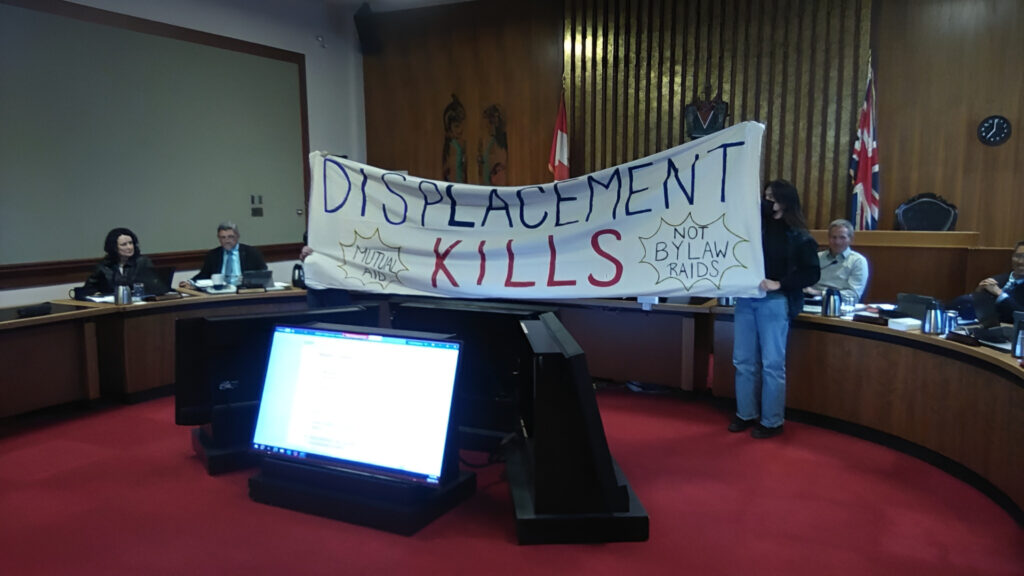
So fake your own press credentials already! Don’t be afraid to send out requests for comments like any serious journalist, and build your reputation as you prop up your own confidence. This is the best way for us activists to get the reporting we wish for, after all. And the material we produce may even find its way to mainstream media articles, as did for example a picture of mine I captured at a Victoria City Hall protest in April 2024 at which two advocates held a banner condemning bylaw officers’ forced displacement of the unhoused;18 without it Victoria News might not have published the piece for lack of material.
With trial and error, I myself managed to build a relationship with reporters and break through the media brick wall. Allow me to show you how it’s done, hoping to spare you the blunders I initially made in presuming, just like you, that traditional media are either our saviours or our foes. They are neither. Understanding their point of view makes navigating their world a lot easier.
The remainder of this chapter is an edited version of an article I posted on the Rulebreakers blog on 2025/01/07:
How to Reach Out to the Mainstream Media
Protests need exposure in order to be effective, yet activists struggle with reaching out to news outlets. Come read about how to get media coverage for your campaign.
Perhaps the most difficult hurdle for an organizer to overcome is getting mainstream media exposure. The vast majority of protests I cover get none whatsoever. Many activists just don’t bother, perhaps thinking their event is too small or mundane to be worth the effort, or do reach out persistently without ever getting a bite.
Getting the media interested isn’t that hard, however; the main issue is that there’s no manual out there to navigate this notoriously impenetrable world, so I’m writing one tailored for activists weary of being ignored. I’ve pulled it off repeatedly, and so can you if you follow these simple tips.
Tell a story
The main blunder activists make in approaching the media is trying to sell them a cause. With a few exceptions, mainstream media outlets just don’t care about your cause, or at least they’re not nearly as passionate about it as you are. And since they’re outsiders, they don’t necessarily know why their audience should care either.
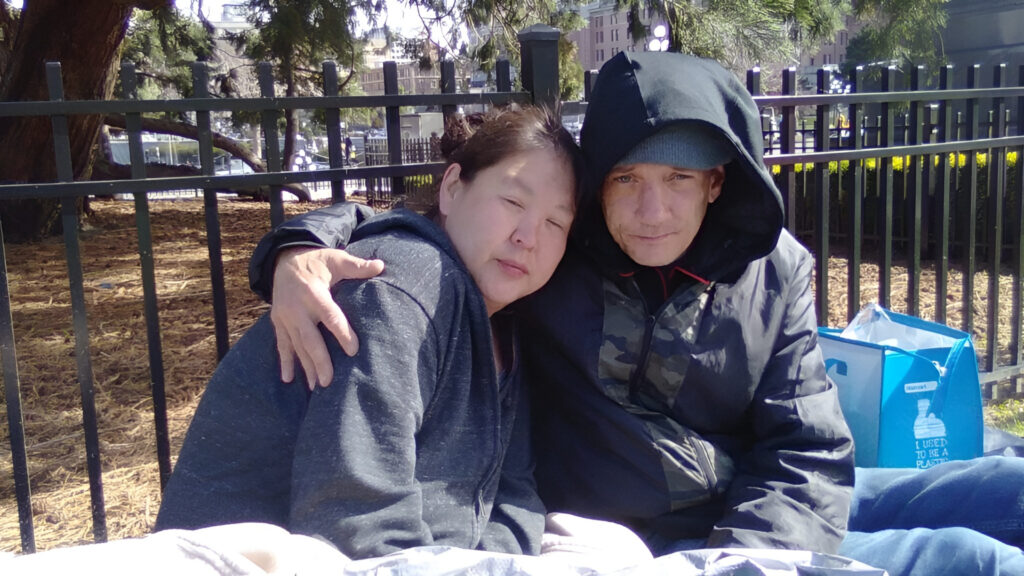
Media strategy needs to come at the earliest stage of protest planning. Don’t just plot an event and then send invites to journalists, that rarely works. Think early on about what would get the general public interested instead. Tell a story, and come up with a bold concept. Camp on the Legislature precincts if you have to, like this homeless couple whose child was taken away by the government did in April 2023.19 See? No protest is too small to get through.
Pitching the mainstream media a campaign, as opposed to a single event, works even better. For example, we at 1 Million Voices For Inclusion have had a lot of success selling our crusade against We Unify because we spent weeks building momentum prior to the protest proper,20 with a letter writing campaign, the endorsement of politicians and advocacy groups, and a rally to address the municipal council.
Networking!
Ever attended a job hunting workshop? Then you must have been told it’s all about networking. Forget sending hundreds of resumes on job finding websites, that just doesn’t cut it; approach employers directly, preferably by the back door.
The world of journalism works just the same. Although you might enjoy some success with the generic tips email, it’s so much better to know reporters personally. The best way in my experience is to talk to them on the ground. Granted, journalists aren’t covering events to casually chat with the attendance, but that shouldn’t dissuade you from engaging with them. For example, I realized at some point that they struggle with crowd counts, so I started sharing mine on the fly with the approach I use, and that made a good relationship starter.
Unsure how to proceed? Keep in mind activists are not allowed to be shy, so whatever is stopping you from approaching reporters, kill it. Besides, reporters are people too, and they may conversely be reluctant to approach activists, so you might actually be doing them a favour by breaking the ice. The world of activism looks just as impenetrable to media people, after all.
Even better than a casual exchange, of course, is to get interviewed. Reporters covering an event are prowling for people to interview, so try to grab their attention, even if it’s not your event. It’s easier than you think: once I did it inadvertently by attending a municipal council meeting debating a motion on daytime sheltering by homeless people, just by wearing a “STOP THE STREET SWEEPS D.T.E.S.” T-shirt—which might as well read “I’M AN ADVOCATE FOR THE HOMELESS, INTERVIEW ME!!!”—and indeed got interviewed twice in a row.21
And just like in the business world, if you’re an advocate you need a ‘business’ card with your contact info. Don’t let go of a journalist’s hand without slipping one of these in their waistband! More likely than not they’ll call you back eventually, which is even better than having to reach out to them in the first place.
Do your homework
This is the part where I give you advice not as a fellow activist, but an actual reporter—albeit a fringe one.
I get approached by activists left and right, whether inviting me to cover an upcoming event or on the ground at a current one. One major deficiency I observe is that many organizers haven’t done their homework prior to reaching out. They may not know their topic as well as they think—to put it very delicately, as often I can point out glaring factual issues down to their core platforms. Or they may know their topic, but they don’t have answers ready to basic questions, and they fumble in their approach.
Research is a crucial aspect of protest planning that is indeed neglected. If nothing else, if you invite me to an event, make sure to know the topic better than I do, and that I can’t debunk it with a simple Google or Wikipedia search. Provide me with specific facts and figures, with ironclad references. Not only does it make you look credible, it saves me some time.
Also, having printed educational material at your event helps reporters such as me, not just random bystanders. You might think it’s a waste of time and paper, but if you invite the media to your event, providing a presentable flyer can make a huge difference in coverage—starting with whether you get any.
For example, I covered two rallies in front of the Empress Hotel in Victoria by an animals rights group calling for an end to the sale of fur products. The first time I merely posted pictures because I felt like I didn’t have enough material for an article. The second time they had a leaflet ready, with specific claims and references, and this time I indeed wrote an article about it. Want coverage? Give us reporters material.
Press releases
Oh boy. Press releases are the résumés of the mainstream media universe. And nobody likes writing résumés. Especially you and me.
It doesn’t have to be this much of a chore though. Activists tasked with writing a press release often scuttle themselves by being too stiff about it, intimidated by the weight of contradictory advice on the topic. If it helps, once again put yourself in the shoes of a reporter and you’ll have a good feel of how to word it.
A distinction is frequently made between a media advisory and an actual press release. The former tends to be short, sent 3-5 days before an event, and advertises an event meant for the media to cover; the media usually withholds information in an advisory until the event date. The latter in contrast is released closer to the event, typically the day before, tends to be more verbose, and has for purpose to help a reporter write a piece; indeed parts may even be cut and pasted straight to actual news coverage.
In practice, don’t worry too much about the format, or even the distinction. I’ve seen media advisories which double as press releases. I’ve seen many press releases with creative formatting, doubling as actual news pieces, or appended to feature-length articles, with embedded multimedia and whatnot. There used to be a time, back in the era of snail mail and electric typewriters, when press releases had to be formatted in a specific manner, down to the trailing number signs (###), and anything else would be dismissed as an amateur’s submission without anyone casting more than a glance at it, but in the age of Netflix these rules no longer hold, so feel free to disregard any advice which looks obsolete.
One last thing. Remember we discussed doing your homework? Press releases are make-or-break opportunities to show it off. Even my media advisories feature a references section, however short, if only to show I’ve researched my topic; and if these help a reporter write a feature article, all the better. If you send me a press release, by all means do include references, I’m likely to use them in my piece.
For example, I’ve written a rather elaborate advisory for a protest encampment I held in December 2024 at the Victoria City Hall, which saved me the trouble of writing a separate press release. I’ve chosen this format because I wanted to maximize media coverage prior to the event—which came with a plot twist: I fooled the authorities into fencing off the wrong site.22 The feature article in the Victoria Buzz indeed quoted substantial portions of the release, as if I’d written it myself.23
Interviews and press conferences
If you stress out already at the press release stage by comparing it to a résumé, I can imagine how you feel about media interviews, which are the equivalent of job interviews being broadcast on 6 o’clock news—or worse, on live radio. Except they’re not, so just be casual about them.
Usually, the interviewer will have you stand still in front of a camera for a few minutes while you answer questions. Advocates cannot choose their questions, but they can choose their answers, and unlike in a job interview there are no preset right or wrong answers, so focus on getting your message out. If you don’t like a specific question, that’s just fine, you’re given some latitude to weasel your way around it and discuss the issue from a different angle.
Don’t worry if you fumble a bit. Interviews are typically edited for brevity back at the studio, by professionals who make subjects look good by clipping out the horrible parts. What you do need to worry about is preparation. Once again doing your homework is very important; at the very least you should anticipate common questions and have counterarguments ready to answer critics. Try to prepare some sound bites that an editor might like to include in actual reporting, which is likely to be short; a typical three-minute interview may be trimmed down to less than ten seconds, so squeeze your point in as few words as possible. The reporter is likely to close by asking you if you wish to add something, which is a good opportunity to conclude with yet another sound bite.
In contrast, for a press conference you get to choose the format and the pace. Just like with press releases and media advisories, there is no longer a clear formula to follow, although journalists attending these events expect to be treated somehow, so try to come up with visually appealing elements, if only signs or banners; it is also customary to have printed material available, if only a flyer or leaflet amounting to a press release.
Unlike a media interview, a press conference allows you to read from the page, which cuts down on improvisation and stress. You get to say your piece in a predictable fashion, without having to worry about being interrupted, and you have ample time to deliver it. Reporters are allowed to ask questions in turn once the presentation is done, and unlike for interviews they’re the ones improvising, not you. That being said, expect the footage to be edited for brevity just like for an interview, so plan accordingly.
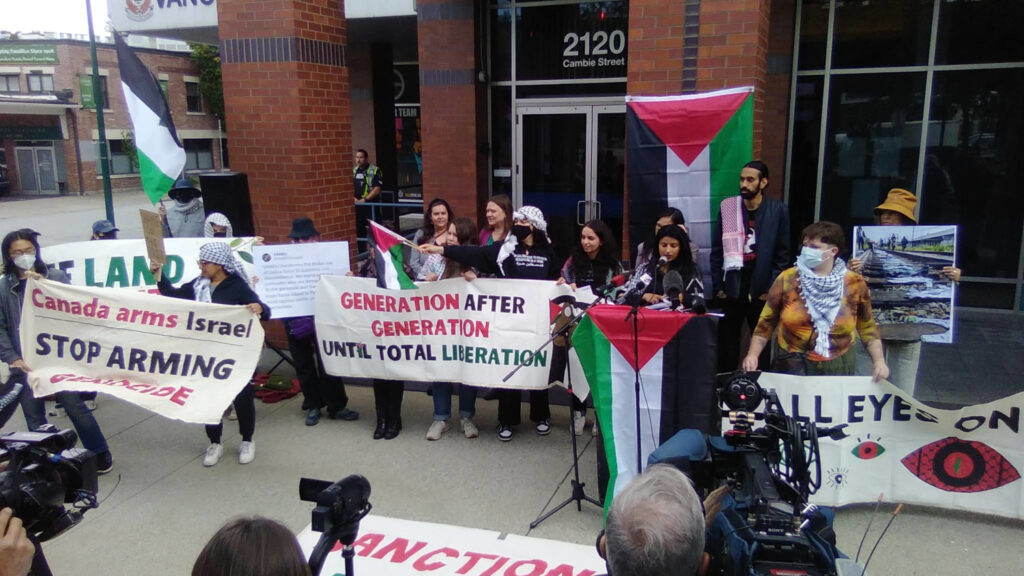
Press conferences are usually called by notable advocates or organizations to either announce major initiatives or comment on emerging developments. Most activists will never call a press conference; I for one never did and never might. That being said, since like for press releases there is no longer a strict format for a press conference to follow, a rally can technically double as one. For example, one was held at the Victoria City Hall in March 2023 by a fellow advocate who invited the media to announce the disappointing outcome of a challenge she’d raised at the Civil Resolution Tribunal against the municipality.24 Another was called at the Vancouver Police Department headquarters in June 2024 by multiple organizations, including the BC Civil Liberties Association, in response to police brutality against Palestine protesters.25 Nobody ever said one cannot invite both the media and a crowd for a public announcement, after all, so there.
Media fatigue
I’d like to conclude this article with an underdiscussed topic, which is media fatigue.
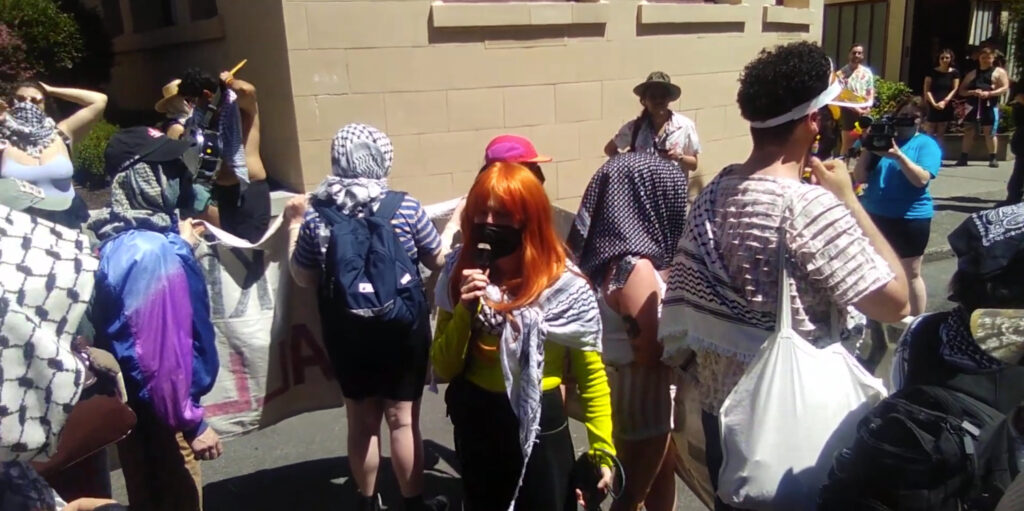
Basically, I would advise treating the media like the exclamation mark: use them sparingly, lest they lose their meaning and impact. Call the media once in a while with interesting announcements and they’ll probably show up, but after a while interest is bound to wear off. Sometimes it’s the activists’ fault for dialling emergency services over a neighbour wearing too much cologne. Other times it’s an entire topic becoming so repetitive it’s no longer considered newsworthy, from COVID to weekend Palestine rallies.
Even if the media do show up at your event, there’s no guarantee they publish a piece. Sometimes it’s a disappointment. Sometimes your event doesn’t make the cut because it got bumped by other news. Even if the outlet does report on the event, specific material may be left out, like entire interviews. It may, or may not, signal media fatigue.
If in doubt, don’t take it personal, and keep sending those media advisories. The world of news reporting is a highly competitive arena, requiring persistence in order to break through. That being said, if the media never take the bite then some adjustments may be in order. I’ve shown you how it’s done, but as I stated first thing in this article there is ultimately no surefire manual to navigate this world so you have to carve your own path using your own wits, otherwise you won’t make the cut indeed. Keep trying until some concept works for you, and keep it evolving in order to remain newsworthy!
Chapter 7: Embrace the digital revolution